
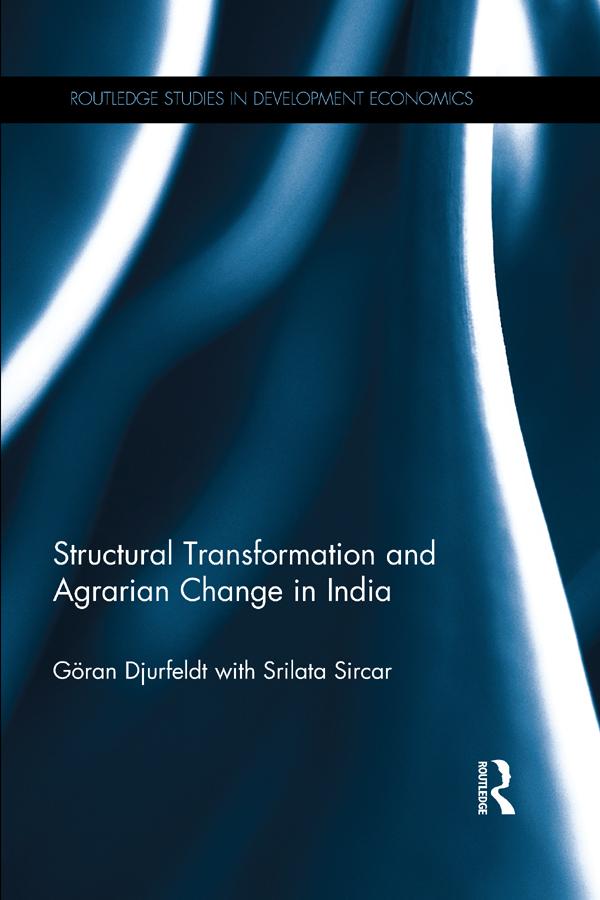
The landlord and his emaciated labourer are symbolic of Indian agriculture. However, this relationship has now changed as large landowners have fallen from their superior position. This volume explores how this emblematic pair is becoming a thing of the past.
Structural Transformation and Agrarian Change in India investigates whether family labour farms are gaining prominence as a consequence of the structural transformation of the economy. The authors work alongside Weberian methodology of ideal types and develop different types of family farms; among them family labour farms that rely mainly on family workers, contrasted with capitalist farms that depend on hired labour. Agriculture is shrinking as a part of the total GDP at the same time as agricultural labour is shrinking as part of the total labour force. The changing agrarian structure is explored with the use of unique long-term survey data and statistical models. Results show that India is approaching farm structures that are typical of East and South East Asia, with pluriactive smallholders as the norm.
This book successfully criticizes popular narratives about Indian agricultural development as well as simplistic evolutionist, Marxist or neoclassical prognoses. It is of great importance to those who study development economics, development studies and South Asian economics.
Maksa helposti kortilla, Klarnalla, Apple Paylla tai Google Paylla. Etkö ole tyytyväinen? Sinulla on aina 14 päivän palautusoikeus. Lue lisää ehdoistamme. Jos sinulla on kysyttävää, lähetä meille sähköpostia osoitteeseen hello@memmo.org.
Memmo tekee opiskelusta helpompaa – missä päin maailmaa ikinä oletkin. Meillä yhdistät kurssikirjat ja fiksut opiskelutyökalut yhteen paikkaan: tiivistelmät, visat, podcastit ja muistikortit. Ja sitten Ted, opiskelukaverisi, joka vastaa kaikkeen, mitä ikinä mietitkin. Yli 50 000 opiskelijaa opiskelee jo täällä – rakennettu auttamaan sinua oppimaan nopeammin ja stressaamaan vähemmän.