
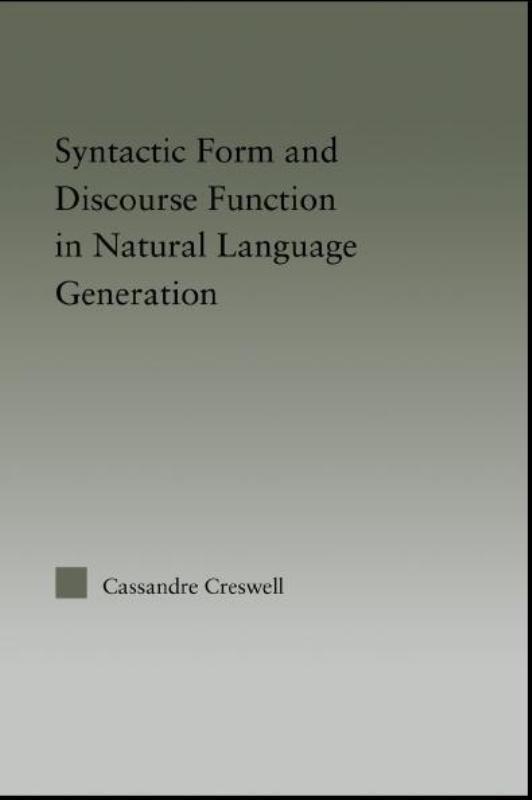
Users of natural languages have many word orders with which to encode the same truth-conditional meaning. They choose contextually appropriate strings from these many ways with little conscious effort and with effective communicative results. Previous computational models of when English speakers produce non-canonical word orders, like topicalization, left-dislocation and clefts, fail. The primary goal of this book is to present a better model of when speakers choose to produce certain non-canonical word orders by incorporating the effects of discourse context and speaker goals on syntactic choice. This book makes extensive use of previously unexamined naturally occurring corpus data of non-canonical word order in English, both to illustrate the points of the theoretical model and to train the statistical model.
Maksa helposti kortilla, Klarnalla, Apple Paylla tai Google Paylla. Etkö ole tyytyväinen? Sinulla on aina 14 päivän palautusoikeus. Lue lisää ehdoistamme. Jos sinulla on kysyttävää, lähetä meille sähköpostia osoitteeseen hello@memmo.org.
Memmo tekee opiskelusta helpompaa – missä päin maailmaa ikinä oletkin. Meillä yhdistät kurssikirjat ja fiksut opiskelutyökalut yhteen paikkaan: tiivistelmät, visat, podcastit ja muistikortit. Ja sitten Ted, opiskelukaverisi, joka vastaa kaikkeen, mitä ikinä mietitkin. Yli 50 000 opiskelijaa opiskelee jo täällä – rakennettu auttamaan sinua oppimaan nopeammin ja stressaamaan vähemmän.
Saatat pitää myös näistä
Osta kirja0