
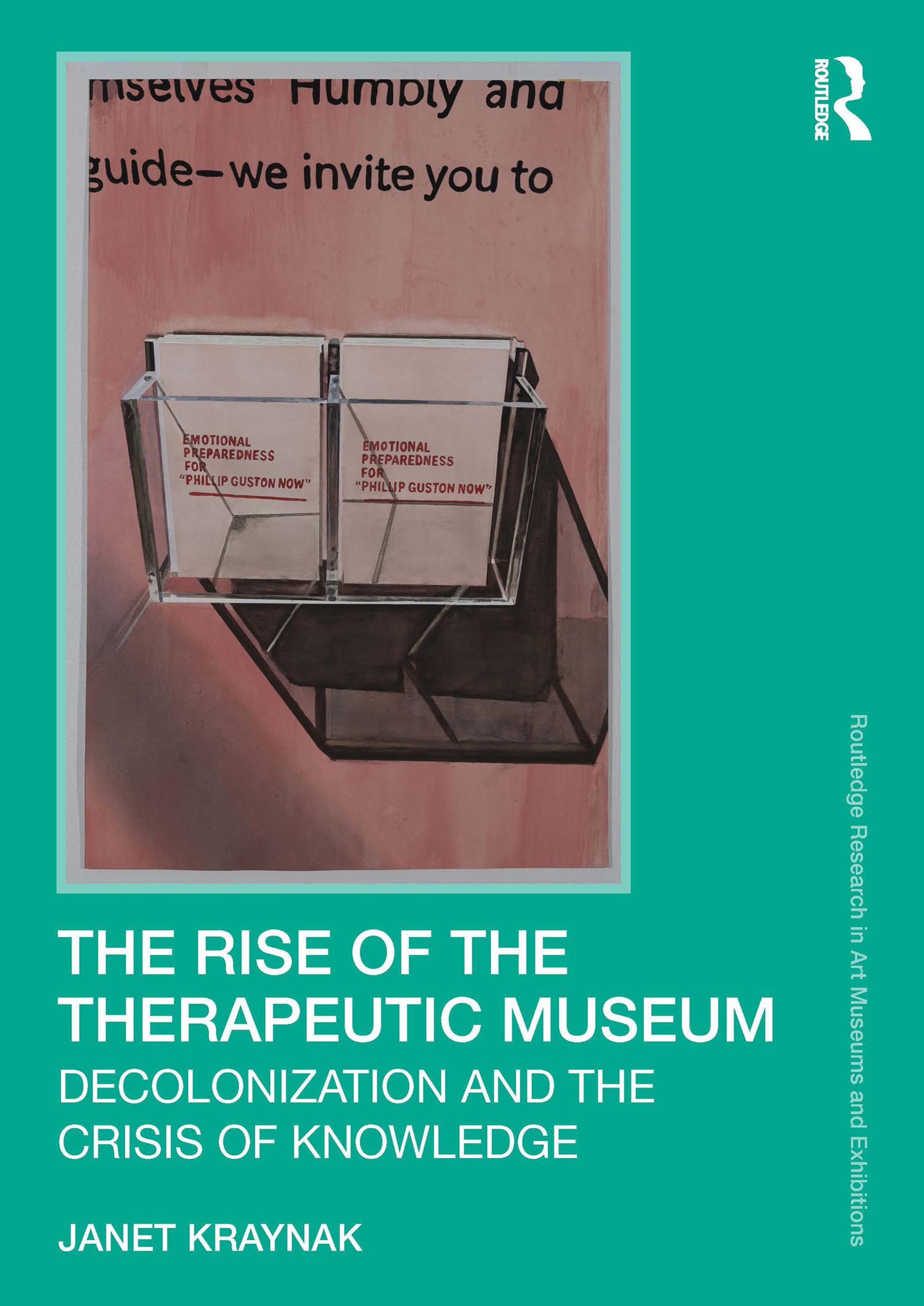
This book considers how and why respite rooms, emotional support brochures, well-being guides, psychological consultants, and care days are becoming common features in the museum of art.
Kraynak poses and answers this question, arguing that under its rightful ambition to decolonize––i.e., to rectify past and present inequalities–– the museum of the Global North is gradually replacing a commitment to knowledge, teaching, and learning with a focus upon care, healing, and well-being (the “therapeutic”). While this transformation might appear, on the surface, benign, culturally familiar, and politically desirable, the author counters these presumptions, probing the history and implications of “the therapeutic museum.” Here, curatorial attention shifts away from the art on view and onto the spectator, whom the museum imagines as a precarious psychological subject, and primary source of meaning. External forces–– new forms of knowledge, encounters with difficulty, even an engagement with art––are treated as a potential threat. As a result, the therapeutic museum not only encourages the
beholder to turn inward, but in so doing deflects attention from or scrutiny of its own practices and systems that perpetuate inequality. Among these are the ongoing legacies colonialism’s epistemic violence, which elevated the knowledge and aesthetic traditions of the Global North while suppressing those of the Global South. In contrast, the book proposes a “pluriversal” (versus universal) museum that maintains the political necessity of knowledge and views pedagogy as a path to emancipation. Emphasizing epistemic justice and the moral right to learn during a time when such freedoms are increasingly under attack, the book makes a powerful case for questioning rather than romanticizing the therapeutic museum, which it ultimately reveals to reinforce rather than challenge dominant power.
This is an important intervention that is essential reading for researchers and scholars in Art History, Visual Studies, Museum Studies, and Cultural Studies.
Maksa helposti kortilla, Klarnalla, Apple Paylla tai Google Paylla. Etkö ole tyytyväinen? Sinulla on aina 14 päivän palautusoikeus. Lue lisää ehdoistamme. Jos sinulla on kysyttävää, lähetä meille sähköpostia osoitteeseen hello@memmo.org.
Memmo tekee opiskelusta helpompaa – missä päin maailmaa ikinä oletkin. Meillä yhdistät kurssikirjat ja fiksut opiskelutyökalut yhteen paikkaan: tiivistelmät, visat, podcastit ja muistikortit. Ja sitten Ted, opiskelukaverisi, joka vastaa kaikkeen, mitä ikinä mietitkin. Yli 50 000 opiskelijaa opiskelee jo täällä – rakennettu auttamaan sinua oppimaan nopeammin ja stressaamaan vähemmän.