
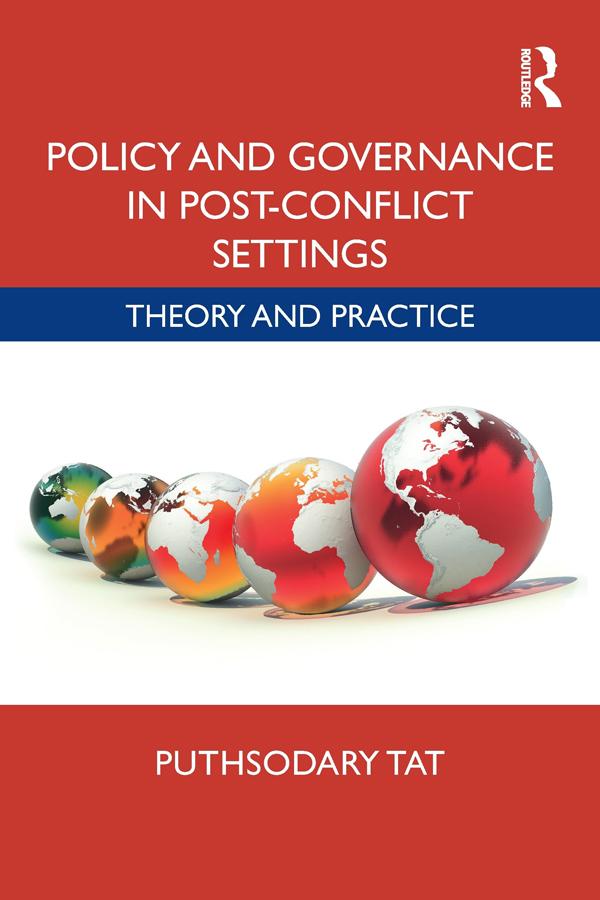
Post-conflict societies are commonly constructed as weak, fragile, and failed states. Economic recovery, risks of renewed violent conflict, natural resource degradation, and poverty alleviation become prioritized agendas of donor countries and international institutions. Billions of dollars on development policy and governance reform have been invested. However, misapplication, ineffectiveness, and foreign aid dependency have become a controversial debate on "whose policy, whose governance, and whose outcomes."
To understand the problems, the author employs a blend of social constructionism and discourse theory to establish a platform for understanding and discussing hegemonic aid conditionality on recipient governments. The theories also help analyze how the meanings of "post-conflict governance" are socially, economically, and politically constructed and used in state building, state apparatuses, institutional building, and policy-making process. He reveals that the philosophical and theoretical knowledge that underlies the interface between the mode of governance and policy design create the consensus of values, norms and indicators between experts, public servants, donors and communities in post-conflict settings. The author also shares illuminating case studies by way of his considerable wealth of experience leading reconstructive efforts in Afghanistan and Cambodia.
Maksa helposti kortilla, Klarnalla, Apple Paylla tai Google Paylla. Etkö ole tyytyväinen? Sinulla on aina 14 päivän palautusoikeus. Lue lisää ehdoistamme. Jos sinulla on kysyttävää, lähetä meille sähköpostia osoitteeseen hello@memmo.org.
Memmo tekee opiskelusta helpompaa – missä päin maailmaa ikinä oletkin. Meillä yhdistät kurssikirjat ja fiksut opiskelutyökalut yhteen paikkaan: tiivistelmät, visat, podcastit ja muistikortit. Ja sitten Ted, opiskelukaverisi, joka vastaa kaikkeen, mitä ikinä mietitkin. Yli 50 000 opiskelijaa opiskelee jo täällä – rakennettu auttamaan sinua oppimaan nopeammin ja stressaamaan vähemmän.