
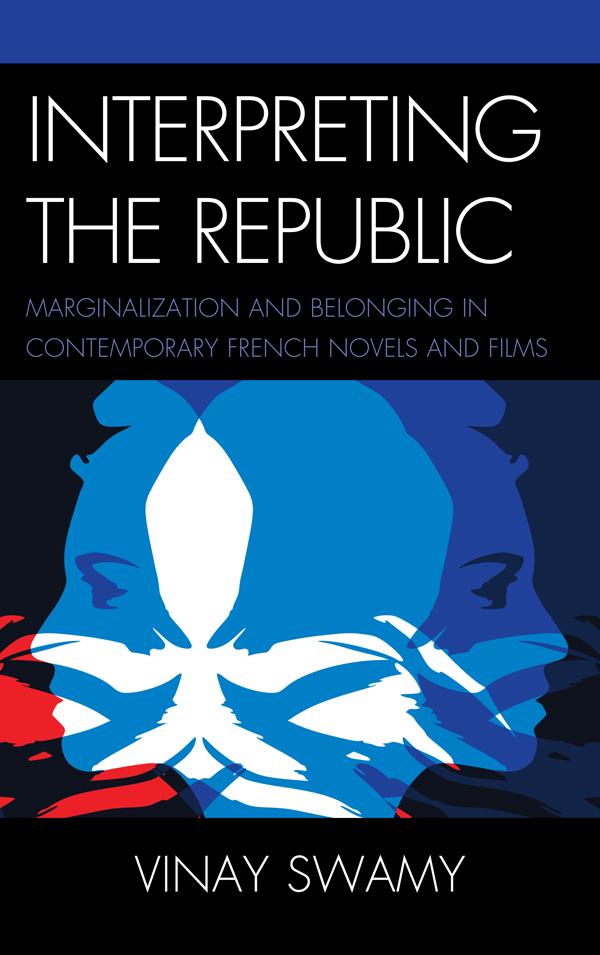
Interpreting the Republic focuses on contemporary French literary and cinematic works (1986-2003) that reflect on what it means to belong to a nation such as France by giving voice to those who find themselves marginalized by French society. While citizenship and belonging can be, and indeed are, interpreted differently depending on the socio-cultural and political context, it is the foundational universalist republican principle of egalitarianism that has remained the sacred cow of French society. One of the major claims of this study is that the rigidity of French national discourse that attempts to impose a certain homogeneity in its official identificatory practices—all citizens are French, and thus difference (ethnic, sexual or other) ceases to matter—is but one of the many possible interpretations of the notion of the Republic. Vinay Swamy seeks to show how such supposedly unshakeable principles, too, can be, and often are, reinterpreted in novel ways by the works analyzed in this study, which carve out niches for their protagonists that are otherwise foreclosed in the French national space.
Swamy examines the different tactics of identification deployed in works ranging from early "romans beurs" by Azouz Begag, Farida Belghoul and Soraya Nini, and Allah Superstar, the 2003 satirical novel by Y.B., to a number of films including Gazon maudit (1995), Ma vie en rose (1997), Le Placard (2001), Chouchou (2003), all of which (re)interpret the Republic in an effort to legitimize their protagonists' otherwise marginalized social position(s). He demonstrates how all these works put pressure, in a variety of ways, on an unacknowledged understanding of the institutional positions.
Swamy examines the different tactics of identification deployed in works ranging from early "romans beurs" by Azouz Begag, Farida Belghoul and Soraya Nini, and Allah Superstar, the 2003 satirical novel by Y.B., to a number of films including Gazon maudit (1995), Ma vie en rose (1997), Le Placard (2001), Chouchou (2003), all of which (re)interpret the Republic in an effort to legitimize their protagonists' otherwise marginalized social position(s). He demonstrates how all these works put pressure, in a variety of ways, on an unacknowledged understanding of the institutional positions.
Sivuja: 212
Kategoria: Kultur-, Genus- & Postkoloniala studier
e-ISBN: 9780739165386
Lähetyspaino: 1.2 kg
Toimitusaika: 1-2 päivää
Maksa helposti kortilla, Klarnalla, Apple Paylla tai Google Paylla. Etkö ole tyytyväinen? Sinulla on aina 14 päivän palautusoikeus. Lue lisää ehdoistamme. Jos sinulla on kysyttävää, lähetä meille sähköpostia osoitteeseen hello@memmo.org.
Memmo tekee opiskelusta helpompaa – missä päin maailmaa ikinä oletkin. Meillä yhdistät kurssikirjat ja fiksut opiskelutyökalut yhteen paikkaan: tiivistelmät, visat, podcastit ja muistikortit. Ja sitten Ted, opiskelukaverisi, joka vastaa kaikkeen, mitä ikinä mietitkin. Yli 50 000 opiskelijaa opiskelee jo täällä – rakennettu auttamaan sinua oppimaan nopeammin ja stressaamaan vähemmän.