
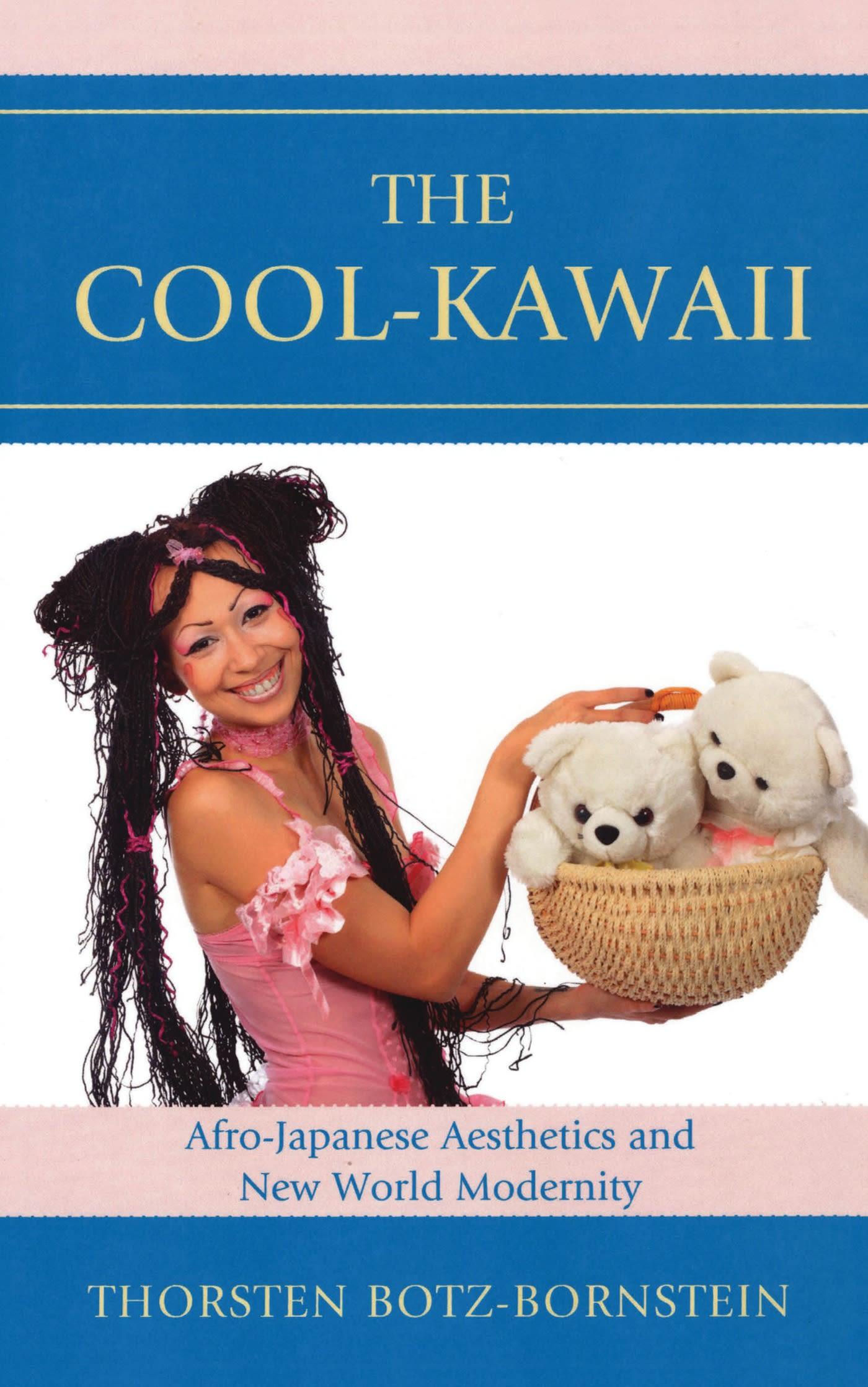
At the turn of the millennium, international youth culture is dominated by mainly two types of aesthetics: the African American cool, which, propelled by Hip-Hop music, has become the world's favorite youth culture; and the Japanese aesthetics of kawaii or cute, that is distributed internationally by Japan's powerful anime industry.
The USA and Japan are cultural superpowers and global trendsetters because they make use of two particular concepts that hide complex structures under their simple surfaces and are difficult to define, but continue to fascinate the world: cool and kawaii. The Cool-Kawaii: Afro-Japanese Aesthetics and New World Modernity, by Thorsten Botz-Bornstein, analyzes these attitudes and explains the intrinsic powers that are leading to a fusion of both aesthetics.
Cool and kawaii are expressions set against the oppressive homogenizations that occur within official modern cultures, but they are also catalysts of modernity. Cool and kawaii do not refer us back to a pre-modern ethnic past. Just like the cool African American man has almost no relationship with traditional African ideas about masculinity, the kawaii shôjo is not the personification of the traditional Japanese ideal of the feminine, but signifies an ideological institution of women based on Japanese modernity in the Meiji period, that is, a feminine image based on westernization.
At the same time, cool and kawaii do not transport us into a futuristic, impersonal world of hypermodernity based on assumptions of constant modernization. Cool and kawaii stand for another type of modernity, which is not technocratic, but rather "Dandyist" and closely related to the search for human dignity and liberation.
The USA and Japan are cultural superpowers and global trendsetters because they make use of two particular concepts that hide complex structures under their simple surfaces and are difficult to define, but continue to fascinate the world: cool and kawaii. The Cool-Kawaii: Afro-Japanese Aesthetics and New World Modernity, by Thorsten Botz-Bornstein, analyzes these attitudes and explains the intrinsic powers that are leading to a fusion of both aesthetics.
Cool and kawaii are expressions set against the oppressive homogenizations that occur within official modern cultures, but they are also catalysts of modernity. Cool and kawaii do not refer us back to a pre-modern ethnic past. Just like the cool African American man has almost no relationship with traditional African ideas about masculinity, the kawaii shôjo is not the personification of the traditional Japanese ideal of the feminine, but signifies an ideological institution of women based on Japanese modernity in the Meiji period, that is, a feminine image based on westernization.
At the same time, cool and kawaii do not transport us into a futuristic, impersonal world of hypermodernity based on assumptions of constant modernization. Cool and kawaii stand for another type of modernity, which is not technocratic, but rather "Dandyist" and closely related to the search for human dignity and liberation.
Maksa helposti kortilla, Klarnalla, Apple Paylla tai Google Paylla. Etkö ole tyytyväinen? Sinulla on aina 14 päivän palautusoikeus. Lue lisää ehdoistamme. Jos sinulla on kysyttävää, lähetä meille sähköpostia osoitteeseen hello@memmo.org.
Memmo tekee opiskelusta helpompaa – missä päin maailmaa ikinä oletkin. Meillä yhdistät kurssikirjat ja fiksut opiskelutyökalut yhteen paikkaan: tiivistelmät, visat, podcastit ja muistikortit. Ja sitten Ted, opiskelukaverisi, joka vastaa kaikkeen, mitä ikinä mietitkin. Yli 50 000 opiskelijaa opiskelee jo täällä – rakennettu auttamaan sinua oppimaan nopeammin ja stressaamaan vähemmän.