
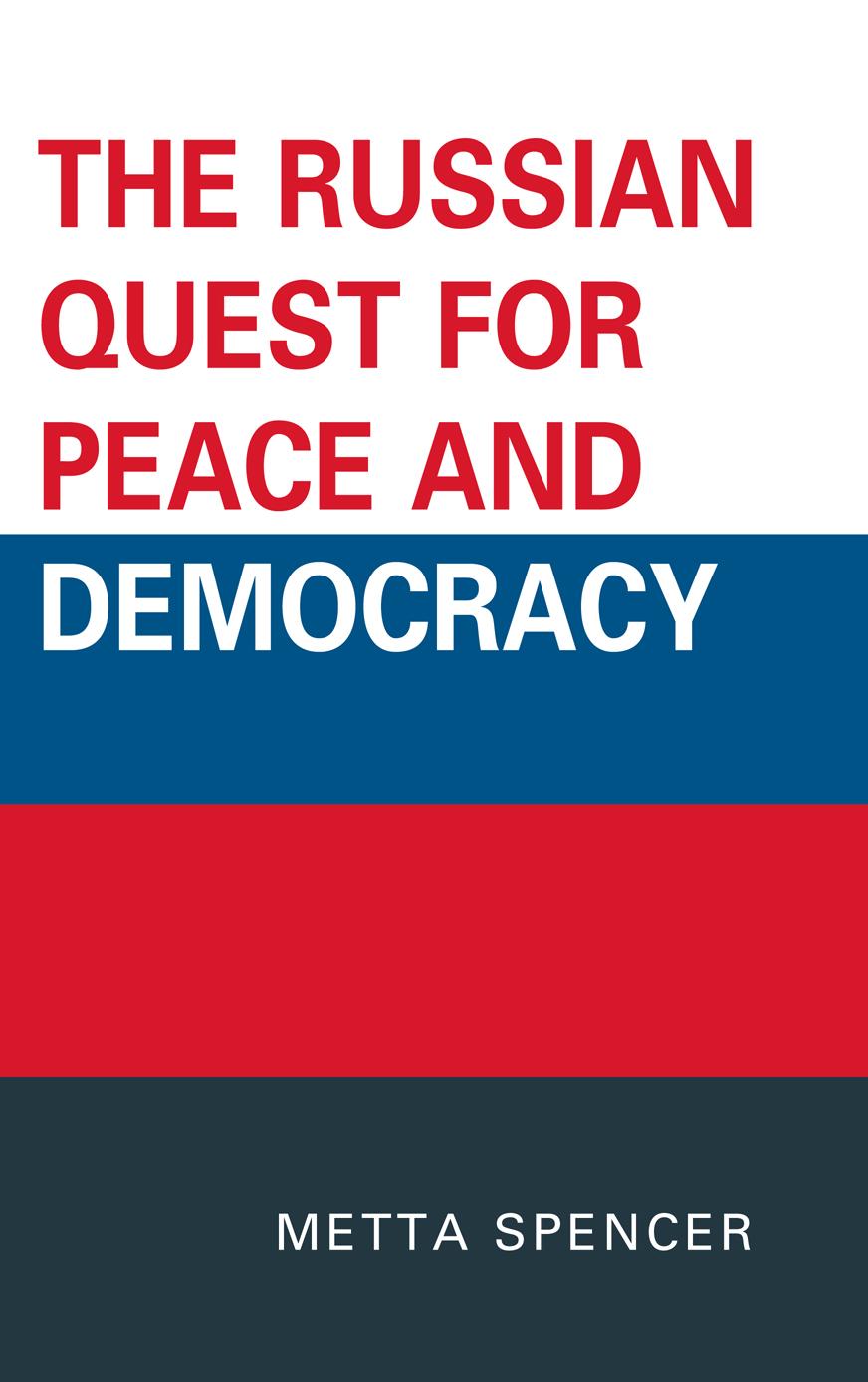
In The Russian Quest for Peace and Democracy, Metta Spencer recounts the political and military changes that have occurred in Russia up to mid-2010. Using hundreds of interviews she conducted with officials, dissidents, and liberal intellectuals, she describes the various groups, forces, and individuals that worked to liberalize the totalitarian Soviet Union and its fellow nations behind the Iron Curtain, and which ultimately brought about the dissolution of those repressive governments.
Spencer identifies four political orientations to describe Soviet society: "Sheep," ordinary citizens who accepted the undemocratic regime they lived in without challenging it; "Dinosaurs," hard-line Communist officials; "Termites," including Mikhail Gorbachev and his advisers and government; and "Barking Dogs," a few hundred dissidents who made "a lot of noise" protesting, hoping to awaken a grass-roots demand for democracy. The strange rivalry between the Termites and Barking Dogs would ultimately doom perestroika.
Spencer's research dispels the widely-held perception that US President Ronald Reagan "won" the Cold War by standing firm until the Soviet Union "blinked first." There are vitally important lessons to be learned from the Soviet period, about how to assist citizens of totalitarian and authoritarian regimes around the world.
The irony is that transnational civil society organizations, major sources of the progress in Soviet Russia, are still needed today in authoritarian Russia, under Vladimir Putin and Dmitry Medvedev, for totalitarianism remains a potential social trap. In The Russian Quest for Peace and Democracy, Metta Spencer suggests new ways of building urgently-needed social capital in today's Russia, where democracy has yet to flourish.
Spencer identifies four political orientations to describe Soviet society: "Sheep," ordinary citizens who accepted the undemocratic regime they lived in without challenging it; "Dinosaurs," hard-line Communist officials; "Termites," including Mikhail Gorbachev and his advisers and government; and "Barking Dogs," a few hundred dissidents who made "a lot of noise" protesting, hoping to awaken a grass-roots demand for democracy. The strange rivalry between the Termites and Barking Dogs would ultimately doom perestroika.
Spencer's research dispels the widely-held perception that US President Ronald Reagan "won" the Cold War by standing firm until the Soviet Union "blinked first." There are vitally important lessons to be learned from the Soviet period, about how to assist citizens of totalitarian and authoritarian regimes around the world.
The irony is that transnational civil society organizations, major sources of the progress in Soviet Russia, are still needed today in authoritarian Russia, under Vladimir Putin and Dmitry Medvedev, for totalitarianism remains a potential social trap. In The Russian Quest for Peace and Democracy, Metta Spencer suggests new ways of building urgently-needed social capital in today's Russia, where democracy has yet to flourish.
Sivuja: 346
Kategoria: Statsvetenskap & Politik
e-ISBN: 9780739144749
Lähetyspaino: 1.2 kg
Toimitusaika: 1-2 päivää
Maksa helposti kortilla, Klarnalla, Apple Paylla tai Google Paylla. Etkö ole tyytyväinen? Sinulla on aina 14 päivän palautusoikeus. Lue lisää ehdoistamme. Jos sinulla on kysyttävää, lähetä meille sähköpostia osoitteeseen hello@memmo.org.
Memmo tekee opiskelusta helpompaa – missä päin maailmaa ikinä oletkin. Meillä yhdistät kurssikirjat ja fiksut opiskelutyökalut yhteen paikkaan: tiivistelmät, visat, podcastit ja muistikortit. Ja sitten Ted, opiskelukaverisi, joka vastaa kaikkeen, mitä ikinä mietitkin. Yli 50 000 opiskelijaa opiskelee jo täällä – rakennettu auttamaan sinua oppimaan nopeammin ja stressaamaan vähemmän.