
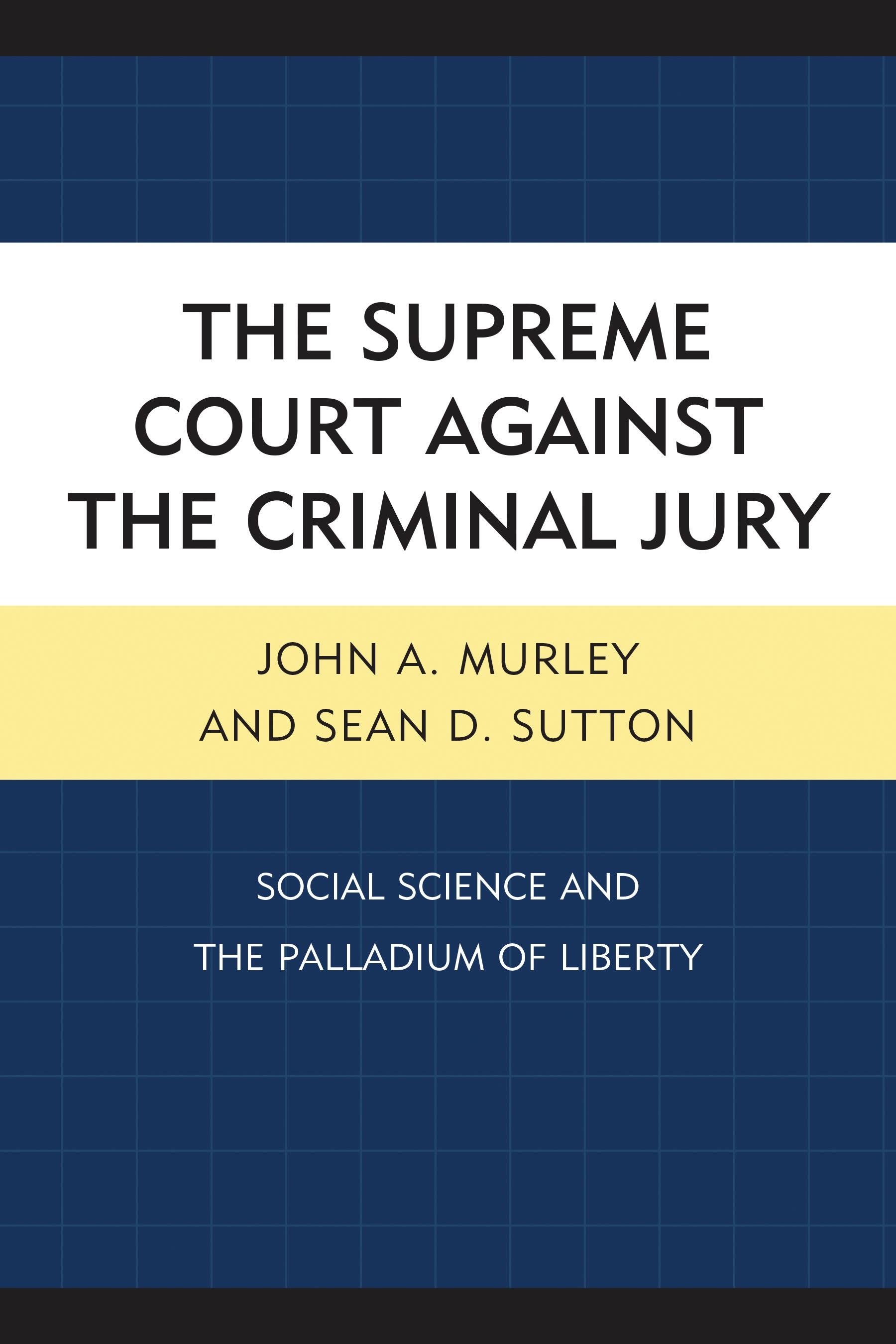
The Supreme Court against the Criminal Jury: Social Science and the Palladium of Liberty is an analysis of the United States Supreme Court decisions in what has come to be called the “jury-size” and “jury-decision rule” cases. In Williams v. Florida (1970) and Ballew v. Georgia (1978), a majority of the Supreme Court looked to history, empirical studies, and functional analysis to support its claim that there was “no discernible difference” between the verdicts of juries of six and juries of twelve. In the process the Court also decided that the number twelve was an historical accident and that the twelve-member jury was not an essential ingredient of trial by jury.
Two years later, the Court, following essentially the same line of reasoning used in Williams, decided in the companion cases Apodaca v. Oregon (1972) and Johnson v. Louisiana (1972) that defendants were as well served with juries that reached verdicts by a majority vote of 11-1,10-2 and 9-3 as they were with unanimous jury verdicts. In these cases the Supreme Court rejected the centuries old common law view that the unanimous jury verdict was an essential element of trial by jury. With these four decisions, the criminal jury as it had been known for more than six hundred years under the common law and the Constitution was in principle abandoned. We critique these decisions from the perspective of unreliable jury studies and the impact of these decision on jury nullification.
Two years later, the Court, following essentially the same line of reasoning used in Williams, decided in the companion cases Apodaca v. Oregon (1972) and Johnson v. Louisiana (1972) that defendants were as well served with juries that reached verdicts by a majority vote of 11-1,10-2 and 9-3 as they were with unanimous jury verdicts. In these cases the Supreme Court rejected the centuries old common law view that the unanimous jury verdict was an essential element of trial by jury. With these four decisions, the criminal jury as it had been known for more than six hundred years under the common law and the Constitution was in principle abandoned. We critique these decisions from the perspective of unreliable jury studies and the impact of these decision on jury nullification.
Maksa helposti kortilla, Klarnalla, Apple Paylla tai Google Paylla. Etkö ole tyytyväinen? Sinulla on aina 14 päivän palautusoikeus. Lue lisää ehdoistamme. Jos sinulla on kysyttävää, lähetä meille sähköpostia osoitteeseen hello@memmo.org.
Memmo tekee opiskelusta helpompaa – missä päin maailmaa ikinä oletkin. Meillä yhdistät kurssikirjat ja fiksut opiskelutyökalut yhteen paikkaan: tiivistelmät, visat, podcastit ja muistikortit. Ja sitten Ted, opiskelukaverisi, joka vastaa kaikkeen, mitä ikinä mietitkin. Yli 50 000 opiskelijaa opiskelee jo täällä – rakennettu auttamaan sinua oppimaan nopeammin ja stressaamaan vähemmän.