
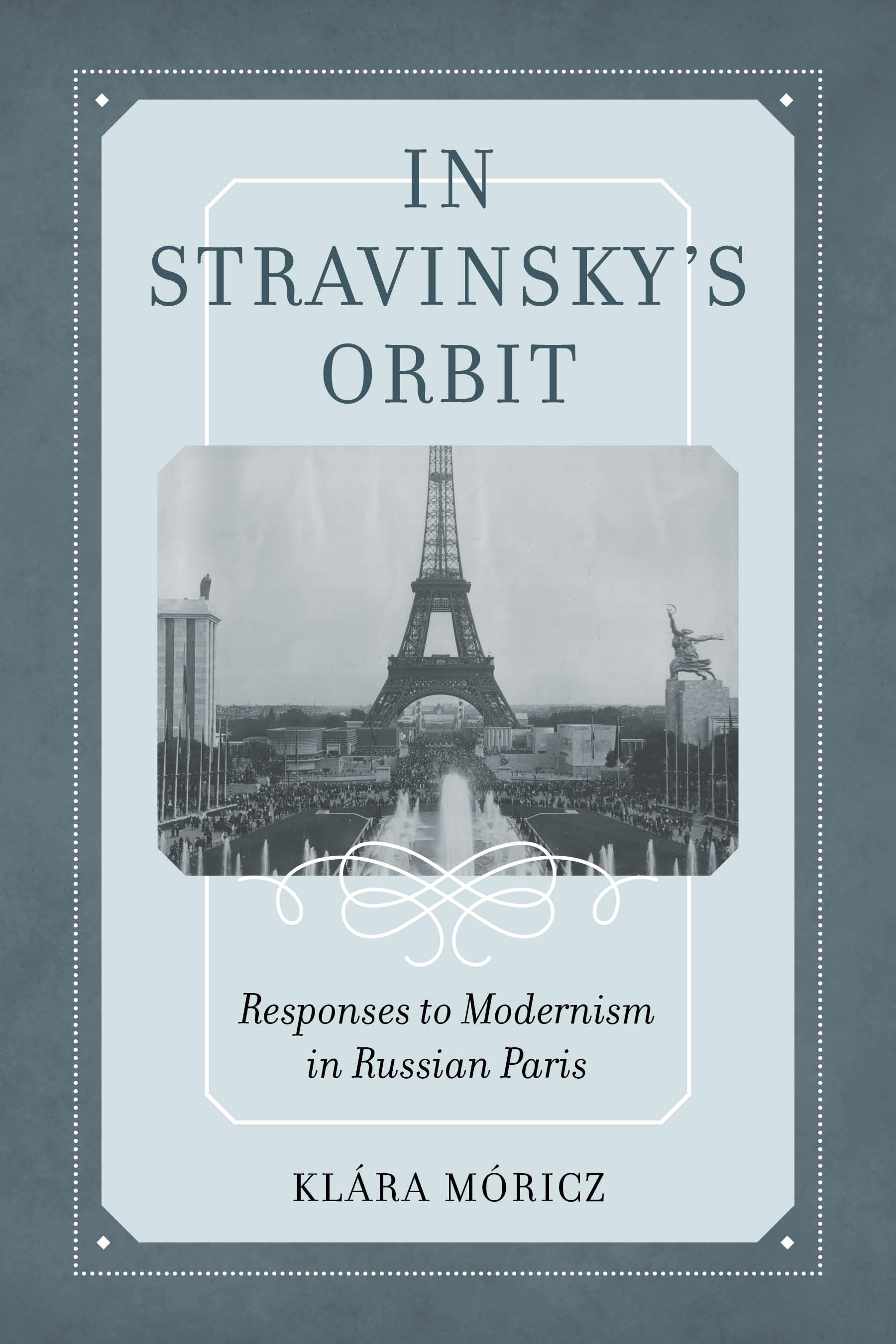
The Bolsheviks’ 1917 political coup caused a seismic disruption in Russian culture. Carried by the first wave of emigrants, Russian culture migrated West, transforming itself as it interacted with the new cultural environment and clashed with exported Soviet trends. In this book, Klára Móricz explores the transnational emigrant space of Russian composers Igor Stravinsky, Vladimir Dukelsky, Sergey Prokofiev, Nicolas Nabokov, and Arthur Lourié in interwar Paris.
Their music reflected the conflict between a modernist narrative demanding innovation and a narrative of exile wedded to the preservation of prerevolutionary Russian culture. The emigrants’ and the Bolsheviks’ contrasting visions of Russia and its past collided frequently in the French capital, where the Soviets displayed their political and artistic products. Russian composers in Paris also had to reckon with Stravinsky’s disproportionate influence: if they succumbed to fashions dictated by their famous compatriot, they risked becoming epigones; if they kept to their old ways, they quickly became irrelevant. Although Stravinsky’s neoclassicism provided a seemingly neutral middle ground between innovation and nostalgia, it was also marked by the exilic experience. Móricz offers this unexplored context for Stravinsky’s neoclassicism, shedding new light on this infinitely elusive term.
Their music reflected the conflict between a modernist narrative demanding innovation and a narrative of exile wedded to the preservation of prerevolutionary Russian culture. The emigrants’ and the Bolsheviks’ contrasting visions of Russia and its past collided frequently in the French capital, where the Soviets displayed their political and artistic products. Russian composers in Paris also had to reckon with Stravinsky’s disproportionate influence: if they succumbed to fashions dictated by their famous compatriot, they risked becoming epigones; if they kept to their old ways, they quickly became irrelevant. Although Stravinsky’s neoclassicism provided a seemingly neutral middle ground between innovation and nostalgia, it was also marked by the exilic experience. Móricz offers this unexplored context for Stravinsky’s neoclassicism, shedding new light on this infinitely elusive term.
Sivuja: 310
Kategoria: Musikvetenskap
e-ISBN: 9780520975521
Lähetyspaino: 1.2 kg
Toimitusaika: 1-2 päivää
Maksa helposti kortilla, Klarnalla, Apple Paylla tai Google Paylla. Etkö ole tyytyväinen? Sinulla on aina 14 päivän palautusoikeus. Lue lisää ehdoistamme. Jos sinulla on kysyttävää, lähetä meille sähköpostia osoitteeseen hello@memmo.org.
Memmo tekee opiskelusta helpompaa – missä päin maailmaa ikinä oletkin. Meillä yhdistät kurssikirjat ja fiksut opiskelutyökalut yhteen paikkaan: tiivistelmät, visat, podcastit ja muistikortit. Ja sitten Ted, opiskelukaverisi, joka vastaa kaikkeen, mitä ikinä mietitkin. Yli 50 000 opiskelijaa opiskelee jo täällä – rakennettu auttamaan sinua oppimaan nopeammin ja stressaamaan vähemmän.
Saatat pitää myös näistä
Osta kirja0