
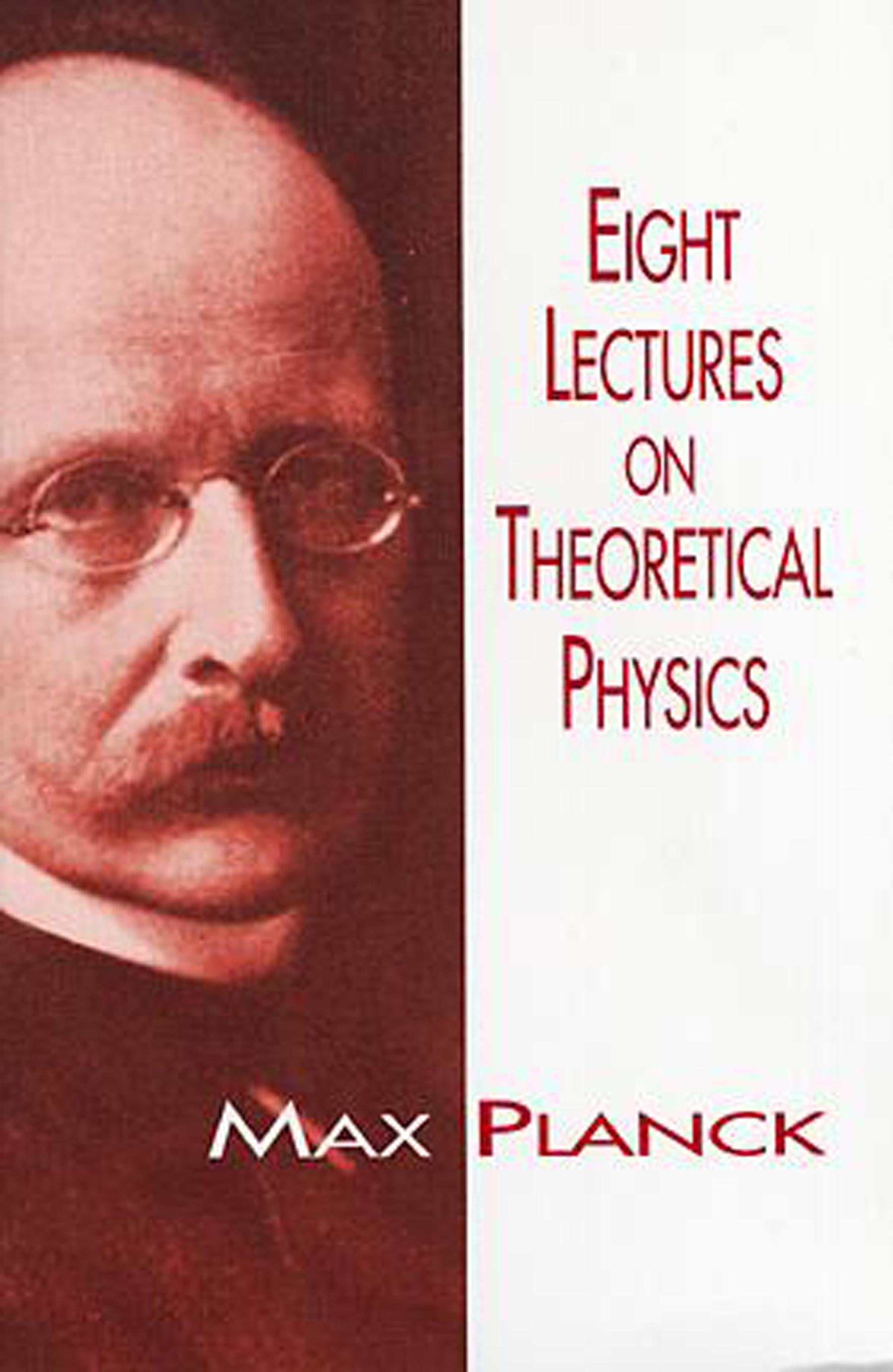
In 1909 the great German physicist and Nobel Prize winner Max Planck (1858–1947) delivered a series of eight lectures at Columbia University giving a fascinating overview of the new state of physics, which he had played a crucial role in bringing about.
The first, third, fifth, and sixth lectures present his account of the revolutionary developments occasioned when he first applied the quantum hypothesis to blackbody radiation. The reader is given a valuable opportunity to witness Planck's thought processes both on the level of philosophical principles as well as their application to physical processes on the microscopic and macroscopic scales.
In the second and fourth lectures Planck shows how the new ideas of statistical mechanics transformed the understanding of chemical physics. The seventh lecture discusses the principle of least action, while the final one gives an account of the theory of special relativity, of which Planck had been an early champion.
These lectures are especially important since they reflect Planck's reconsiderations and rethinking of his original discovery of quantum theory. A new Introduction by Peter Pesic places this book in historical perspective among Planck's works and those of his contemporaries. Now available in this inexpensive edition, it will be of particular interest to students of modern physics and of the philosophy and history of science.
The first, third, fifth, and sixth lectures present his account of the revolutionary developments occasioned when he first applied the quantum hypothesis to blackbody radiation. The reader is given a valuable opportunity to witness Planck's thought processes both on the level of philosophical principles as well as their application to physical processes on the microscopic and macroscopic scales.
In the second and fourth lectures Planck shows how the new ideas of statistical mechanics transformed the understanding of chemical physics. The seventh lecture discusses the principle of least action, while the final one gives an account of the theory of special relativity, of which Planck had been an early champion.
These lectures are especially important since they reflect Planck's reconsiderations and rethinking of his original discovery of quantum theory. A new Introduction by Peter Pesic places this book in historical perspective among Planck's works and those of his contemporaries. Now available in this inexpensive edition, it will be of particular interest to students of modern physics and of the philosophy and history of science.
Maksa helposti kortilla, Klarnalla, Apple Paylla tai Google Paylla. Etkö ole tyytyväinen? Sinulla on aina 14 päivän palautusoikeus. Lue lisää ehdoistamme. Jos sinulla on kysyttävää, lähetä meille sähköpostia osoitteeseen hello@memmo.org.
Memmo tekee opiskelusta helpompaa – missä päin maailmaa ikinä oletkin. Meillä yhdistät kurssikirjat ja fiksut opiskelutyökalut yhteen paikkaan: tiivistelmät, visat, podcastit ja muistikortit. Ja sitten Ted, opiskelukaverisi, joka vastaa kaikkeen, mitä ikinä mietitkin. Yli 50 000 opiskelijaa opiskelee jo täällä – rakennettu auttamaan sinua oppimaan nopeammin ja stressaamaan vähemmän.
Saatat pitää myös näistä
Osta kirja0