
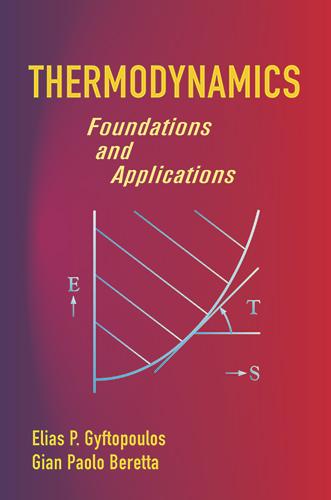
Designed for both undergraduate and graduate students, this authoritative milestone in the foundational development of thermodynamics provides a unique reference for all physicists and engineers. Basic concepts and applications are discussed in complete detail with attention to generality and logical consistency, removing ambiguities and limitations of traditional presentations. Worked-out examples and end-of-chapter problems illustrate the use of energy and entropy balances as powerful analytical keystones in physics and engineering.
The text provides material for undergraduate and graduate courses. At the introductory level, it covers heat engines, stable-equilibrium-state models for ideal-gas, incompressible-fluid and solid behaviors, heat, work and bulk-flow interactions, thermodynamic efficiency, energy conversion systems, energy, and availability/ At the intermediate level, it covers ideal and nonideal mixtures, chemical reactions, chemical equilibrium, and combustion.
At the advanced level, the unique non-traditional order of exposition of the basic concepts and principles (system, property, state, process, first law, energy, equilibrium, stable equilibrium, second law, entropy) allows rigorous general definitions of energy and entropy valid for all systems (large and small, few- and many- particles) and all states (stable and non-stable equilibrium, as well as non-equilibrium). In particular, entropy is defined before and independently of the definitions of temperature and heat, and of the simple-system model for many-particle systems.
The text provides material for undergraduate and graduate courses. At the introductory level, it covers heat engines, stable-equilibrium-state models for ideal-gas, incompressible-fluid and solid behaviors, heat, work and bulk-flow interactions, thermodynamic efficiency, energy conversion systems, energy, and availability/ At the intermediate level, it covers ideal and nonideal mixtures, chemical reactions, chemical equilibrium, and combustion.
At the advanced level, the unique non-traditional order of exposition of the basic concepts and principles (system, property, state, process, first law, energy, equilibrium, stable equilibrium, second law, entropy) allows rigorous general definitions of energy and entropy valid for all systems (large and small, few- and many- particles) and all states (stable and non-stable equilibrium, as well as non-equilibrium). In particular, entropy is defined before and independently of the definitions of temperature and heat, and of the simple-system model for many-particle systems.
Maksa helposti kortilla, Klarnalla, Apple Paylla tai Google Paylla. Etkö ole tyytyväinen? Sinulla on aina 14 päivän palautusoikeus. Lue lisää ehdoistamme. Jos sinulla on kysyttävää, lähetä meille sähköpostia osoitteeseen hello@memmo.org.
Memmo tekee opiskelusta helpompaa – missä päin maailmaa ikinä oletkin. Meillä yhdistät kurssikirjat ja fiksut opiskelutyökalut yhteen paikkaan: tiivistelmät, visat, podcastit ja muistikortit. Ja sitten Ted, opiskelukaverisi, joka vastaa kaikkeen, mitä ikinä mietitkin. Yli 50 000 opiskelijaa opiskelee jo täällä – rakennettu auttamaan sinua oppimaan nopeammin ja stressaamaan vähemmän.
Saatat pitää myös näistä
Osta kirja0