
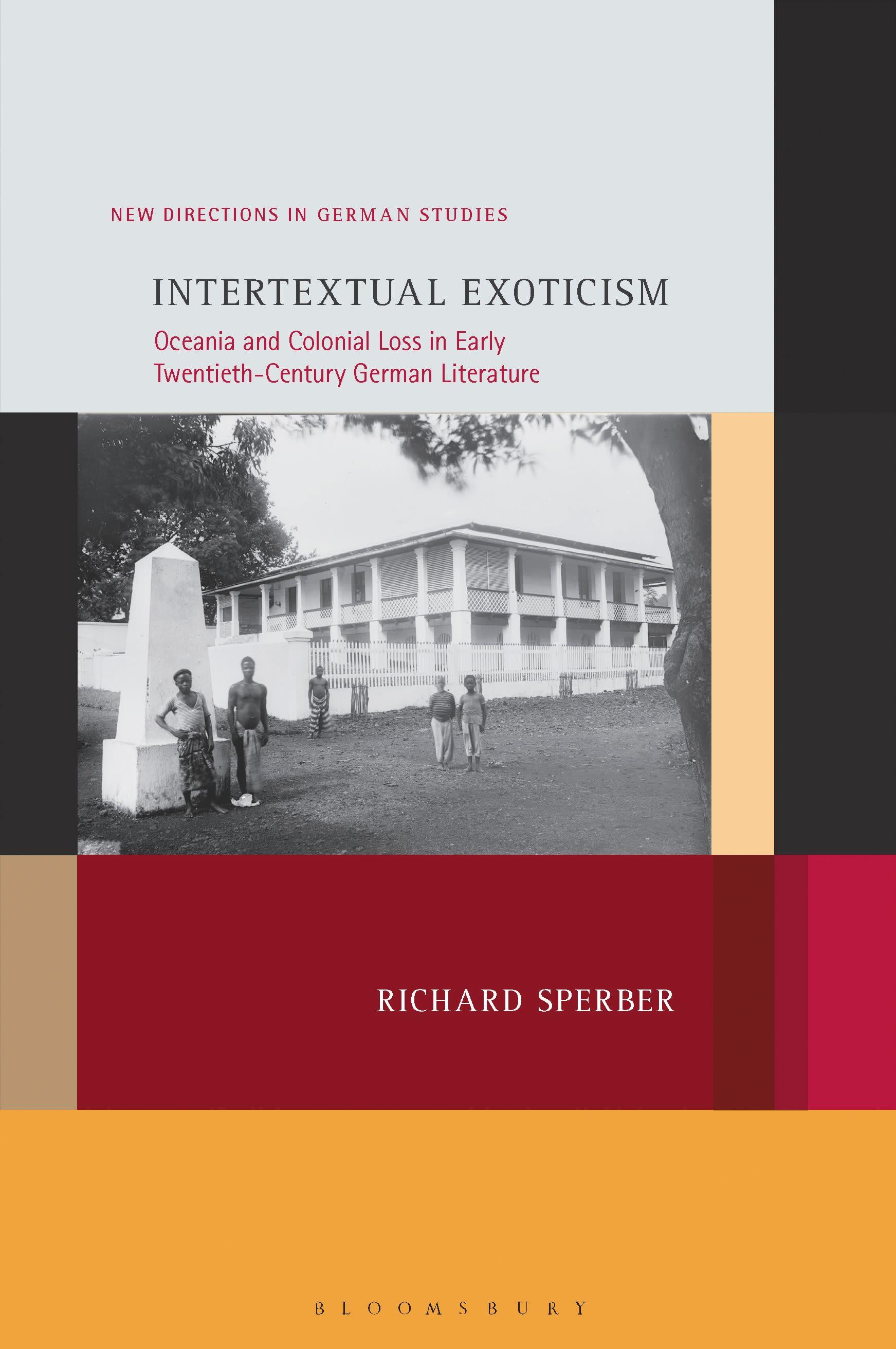
Intertextual Exoticism reads a body of non-canonical German exoticist literature published after imperial Germany's loss of colonial Oceania in 1914, applying theories of "intertextuality" (Kristeva) and recent scholarship on literary exoticism to explore Germany's postwar crises of psychology, masculinity, and national identity mapped onto Oceanic spaces.
Many readers are familiar with late Victorian texts expressing imperial Britain's anxieties. Richard Sperber expands the scope of these texts in the context of a post-imperial Europe, examining how German exoticist literature, published after German colonial loss in Oceania in 1914, intensifies the gothic themes and subjectivities of these Victorian texts.
The first part of this volume examines eight adventure narratives of Oceania, demonstrating how they do not necessarily present or represent a single, unified German colonial project. They take place on islands owned by Australia and Britain, and the unprepared German protagonists-amateur naturalists and bungling traders-are compared unfavourably to resolute Anglophone adventurers. The second part then pairs five well-known exoticist texts, including Conrad's Heart of Darkness, Stevenson's The Beach of Falesá, Haggard's She, Hitchens' The Garden of Allah, and Wilde's Salomé, with five non-canonical exoticist German texts. Sperber shows through these pairings how German literary exoticism becomes a transnational and intertextual literature that rereads dominant themes in 20th-century Europe's greater literatures of exoticism and colonial loss.
Many readers are familiar with late Victorian texts expressing imperial Britain's anxieties. Richard Sperber expands the scope of these texts in the context of a post-imperial Europe, examining how German exoticist literature, published after German colonial loss in Oceania in 1914, intensifies the gothic themes and subjectivities of these Victorian texts.
The first part of this volume examines eight adventure narratives of Oceania, demonstrating how they do not necessarily present or represent a single, unified German colonial project. They take place on islands owned by Australia and Britain, and the unprepared German protagonists-amateur naturalists and bungling traders-are compared unfavourably to resolute Anglophone adventurers. The second part then pairs five well-known exoticist texts, including Conrad's Heart of Darkness, Stevenson's The Beach of Falesá, Haggard's She, Hitchens' The Garden of Allah, and Wilde's Salomé, with five non-canonical exoticist German texts. Sperber shows through these pairings how German literary exoticism becomes a transnational and intertextual literature that rereads dominant themes in 20th-century Europe's greater literatures of exoticism and colonial loss.
Páginas: 376
Categoría: Litteraturvetenskap & Teori
e-ISBN: 9798765135495
Peso de envío: 1.2 kg
Envío en: 1-2 días
Paga fácilmente con tarjeta, Klarna, Apple Pay o Google Pay. ¿No estás contento? Siempre tienes 14 días de garantía de devolución. Lee más en nuestros términos. Si tienes preguntas, escríbenos a hello@memmo.org.
Memmo hace que estudiar sea más fácil, estés donde estés. Aquí tienes tus libros de texto y herramientas de estudio inteligentes en un solo lugar: resúmenes, quizzes, podcasts y flashcards. Y también a Ted, tu compañero de estudio que responde a todo lo que te preguntes. Más de 50 000 estudiantes ya estudian aquí. Está hecho para que aprendas más rápido y te estreses menos.