
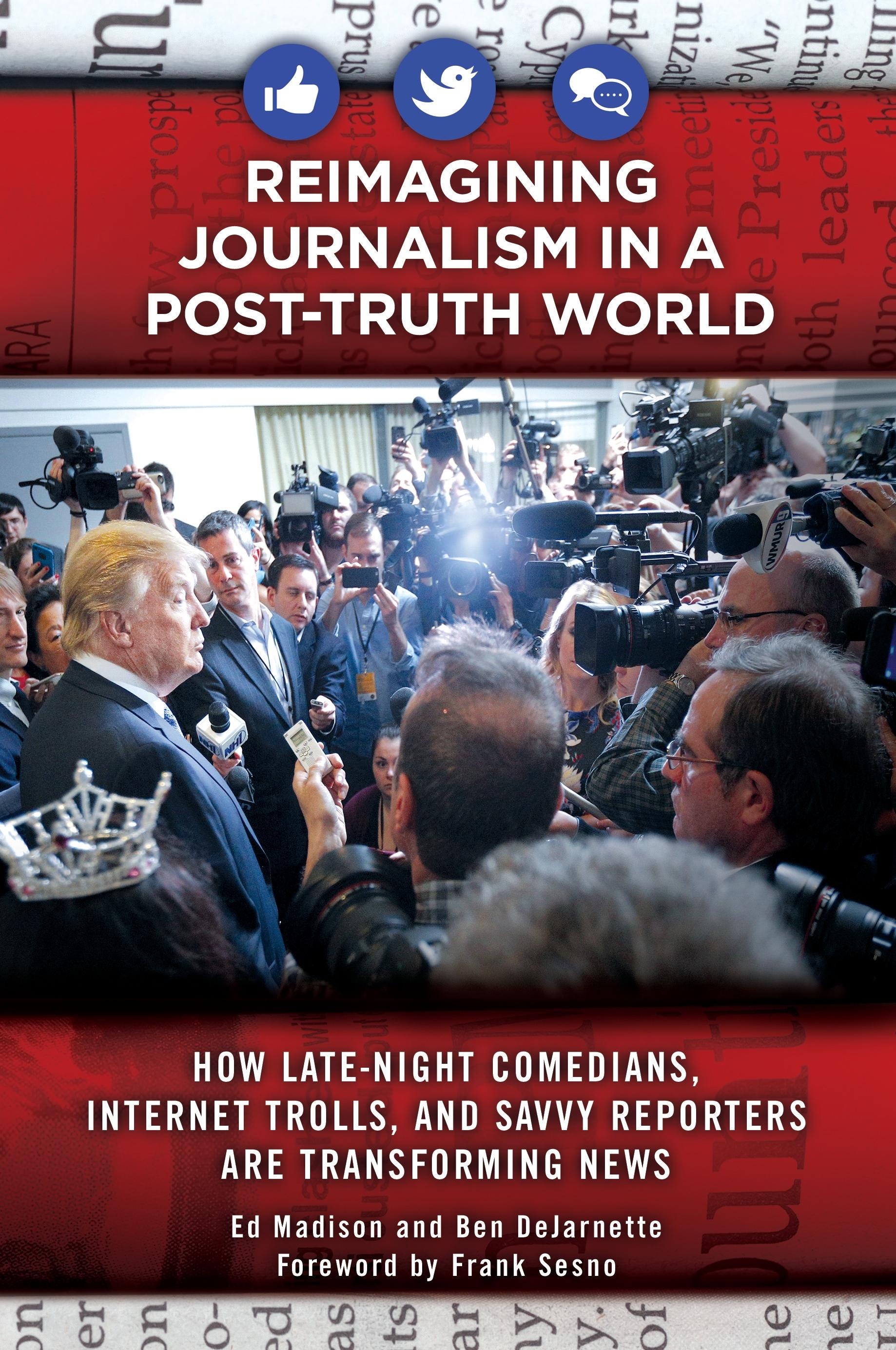
Amidst "alternative facts" and "post-truth" politics, news journalism is more important and complex than ever. This book examines journalism's evolution within digital media's ecosystem where lies often spread faster than truth, and consumers expect conversations, not lectures.
Tthe 2016 U.S. presidential election delivered a stunning result, but the news media's breathless coverage of it was no surprise. News networks turned debates into primetime entertainment, reporters spent more time covering poll results than public policy issues, and the cozy relationship between journalists and political insiders helped ensure intrigue and ratings, even as it eroded journalism's role as democracy's "Fourth Estate." Against this sobering backdrop, a broadcast news veteran and a millennial newshound consider how journalism can regain the public's trust by learning from pioneers both within and beyond the profession. Connecting the dots between faux news, "fake news," and real news, coauthors Madison and DeJarnette provide an unflinching analysis of where mainstream journalism went wrong—and what the next generation of reporters can do to make it right.
The significance of Donald Trump's presidency is not lost on the authors, but Reimagining Journalism in a Post-Truth World is not a post-mortem of the 2016 presidential election, nor is it a how-to guide for reporting on Trump's White House. Instead, this accessible and engaging book offers a broader perspective on contemporary journalism, pairing lively anecdotes with insightful analysis of long-term trends and challenges. Drawing on their expertise in media innovation and entrepreneurship, the authors explore how comedians like John Oliver, Trevor Noah, and Samantha Bee are breaking (and reshaping) the rules of political journalism; how legacy media outlets like The Boston Globe, The Washington Post, and The New York Times are retooling for the digital age; and how newcomers like Vice, Hearken, and De Correspondent are innovating new models for reporting and storytelling. Anyone seeking to make sense of modern journalism and its intersections with democracy will want to read this book.
Tthe 2016 U.S. presidential election delivered a stunning result, but the news media's breathless coverage of it was no surprise. News networks turned debates into primetime entertainment, reporters spent more time covering poll results than public policy issues, and the cozy relationship between journalists and political insiders helped ensure intrigue and ratings, even as it eroded journalism's role as democracy's "Fourth Estate." Against this sobering backdrop, a broadcast news veteran and a millennial newshound consider how journalism can regain the public's trust by learning from pioneers both within and beyond the profession. Connecting the dots between faux news, "fake news," and real news, coauthors Madison and DeJarnette provide an unflinching analysis of where mainstream journalism went wrong—and what the next generation of reporters can do to make it right.
The significance of Donald Trump's presidency is not lost on the authors, but Reimagining Journalism in a Post-Truth World is not a post-mortem of the 2016 presidential election, nor is it a how-to guide for reporting on Trump's White House. Instead, this accessible and engaging book offers a broader perspective on contemporary journalism, pairing lively anecdotes with insightful analysis of long-term trends and challenges. Drawing on their expertise in media innovation and entrepreneurship, the authors explore how comedians like John Oliver, Trevor Noah, and Samantha Bee are breaking (and reshaping) the rules of political journalism; how legacy media outlets like The Boston Globe, The Washington Post, and The New York Times are retooling for the digital age; and how newcomers like Vice, Hearken, and De Correspondent are innovating new models for reporting and storytelling. Anyone seeking to make sense of modern journalism and its intersections with democracy will want to read this book.
Paga fácilmente con tarjeta, Klarna, Apple Pay o Google Pay. ¿No estás contento? Siempre tienes 14 días de garantía de devolución. Lee más en nuestros términos. Si tienes preguntas, escríbenos a hello@memmo.org.
Memmo hace que estudiar sea más fácil, estés donde estés. Aquí tienes tus libros de texto y herramientas de estudio inteligentes en un solo lugar: resúmenes, quizzes, podcasts y flashcards. Y también a Ted, tu compañero de estudio que responde a todo lo que te preguntes. Más de 50 000 estudiantes ya estudian aquí. Está hecho para que aprendas más rápido y te estreses menos.