
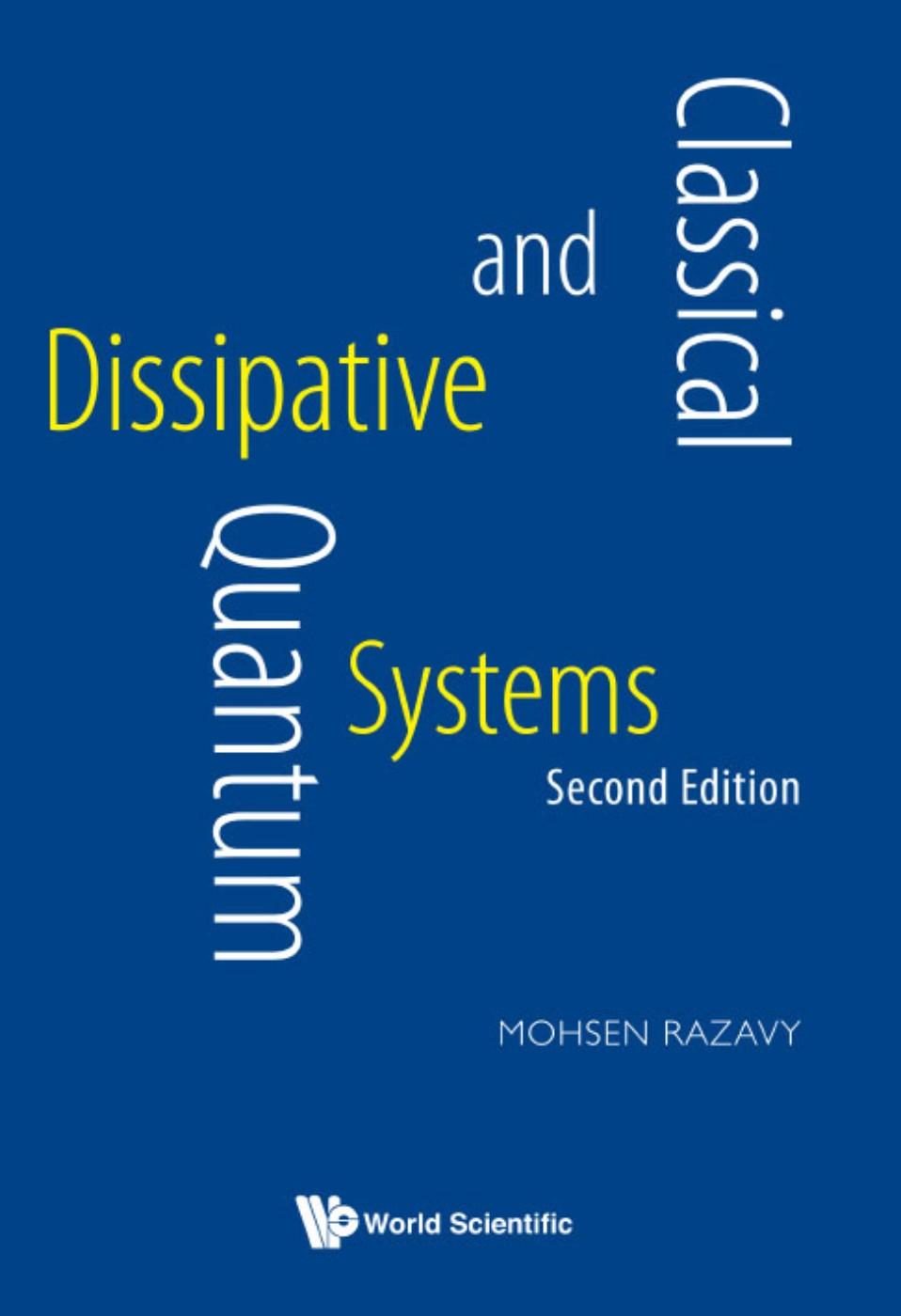
Dissipative forces play an important role in problems of classical as well as quantum mechanics. Since these forces are not among the basic forces of nature, it is essential to consider whether they should be treated as phenomenological interactions used in the equations of motion, or they should be derived from other conservative forces. In this book we discuss both approaches in detail starting with the Stoke's law of motion in a viscous fluid and ending with a rather detailed review of the recent attempts to understand the nature of the drag forces originating from the motion of a plane or a sphere in vacuum caused by the variations in the zero-point energy. In the classical formulation, mathematical techniques for construction of Lagrangian and Hamiltonian for the variational formulation of non-conservative systems are discussed at length. Various physical systems of interest including the problem of radiating electron, theory of natural line width, spin-boson problem, scattering and trapping of heavy ions and optical potential models of nuclear reactions are considered and solved.
Paga fácilmente con tarjeta, Klarna, Apple Pay o Google Pay. ¿No estás contento? Siempre tienes 14 días de garantía de devolución. Lee más en nuestros términos. Si tienes preguntas, escríbenos a hello@memmo.org.
Memmo hace que estudiar sea más fácil, estés donde estés. Aquí tienes tus libros de texto y herramientas de estudio inteligentes en un solo lugar: resúmenes, quizzes, podcasts y flashcards. Y también a Ted, tu compañero de estudio que responde a todo lo que te preguntes. Más de 50 000 estudiantes ya estudian aquí. Está hecho para que aprendas más rápido y te estreses menos.
También te podría gustar
Comprar el libro0