
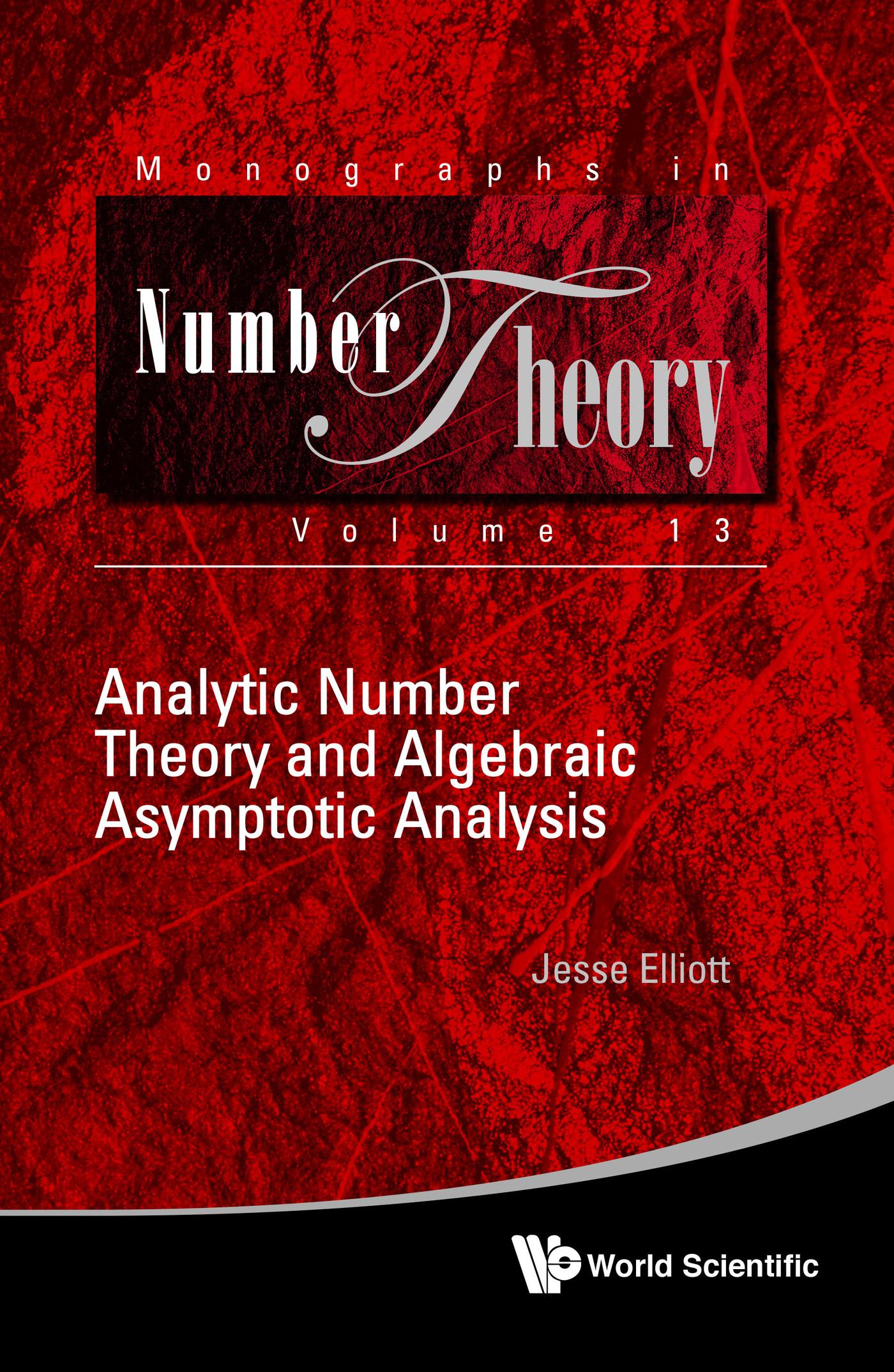
This monograph introduces a unified framework for analyzing and comparing the asymptotic growth of number-theoretic functions through the novel notions of degree and logexponential degree. Extending the asymptotic calculus shaped by du Bois-Reymond, Landau, and Hardy — rooted in notations such as O, o, and ∼ — it provides a formal algebraic language for comparing growth rates, interpreting numerical evidence, and connecting longstanding problems, including the Riemann hypothesis. The new degree formalism incorporates Hardy's logarithmico-exponential functions, built from id, exp, and log using the operations of addition, multiplication, division, and composition, as benchmarks for comparison. The monograph develops foundational results about the structure and algebra of the degree formalism, including its relation to Karamata theory, Hardy fields, transseries, and asymptotic differential algebra. While not offering proofs of major conjectures, it proposes a new way of establishing interdependencies among error terms. Applications to summatory functions, prime gaps, the Riemann zeta function, and Diophantine approximation demonstrate the framework's reach and utility. These applications reduce error terms in analytic number theory to core set of primitives, including the function π(x) — li(x), whose degree equals ½ if and only if the Riemann hypothesis holds.
Contents:
- A Survey of Analytic Number Theory:
- A Brief History of Primes
- Asymptotic Analysis
- Arithmetic Functions
- Special Functions in Analytic Number Theory
- The Analytic Theory of Primes
- Algebraic Asymptotic Analysis:
- Logexponential Degree
- Asymptotic Algebra
- Asymptotic Continued Fraction Expansions
- Applications of Algebraic Asymptotic Analysis to Number Theory:
- The Prime Counting Function π(x) and Related Functions
- Summatory Functions
- The Riemann Zeta Function ζ(s)
- Primes in Intervals, the nth Prime, and the nth Prime Gap
- Diophantine Approximation and Continued Fractions
- Conjectures
Readership: Mathematicians or graduate students in mathematics, especially those specializing in analytic number theory or asymtptotic algebra. Sector: academia.
Paga fácilmente con tarjeta, Klarna, Apple Pay o Google Pay. ¿No estás contento? Siempre tienes 14 días de garantía de devolución. Lee más en nuestros términos. Si tienes preguntas, escríbenos a hello@memmo.org.
Memmo hace que estudiar sea más fácil, estés donde estés. Aquí tienes tus libros de texto y herramientas de estudio inteligentes en un solo lugar: resúmenes, quizzes, podcasts y flashcards. Y también a Ted, tu compañero de estudio que responde a todo lo que te preguntes. Más de 50 000 estudiantes ya estudian aquí. Está hecho para que aprendas más rápido y te estreses menos.