
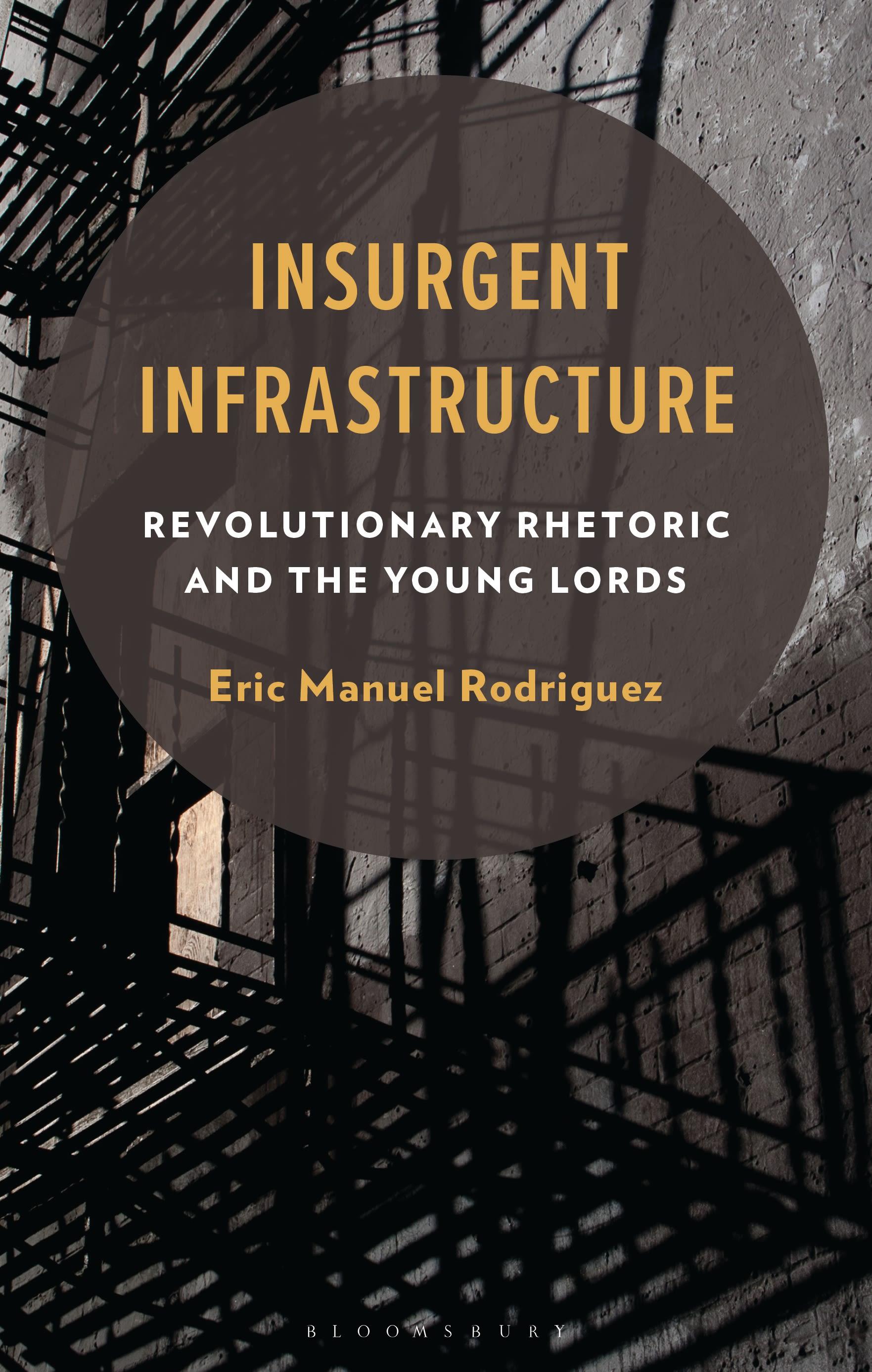
Eric Manuel Rodriguez argues that revolutionary rhetoric operates as insurgent infrastructure rather than symbolic performance.
Examining the Young Lords, a revolutionary nationalist organization forged from conditions of colonial displacement, racial capitalism, and urban neglect, this book argues that rhetorical studies requires recalibration to account for rhetoric's material dimensions and its capacity to coordinate collective survival. Through sustained analysis of the Young Lords' bilingual newspaper Palante, their 13-Point Program and Platform, Rules of Discipline, and the occupations, clinics, and educational programs that constituted their revolutionary praxis, Rodriguez demonstrates how rhetoric coordinated bodies, resources, and time under conditions of organized abandonment.
Drawing on decolonial theory, foquismo, and the concept of kairos, the study reframes rhetorical action as the construction of counter-institutions – free clinics, autonomous media, community defense, liberation schools – that sustained collective survival. Tracing the organization's rhetorical evolution from Chicago to New York and its eventual fracture, Eric Manuel Rodriguez reveals how print, pedagogy, and occupation functioned as logistical media for mobilization, and how the three principles – insurgent infrastructure, dialectical pedagogy, and collective logistics – connect the Young Lords' legacy to contemporary movements and abolitionist organizing.
Examining the Young Lords, a revolutionary nationalist organization forged from conditions of colonial displacement, racial capitalism, and urban neglect, this book argues that rhetorical studies requires recalibration to account for rhetoric's material dimensions and its capacity to coordinate collective survival. Through sustained analysis of the Young Lords' bilingual newspaper Palante, their 13-Point Program and Platform, Rules of Discipline, and the occupations, clinics, and educational programs that constituted their revolutionary praxis, Rodriguez demonstrates how rhetoric coordinated bodies, resources, and time under conditions of organized abandonment.
Drawing on decolonial theory, foquismo, and the concept of kairos, the study reframes rhetorical action as the construction of counter-institutions – free clinics, autonomous media, community defense, liberation schools – that sustained collective survival. Tracing the organization's rhetorical evolution from Chicago to New York and its eventual fracture, Eric Manuel Rodriguez reveals how print, pedagogy, and occupation functioned as logistical media for mobilization, and how the three principles – insurgent infrastructure, dialectical pedagogy, and collective logistics – connect the Young Lords' legacy to contemporary movements and abolitionist organizing.
Páginas: 192
Categoría: Kultur-, Genus- & Postkoloniala studier
e-ISBN: 9781978769427
Peso de envío: 1.2 kg
Envío en: 1-2 días
Paga fácilmente con tarjeta, Klarna, Apple Pay o Google Pay. ¿No estás contento? Siempre tienes 14 días de garantía de devolución. Lee más en nuestros términos. Si tienes preguntas, escríbenos a hello@memmo.org.
Memmo hace que estudiar sea más fácil, estés donde estés. Aquí tienes tus libros de texto y herramientas de estudio inteligentes en un solo lugar: resúmenes, quizzes, podcasts y flashcards. Y también a Ted, tu compañero de estudio que responde a todo lo que te preguntes. Más de 50 000 estudiantes ya estudian aquí. Está hecho para que aprendas más rápido y te estreses menos.