
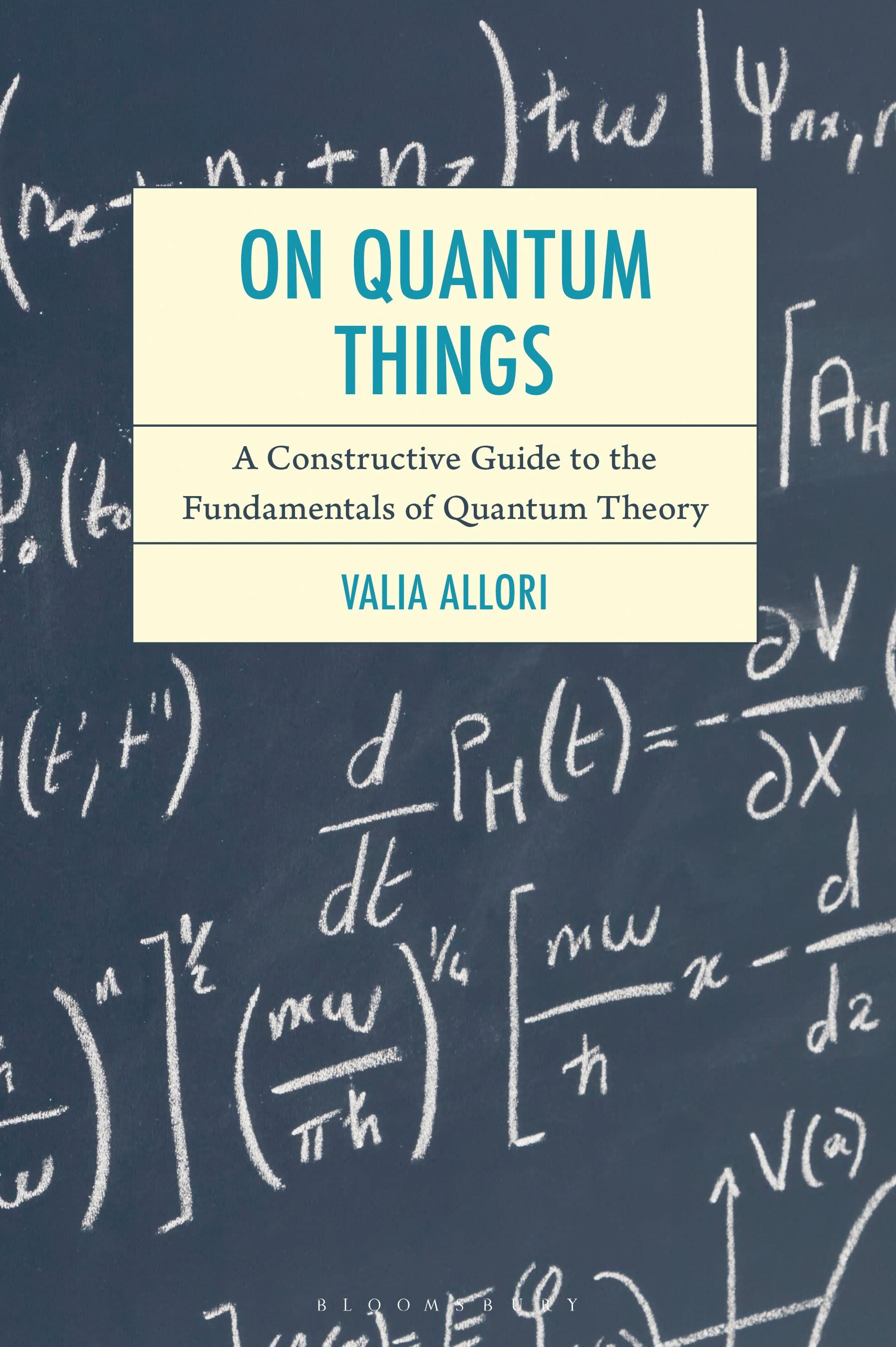
A realist, particle-based view of quantum theory-where the wavefunction no longer plays a central role-offers a clear, commonsense alternative to dominant metaphysical views.
This book explores the metaphysics of quantum theory through a lens of scientific realism-the belief that successful scientific theories describe reality. It critically evaluates various interpretations, including structural realism, wave function realism, and the many-worlds view, highlighting their limitations. Valia Allori proposes a “spatiotemporal foundational ontology” approach, grounded in particles as fundamental entities evolving in three-dimensional space and time, following uniform, symmetric laws. This view is exemplified by Bohmian mechanics (pilot-wave theory), offering a constructive, commonsensical explanation of quantum phenomena. The wave function, in this framework, is not a physical object but plays a functional, law-like role in explaining interactions. Further, the book advances a radical thesis: fundamental particles lack intrinsic properties like mass or charge and are instead “bare” objects distinguished only by the laws governing them. This thesis allows a middle path between traditional object-based metaphysics and eliminative structuralism. Ultimately, the author argues that had physics developed more rationally, instead of following a historical path shaped by contingent choices, the pilot-wave theory might have been the dominant interpretation, minimizing the proliferation of speculative alternatives.
This book explores the metaphysics of quantum theory through a lens of scientific realism-the belief that successful scientific theories describe reality. It critically evaluates various interpretations, including structural realism, wave function realism, and the many-worlds view, highlighting their limitations. Valia Allori proposes a “spatiotemporal foundational ontology” approach, grounded in particles as fundamental entities evolving in three-dimensional space and time, following uniform, symmetric laws. This view is exemplified by Bohmian mechanics (pilot-wave theory), offering a constructive, commonsensical explanation of quantum phenomena. The wave function, in this framework, is not a physical object but plays a functional, law-like role in explaining interactions. Further, the book advances a radical thesis: fundamental particles lack intrinsic properties like mass or charge and are instead “bare” objects distinguished only by the laws governing them. This thesis allows a middle path between traditional object-based metaphysics and eliminative structuralism. Ultimately, the author argues that had physics developed more rationally, instead of following a historical path shaped by contingent choices, the pilot-wave theory might have been the dominant interpretation, minimizing the proliferation of speculative alternatives.
Paga fácilmente con tarjeta, Klarna, Apple Pay o Google Pay. ¿No estás contento? Siempre tienes 14 días de garantía de devolución. Lee más en nuestros términos. Si tienes preguntas, escríbenos a hello@memmo.org.
Memmo hace que estudiar sea más fácil, estés donde estés. Aquí tienes tus libros de texto y herramientas de estudio inteligentes en un solo lugar: resúmenes, quizzes, podcasts y flashcards. Y también a Ted, tu compañero de estudio que responde a todo lo que te preguntes. Más de 50 000 estudiantes ya estudian aquí. Está hecho para que aprendas más rápido y te estreses menos.