
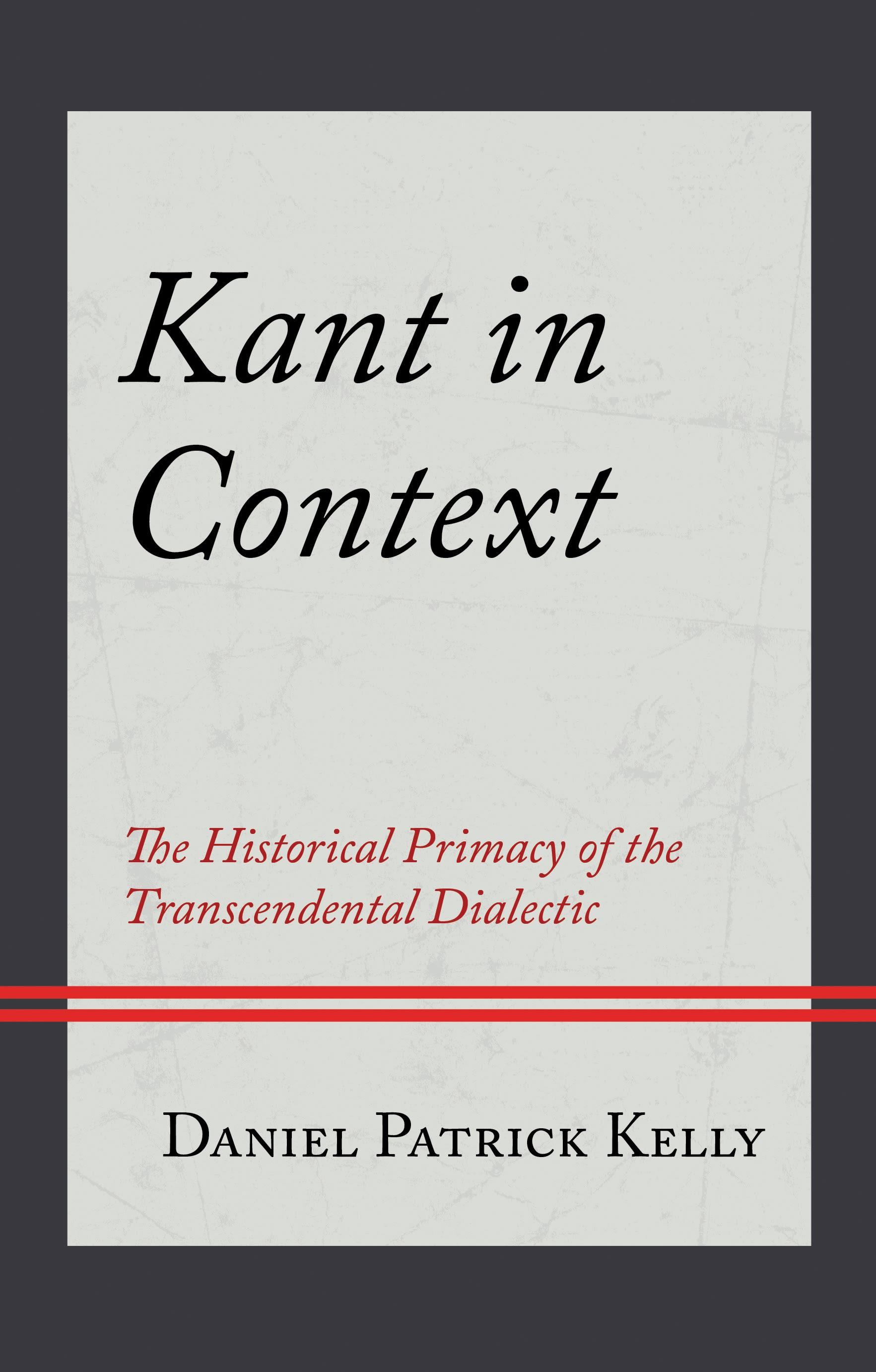
Kant in Context: The Historical Primacy of the Transcendental Dialectic examines the introduction of Kant’s critical philosophy through the lens of historical contextualization. Daniel Patrick Kelly argues that Kant’s seismic Copernican epistemic turn must be adequately positioned and understood within the German philosophical landscape that developed in Spinoza’s wake. This necessary historical analysis illuminates the development and comparative strength of Kant’s emergent transcendental idealism. However, in order to render the introduction of Kant’s critical system sufficient to this historical task, this book heuristically organizes the contents of the Critique of Pure Reason to highlight the work’s meta-philosophical historical conclusions. In this revised take on Kant’s Critique, Kelly argues that the "Transcendental Aesthetic" and subsequent "Transcendental Dialectic" emerge as foundational in understanding Kant’s Critique as a profound historical-methodological development, as they justify and ground the call for his new and supporting science of cognition, placing the "Transcendental Analytic" as inherently secondary in this heuristic reading of the Critique. The author’s overarching contention is that Kant’s identification of the dialectical limitations of metaphysical reasoning provides a more solid justification for Kant’s transcendental idealism than that of the novel postulates of the "Analytic."
Paga fácilmente con tarjeta, Klarna, Apple Pay o Google Pay. ¿No estás contento? Siempre tienes 14 días de garantía de devolución. Lee más en nuestros términos. Si tienes preguntas, escríbenos a hello@memmo.org.
Memmo hace que estudiar sea más fácil, estés donde estés. Aquí tienes tus libros de texto y herramientas de estudio inteligentes en un solo lugar: resúmenes, quizzes, podcasts y flashcards. Y también a Ted, tu compañero de estudio que responde a todo lo que te preguntes. Más de 50 000 estudiantes ya estudian aquí. Está hecho para que aprendas más rápido y te estreses menos.