
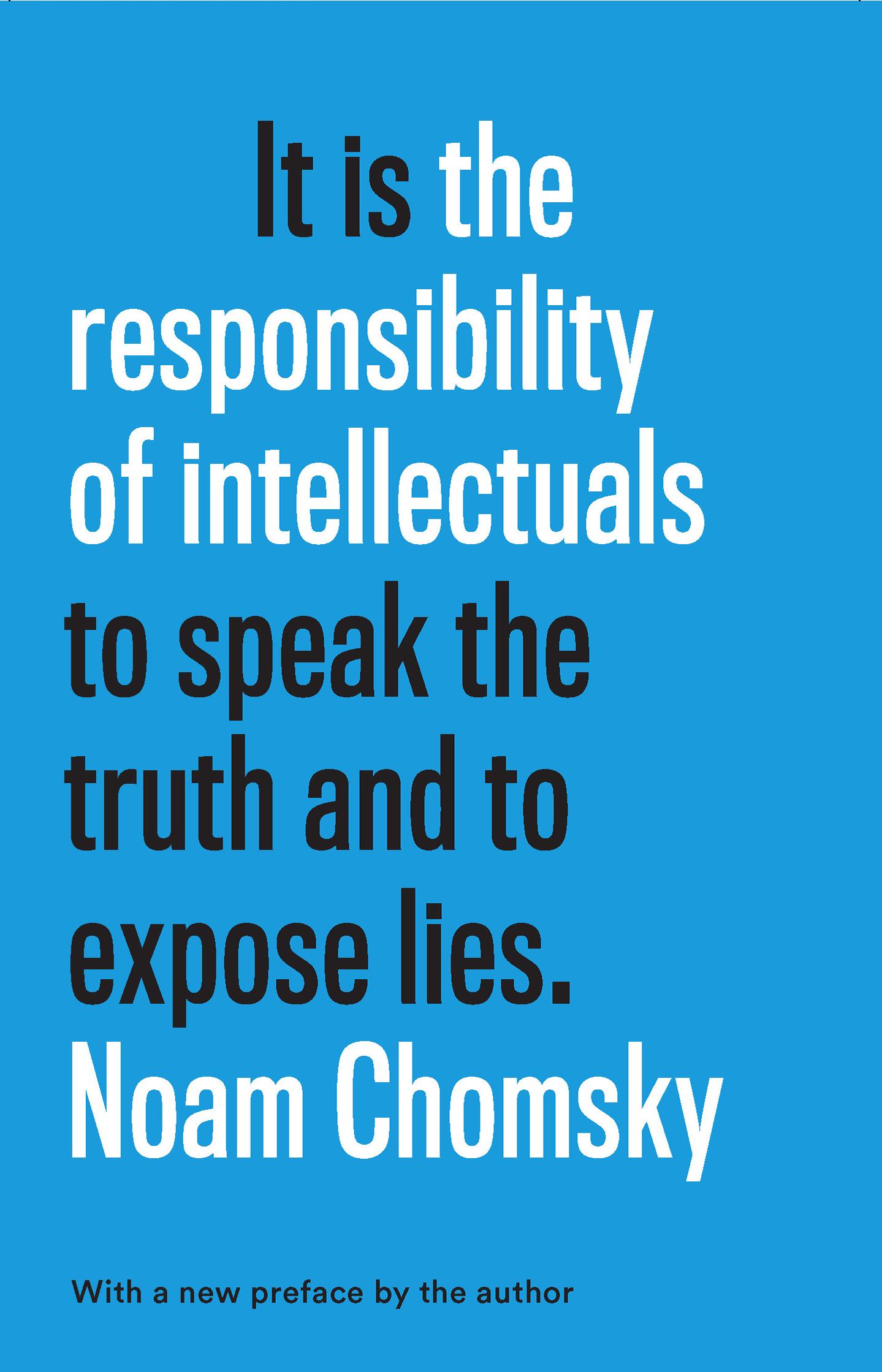
In one of his most famous essays, Noam Chomsky lays out the idea that intellectuals’ relative privilege imbues them with greater responsibility—one that was to be the guiding principle of his intellectual life
“Chomsky is a global phenomenon. . . . He may be the most widely read American voice on foreign policy on the planet.” —The New York Times Book Review
As a nineteen-year-old undergraduate in 1947, Noam Chomsky was deeply affected by articles about the responsibility of intellectuals written by Dwight Macdonald, an editor of Partisan Review and then of Politics. Twenty years later, as the Vietnam War was escalating, Chomsky turned to the question himself, noting that “intellectuals are in a position to expose the lies of governments” and to analyze their “often hidden intentions.”
Originally published in the New York Review of Books, Chomsky’s essay eviscerated the “hypocritical moralism of the past” (such as when Woodrow Wilson set out to teach Latin Americans “the art of good government”) and exposed the destructive policies in Vietnam and the role of intellectuals in justifying them.
Chomsky then turns to the “war on terror” and “enhanced interrogation” of the Bush years in “The Responsibility of Intellectuals Redux,” an essay written on the tenth anniversary of 9/11. As relevant now as it was in 1967, The Responsibility of Intellectuals reminds us that “privilege yields opportunity and opportunity confers responsibilities.”
Paga fácilmente con tarjeta, Klarna, Apple Pay o Google Pay. ¿No estás contento? Siempre tienes 14 días de garantía de devolución. Lee más en nuestros términos. Si tienes preguntas, escríbenos a hello@memmo.org.
Memmo hace que estudiar sea más fácil, estés donde estés. Aquí tienes tus libros de texto y herramientas de estudio inteligentes en un solo lugar: resúmenes, quizzes, podcasts y flashcards. Y también a Ted, tu compañero de estudio que responde a todo lo que te preguntes. Más de 50 000 estudiantes ya estudian aquí. Está hecho para que aprendas más rápido y te estreses menos.