
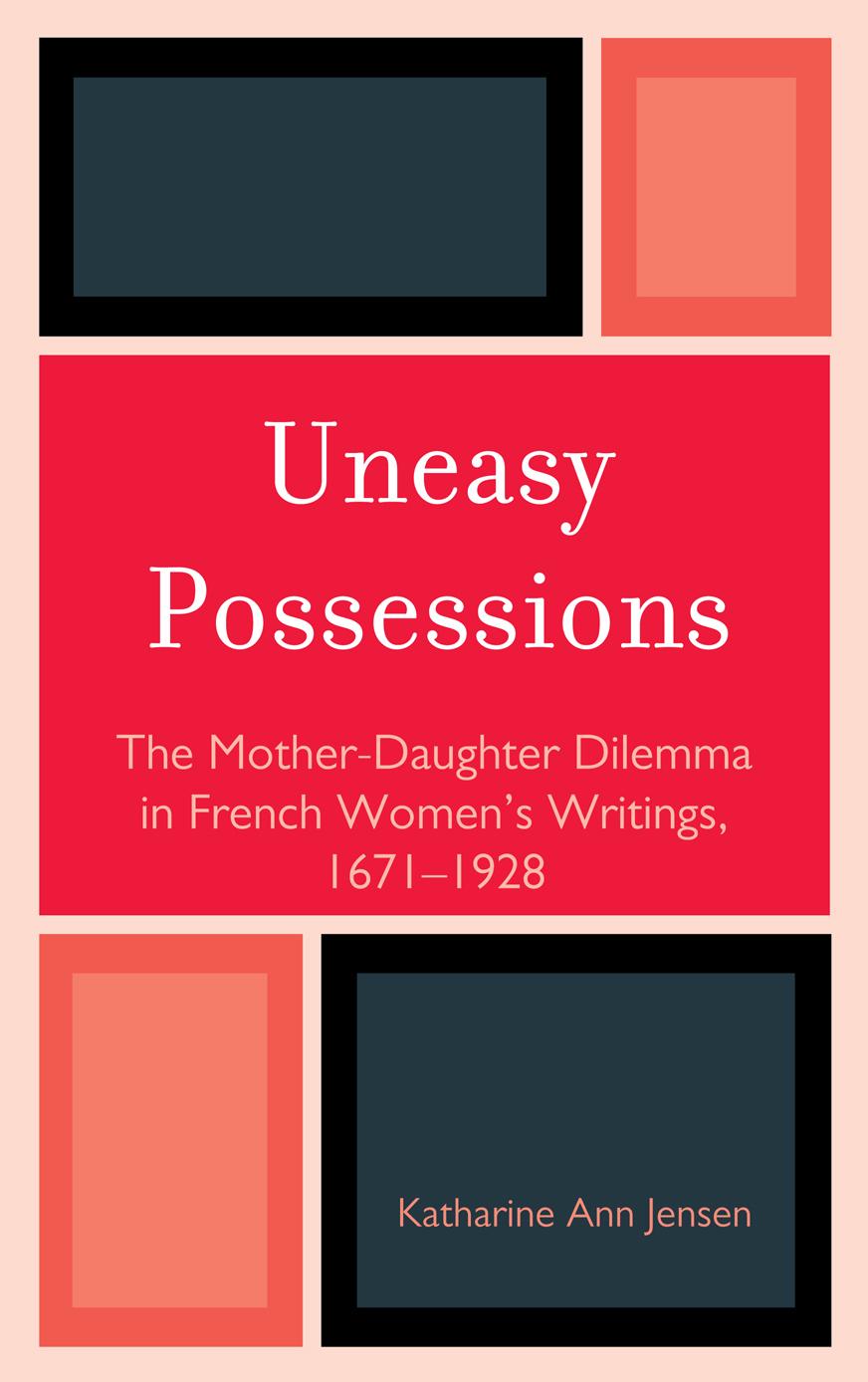
In Uneasy Possessions: The Mother-Daughter Dilemma in French Women's Writings, 1671-1928, Katharine Ann Jensen analyzes the work of five major French women writers, discovering a four-century pattern of mother-daughter relationships marked by domination, submission, and conflict. This groundbreaking study explores work of Marie-Madeleine de Lafayette, Marie de Sévigné, Elisabeth Vigée Lebrun, George Sand, and Colette, providing a new reading of women's history and offering a new understanding of female psychology. Jensen argues that conflict between the mothers and daughters depicted in these texts was the result of two contradictory ideologies. In order to pass proper feminine behavior on to their daughters, mothers were encouraged to construe daughters as part of themselves, even as daughters were expected to adopt their mothers' wishes as their own. At the same time, a developing individualism created a conflict between the daughter's desire for autonomy and her mother's wish to be recognized for having raised a perfect daughter-alter ego.
Despite vast changes in social organization in France over the four centuries of this study, the mother-daughter ideology remained effectively the same. To keep their daughters virgins, mothers were expected to form their daughters in their own image-as a mirror reflection. Mother-daughter reflectivity extended even into the marriage bed, as daughters were taught to remain faithful and to submit to (male) authority throughout their lives. Thus, the daughter's sexuality was channeled into producing legitimate offspring while the mother's ambition was confined to working on her daughter, rather than focused on creating cultural works that might compete with men's. Mothers were rewarded with the narcissistic satisfaction of viewing their filial creations as a socially sanctioned work of art: daughters thus functioned as possessions.
Despite vast changes in social organization in France over the four centuries of this study, the mother-daughter ideology remained effectively the same. To keep their daughters virgins, mothers were expected to form their daughters in their own image-as a mirror reflection. Mother-daughter reflectivity extended even into the marriage bed, as daughters were taught to remain faithful and to submit to (male) authority throughout their lives. Thus, the daughter's sexuality was channeled into producing legitimate offspring while the mother's ambition was confined to working on her daughter, rather than focused on creating cultural works that might compete with men's. Mothers were rewarded with the narcissistic satisfaction of viewing their filial creations as a socially sanctioned work of art: daughters thus functioned as possessions.
Páginas: 456
Categoría: Litteraturvetenskap & Teori
e-ISBN: 9781611490398
Peso de envío: 1.2 kg
Envío en: 1-2 días
Paga fácilmente con tarjeta, Klarna, Apple Pay o Google Pay. ¿No estás contento? Siempre tienes 14 días de garantía de devolución. Lee más en nuestros términos. Si tienes preguntas, escríbenos a hello@memmo.org.
Memmo hace que estudiar sea más fácil, estés donde estés. Aquí tienes tus libros de texto y herramientas de estudio inteligentes en un solo lugar: resúmenes, quizzes, podcasts y flashcards. Y también a Ted, tu compañero de estudio que responde a todo lo que te preguntes. Más de 50 000 estudiantes ya estudian aquí. Está hecho para que aprendas más rápido y te estreses menos.