
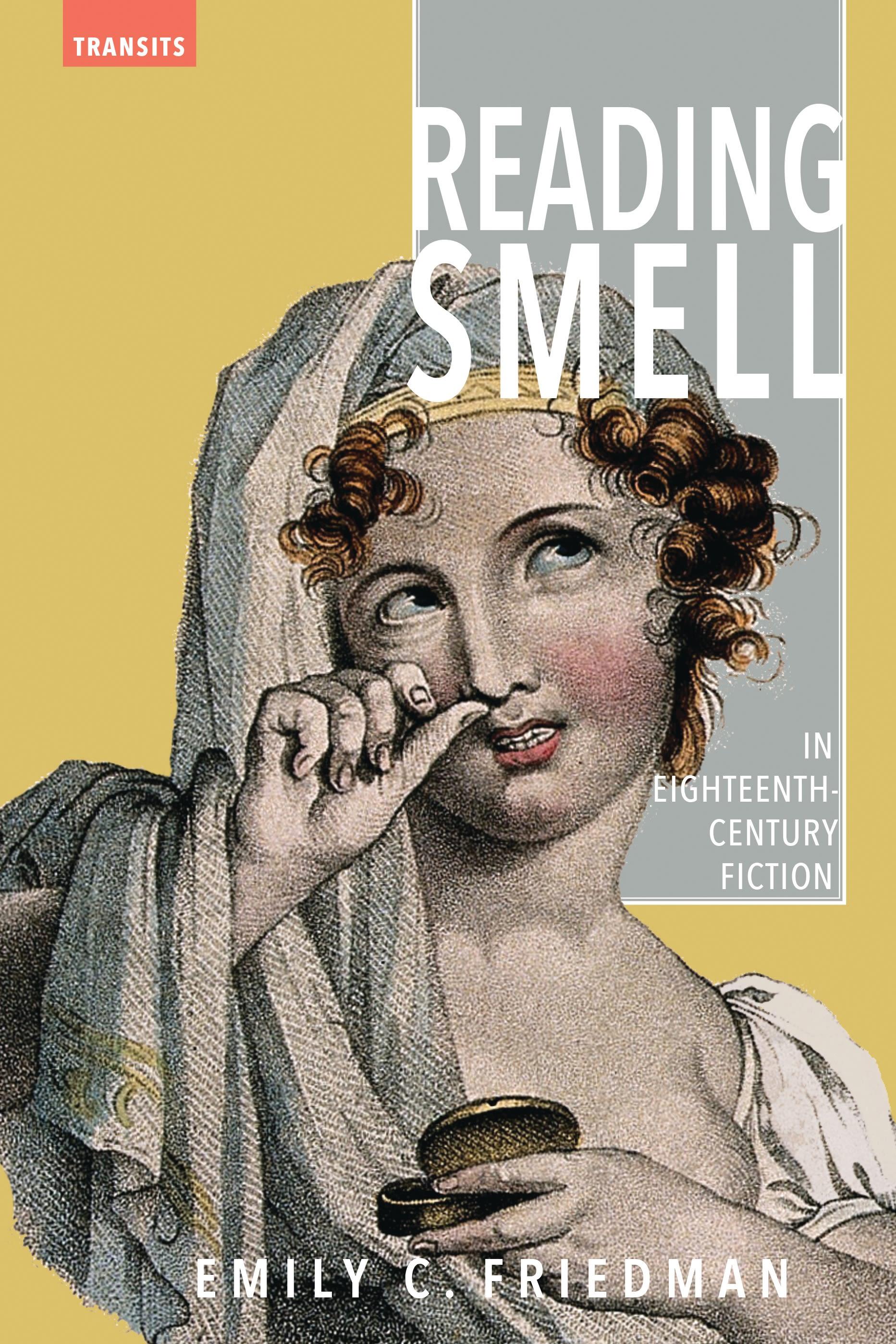
Scent is both an essential and seemingly impossible-to-recover aspect of material culture. Scent is one of our strongest ties to memory, yet to remember a smell without external stimuli is almost impossible for most people. Moreover, human beings’ (specifically Western humans) ability to smell has been diminished through a process of increased emphasis on odor-removal, hygienic practices that emphasize de-odorization (rather than the covering of one odor by another).While other intangibles of the human experience have been placed into the context of the eighteenth-century novel, scent has so far remained largely sidelined in favor of discussions of the visual, the aural, touch, and taste. The past decade has seen a great expansion of our understanding of how smell works physiologically, psychologically, and culturally, and there is no better moment than now to attempt to recover the traces of olfactory perceptions, descriptions, and assumptions.
Reading Smell provides models for how to incorporate olfactory knowledge into new readings of the literary form central to our understanding of the eighteenth century and modernity in general: the novel. The multiplication and development of the novel overlaps strikingly with changes in personal and private hygienic practices that would alter the culture’s relationship to smell. This book examines how far the novel can be understood through a reintroduction of olfactory information. After decades of reading for all kinds of racial, cultural, gendered, and other sorts of absences back into the novel, this book takes one step further: to consider how the recovery of forgotten or overlooked olfactory assumptions might reshape our understanding of these texts. Reading Smell includes wide-scale research and focused case studies of some of the most striking or prevalent uses of olfactory language in eighteenth-century British prose fiction. Highlighting scents with shifting meanings across the period: bodies, tobacco, smelling-bottles, and sulfur, Reading Smell not only provides new insights into canonical works by authors like Swift, Smollett, Richardson, Burney, Austen, and Lewis, but also sheds new light on the history of the British novel as a whole.
Reading Smell provides models for how to incorporate olfactory knowledge into new readings of the literary form central to our understanding of the eighteenth century and modernity in general: the novel. The multiplication and development of the novel overlaps strikingly with changes in personal and private hygienic practices that would alter the culture’s relationship to smell. This book examines how far the novel can be understood through a reintroduction of olfactory information. After decades of reading for all kinds of racial, cultural, gendered, and other sorts of absences back into the novel, this book takes one step further: to consider how the recovery of forgotten or overlooked olfactory assumptions might reshape our understanding of these texts. Reading Smell includes wide-scale research and focused case studies of some of the most striking or prevalent uses of olfactory language in eighteenth-century British prose fiction. Highlighting scents with shifting meanings across the period: bodies, tobacco, smelling-bottles, and sulfur, Reading Smell not only provides new insights into canonical works by authors like Swift, Smollett, Richardson, Burney, Austen, and Lewis, but also sheds new light on the history of the British novel as a whole.
Paga fácilmente con tarjeta, Klarna, Apple Pay o Google Pay. ¿No estás contento? Siempre tienes 14 días de garantía de devolución. Lee más en nuestros términos. Si tienes preguntas, escríbenos a hello@memmo.org.
Memmo hace que estudiar sea más fácil, estés donde estés. Aquí tienes tus libros de texto y herramientas de estudio inteligentes en un solo lugar: resúmenes, quizzes, podcasts y flashcards. Y también a Ted, tu compañero de estudio que responde a todo lo que te preguntes. Más de 50 000 estudiantes ya estudian aquí. Está hecho para que aprendas más rápido y te estreses menos.