
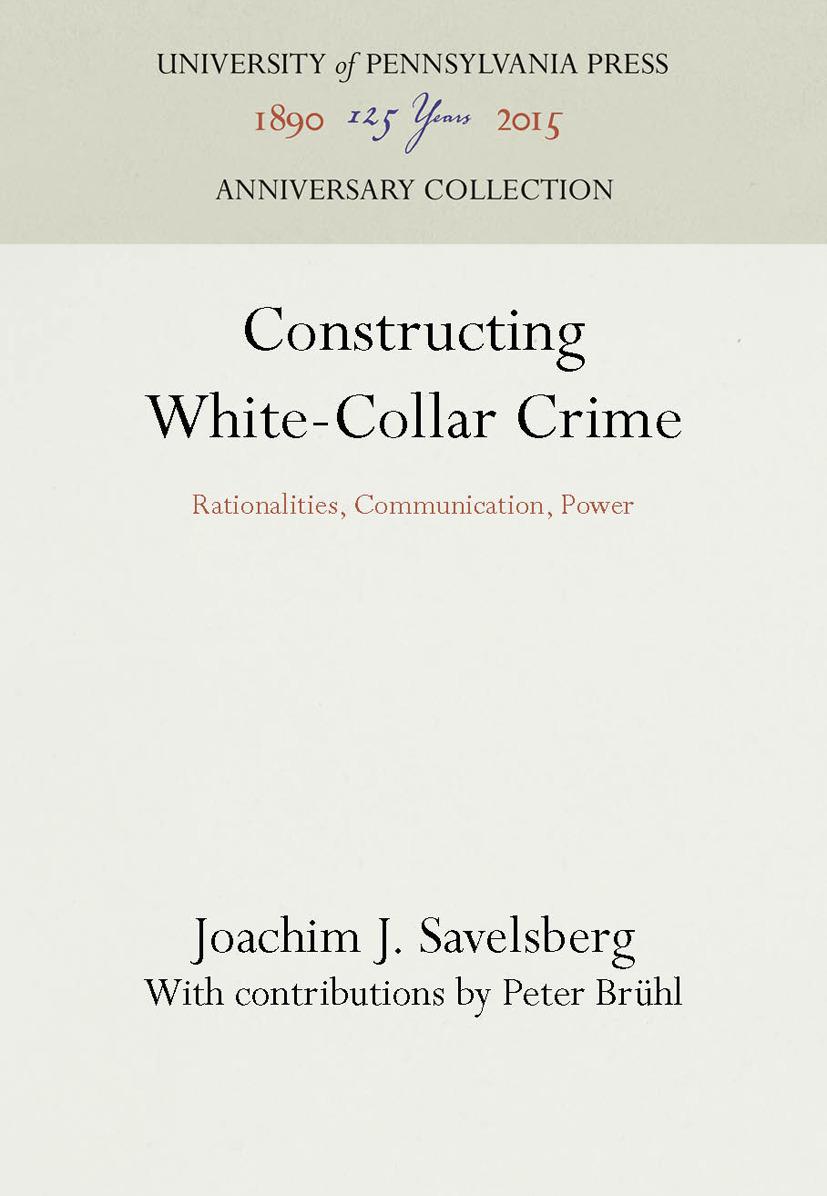
Criminal law norms are socially derived, being constructed in political processes, but only recently has criminological research began to focus on the political construction of criminal law. There has been increasing interest in the quality of these political processes, the decisions that result, and the rationales and social forces guiding these decisions.
In Constructing White-Collar Crime, Joachim J. Savelsberg, a sociologist, and Peter Brühl, a lawyer, have provided an interdisciplinary case study of the construction of new German laws against white-collar crime, relating their results to internationally comparative findings. The analysis is empirical; it is theoretically grounded in a sociological approach that contrasts Marxist versus pluralist or differentiation theory, and functionalist versus conflict group or action theory. The authors also analyze their findings in relation to Max Weber's theory of rationalization of law. In addition the research is methodologically innovative, introducing the technique of cognitive mapping into the study of criminal justice legislation. The book represents the authors' attempts to bridge the gap between microsociological and macrosociological approaches to the construction of criminal law.
The authors analyze action rationales, communication patterns, and power structures as they play out in different stages of the law-making process: claims-making in news media; participation of scholars and practitioners in an expert commission and in parliamentary hearings; involvement of industrial lobbying groups during the drafting of the bill in the Department of Justice; and parliamentary deliberations. The analysis demonstrates the considerable weight of economic and political rationales as opposed to justice criteria in the development of criminal legislation. It also indicates that white-collar crime legislation may have counterproductive consequences. The laws are intended to increase the quality of criminal justice by criminalizing the behavior of the powerful, but the less powerful groups within the white-collar classes are more likely to feel the effects.
Constructing White-Collar Crime will be of interest to students and scholars in the areas of sociology, law, and criminology.
Paga fácilmente con tarjeta, Klarna, Apple Pay o Google Pay. ¿No estás contento? Siempre tienes 14 días de garantía de devolución. Lee más en nuestros términos. Si tienes preguntas, escríbenos a hello@memmo.org.
Memmo hace que estudiar sea más fácil, estés donde estés. Aquí tienes tus libros de texto y herramientas de estudio inteligentes en un solo lugar: resúmenes, quizzes, podcasts y flashcards. Y también a Ted, tu compañero de estudio que responde a todo lo que te preguntes. Más de 50 000 estudiantes ya estudian aquí. Está hecho para que aprendas más rápido y te estreses menos.