
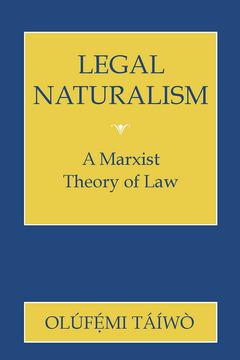
Legal Naturalism advances a clear and convincing case that Marx's theory of law is a form of natural law jurisprudence. It explicates both Marx's writings and the idea of natural law, and makes a forceful contribution to current debates on the foundations of law. Olufemi Taiwo argues that embedded in the corpus of Marxist writing is a plausible, adequate, and coherent legal theory. He describes Marx's general concept of law, which he calls "legal naturalism." For Marxism, natural law isn't a permanent verity; it refers to the basic law of a given epoch or social formation which is an essential aspect of its mode of production. Capitalist law is thus natural law in a capitalist society and is politically and morally progressive relative to the laws of preceding social formations.
Taiwo emphasizes that these formations are dialectical or dynamic, not merely static, so that the law which is naturally appropriate to a capitalist economy will embody tensions and contradictions that replicate the underlying conflicts of that economy. In addition, he discusses the enactment and reform of "positive law"—law established by government institutions—in a Marxian framework.
Paga fácilmente con tarjeta, Klarna, Apple Pay o Google Pay. ¿No estás contento? Siempre tienes 14 días de garantía de devolución. Lee más en nuestros términos. Si tienes preguntas, escríbenos a hello@memmo.org.
Memmo hace que estudiar sea más fácil, estés donde estés. Aquí tienes tus libros de texto y herramientas de estudio inteligentes en un solo lugar: resúmenes, quizzes, podcasts y flashcards. Y también a Ted, tu compañero de estudio que responde a todo lo que te preguntes. Más de 50 000 estudiantes ya estudian aquí. Está hecho para que aprendas más rápido y te estreses menos.