
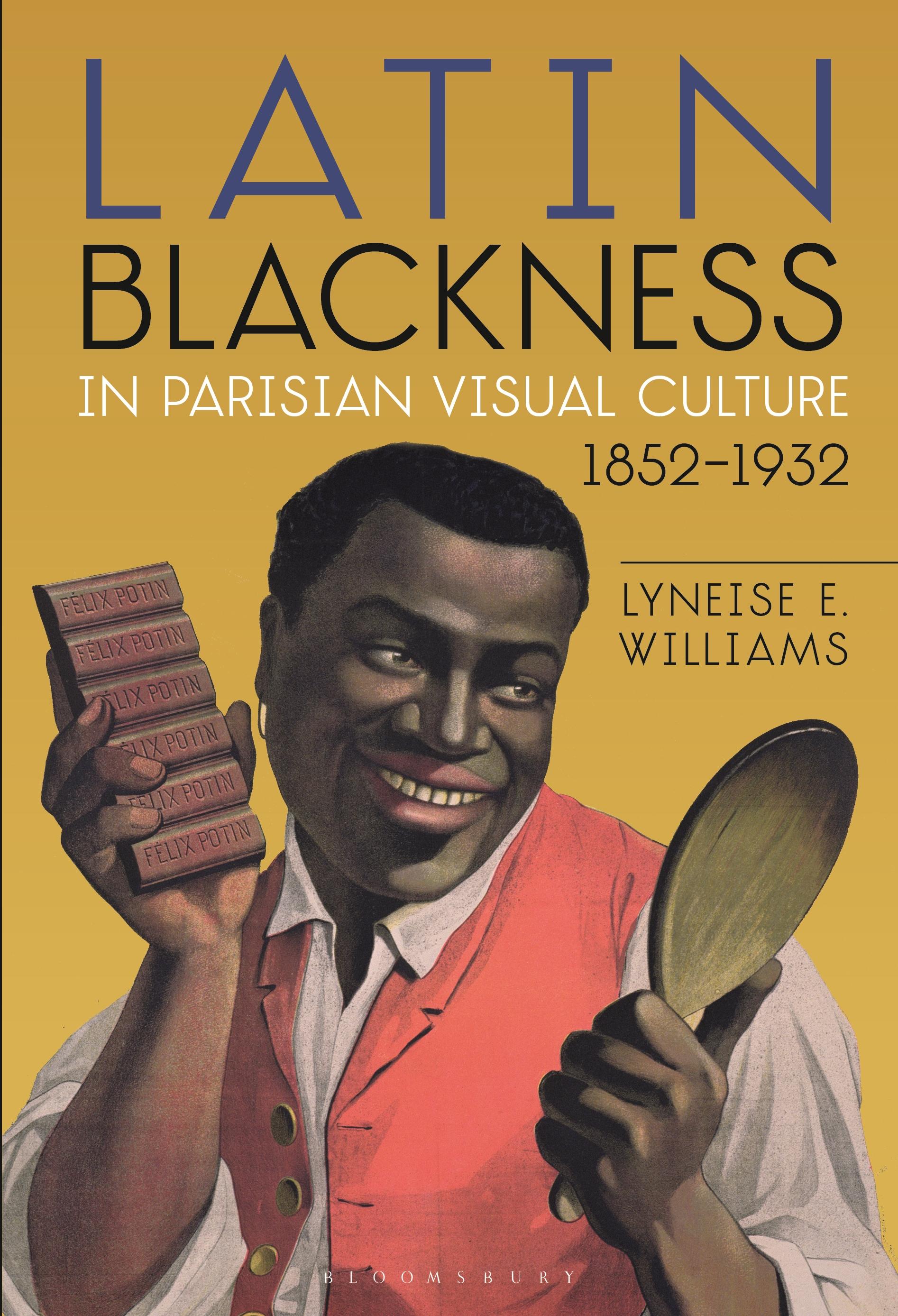
Latin Blackness in Parisian Visual Culture, 1852-1932 examines an understudied visual language used to portray Latin Americans in mid-19th to early 20th-century Parisian popular visual media. The term 'Latinize' is introduced to connect France's early 19th-century endeavors to create “Latin America,” an expansion of the French empire into the Latin-language based Spanish and Portuguese Americas, to its perception of this population.
Latin-American elites traveler to Paris in the 1840s from their newly independent nations were denigrated in representations rather than depicted as equals in a developing global economy. Darkened skin, etched onto images of Latin Americans of European descent mitigated their ability to claim the privileges of their ancestral heritage. Whitened skin, among other codes, imposed on turn-of-the-20th-century Black Latin Americans in Paris tempered their Blackness and rendered them relatively assimilatable compared to colonial Africans, Blacks from the Caribbean, and African Americans.
After identifying mid-to-late 19th-century Latinizing codes, the study focuses on shifts in latinizing visuality between 1890-1933 in three case studies: the depictions of popular Cuban circus entertainer Chocolat; representations of Panamanian World Bantamweight Champion boxer Alfonso Teofilo Brown; and paintings of Black Uruguayans executed by Pedro Figari, a Uruguayan artist, during his residence in Paris between 1925-1933.
Latin-American elites traveler to Paris in the 1840s from their newly independent nations were denigrated in representations rather than depicted as equals in a developing global economy. Darkened skin, etched onto images of Latin Americans of European descent mitigated their ability to claim the privileges of their ancestral heritage. Whitened skin, among other codes, imposed on turn-of-the-20th-century Black Latin Americans in Paris tempered their Blackness and rendered them relatively assimilatable compared to colonial Africans, Blacks from the Caribbean, and African Americans.
After identifying mid-to-late 19th-century Latinizing codes, the study focuses on shifts in latinizing visuality between 1890-1933 in three case studies: the depictions of popular Cuban circus entertainer Chocolat; representations of Panamanian World Bantamweight Champion boxer Alfonso Teofilo Brown; and paintings of Black Uruguayans executed by Pedro Figari, a Uruguayan artist, during his residence in Paris between 1925-1933.
Páginas: 232
Categoría: Kultur-, Genus- & Postkoloniala studier
e-ISBN: 9781501332364
Peso de envío: 1.2 kg
Envío en: 1-2 días
Paga fácilmente con tarjeta, Klarna, Apple Pay o Google Pay. ¿No estás contento? Siempre tienes 14 días de garantía de devolución. Lee más en nuestros términos. Si tienes preguntas, escríbenos a hello@memmo.org.
Memmo hace que estudiar sea más fácil, estés donde estés. Aquí tienes tus libros de texto y herramientas de estudio inteligentes en un solo lugar: resúmenes, quizzes, podcasts y flashcards. Y también a Ted, tu compañero de estudio que responde a todo lo que te preguntes. Más de 50 000 estudiantes ya estudian aquí. Está hecho para que aprendas más rápido y te estreses menos.