
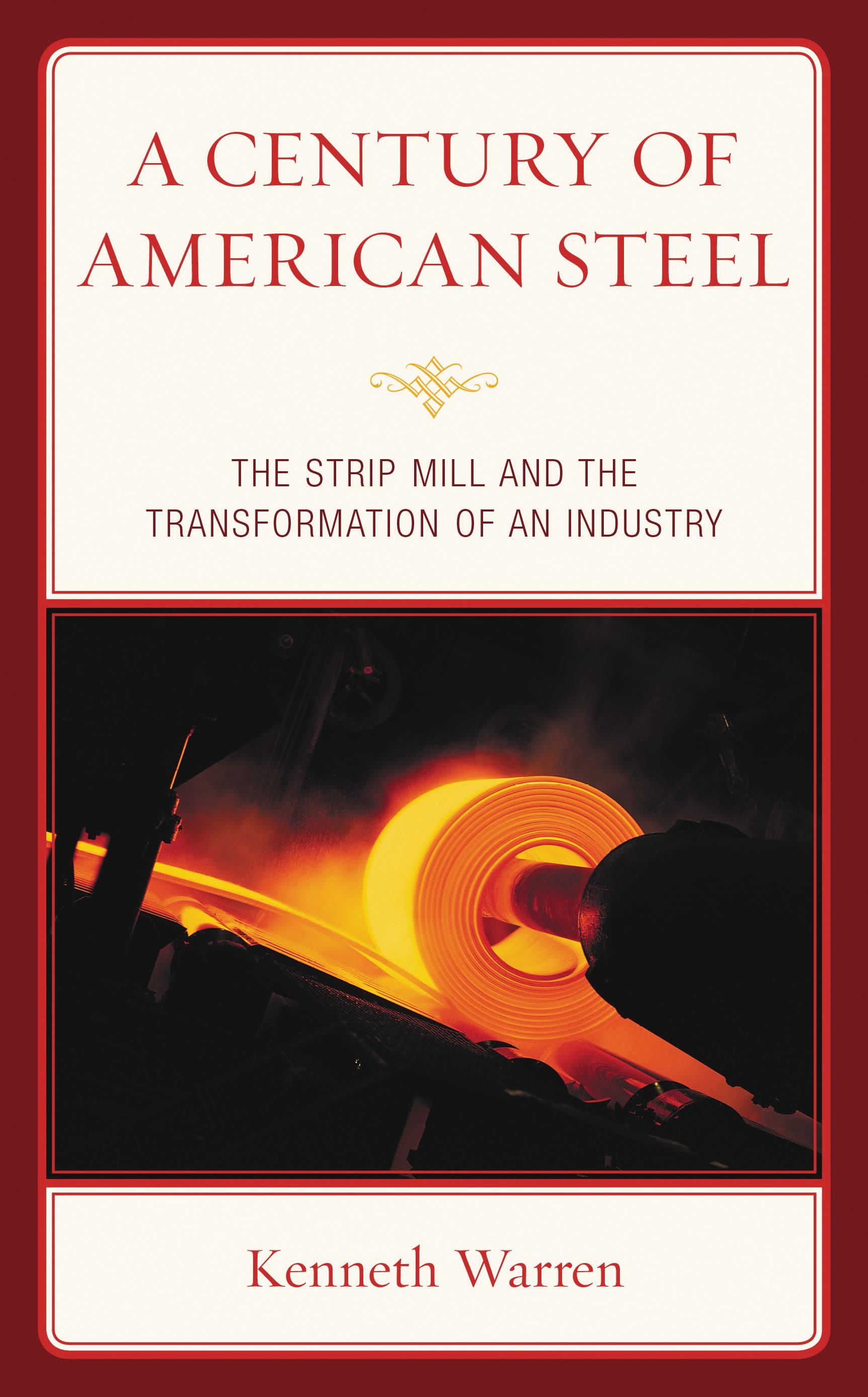
The steel industry provides much of the material basis for modern civilisation. Although its end products are numerous, the largest sector of the industry is involved in the production of wide strip. This is used by countless other industries to make a range of products from automobile bodies, and the cases of domestic appliances, to metal furniture and cans for the preservation of foodstuffs and drinks. A hundred years ago sheet steel was made in labor-intensive operations by a large number of small rolling mills. This is an account of how this relatively backward part of the industry was transformed by the invention and industrial application of a revolutionary new technology. In the hot strip mill a slab of steel was passed through a series of rolls to be reduced into a continuous band of wide strip, which was then shipped either as coils or cut into sheets.
The introduction of the wide continuous hot strip mill began to concentrate the sheet and tin plate industry into much bigger operations complete with iron making, steel works, rolling mills and finishing plant. New companies rose to prominence; some old industry leaders fell behind. Many former locations for sheet manufacture were abandoned, but other old plants and companies re-equipped and survived. Major producers of other products entered the new trade. Less than thirty years ago another major change began when electric arc steel furnace operators began to install strip mills and the trade of the now rather inappropriately named `mini-mill` grew rapidly at the expense of the longer established iron—open hearth steel—primary rolling mill—strip mill industry. Now, as its centenary approaches, the strip mill sector is still undergoing major changes. This book surveys the growth, structure and changes in this dominant part of the steel industry. The strip mill has transformed steel world-wide, but in its origins and development it has above all been a distinctively American achievement.
The introduction of the wide continuous hot strip mill began to concentrate the sheet and tin plate industry into much bigger operations complete with iron making, steel works, rolling mills and finishing plant. New companies rose to prominence; some old industry leaders fell behind. Many former locations for sheet manufacture were abandoned, but other old plants and companies re-equipped and survived. Major producers of other products entered the new trade. Less than thirty years ago another major change began when electric arc steel furnace operators began to install strip mills and the trade of the now rather inappropriately named `mini-mill` grew rapidly at the expense of the longer established iron—open hearth steel—primary rolling mill—strip mill industry. Now, as its centenary approaches, the strip mill sector is still undergoing major changes. This book surveys the growth, structure and changes in this dominant part of the steel industry. The strip mill has transformed steel world-wide, but in its origins and development it has above all been a distinctively American achievement.
Paga fácilmente con tarjeta, Klarna, Apple Pay o Google Pay. ¿No estás contento? Siempre tienes 14 días de garantía de devolución. Lee más en nuestros términos. Si tienes preguntas, escríbenos a hello@memmo.org.
Memmo hace que estudiar sea más fácil, estés donde estés. Aquí tienes tus libros de texto y herramientas de estudio inteligentes en un solo lugar: resúmenes, quizzes, podcasts y flashcards. Y también a Ted, tu compañero de estudio que responde a todo lo que te preguntes. Más de 50 000 estudiantes ya estudian aquí. Está hecho para que aprendas más rápido y te estreses menos.