
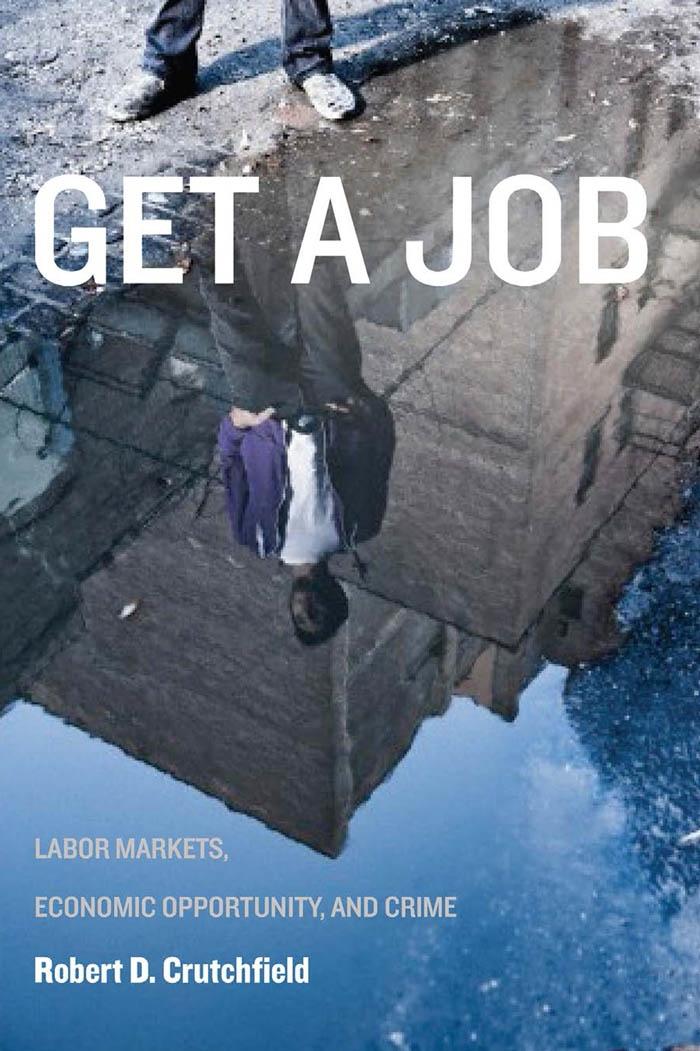
Are the unemployed more likely to commit crimes? Does having a job make one less likely to commit a crime? Criminologists have found that individuals who are marginalized from the labor market are more likely to commit crimes, and communities with more members who are marginal to the labor market have higher rates of crime. Yet, as Robert Crutchfield explains, contrary to popular expectations, unemployment has been found to be an inconsistent predictor of either individual criminality or collective crime rates. In Get a Job, Crutchfield offers a carefully nuanced understanding of the links among work, unemployment, and crime.
Crutchfield explains how people’s positioning in the labor market affects their participation in all kinds of crimes, from violent acts to profit-motivated offenses such as theft and drug trafficking. Crutchfield also draws on his first-hand knowledge of growing up in a poor, black neighborhood in Pittsburgh and later working on the streets as a parole officer, enabling him to develop a more complete understanding of how work and crime are related and both contribute to, and are a result of, social inequalities and disadvantage. Well-researched and informative, Get a Job tells a powerful story of one of the most troubling side effects of economic disparities in America.
Paga fácilmente con tarjeta, Klarna, Apple Pay o Google Pay. ¿No estás contento? Siempre tienes 14 días de garantía de devolución. Lee más en nuestros términos. Si tienes preguntas, escríbenos a hello@memmo.org.
Memmo hace que estudiar sea más fácil, estés donde estés. Aquí tienes tus libros de texto y herramientas de estudio inteligentes en un solo lugar: resúmenes, quizzes, podcasts y flashcards. Y también a Ted, tu compañero de estudio que responde a todo lo que te preguntes. Más de 50 000 estudiantes ya estudian aquí. Está hecho para que aprendas más rápido y te estreses menos.