
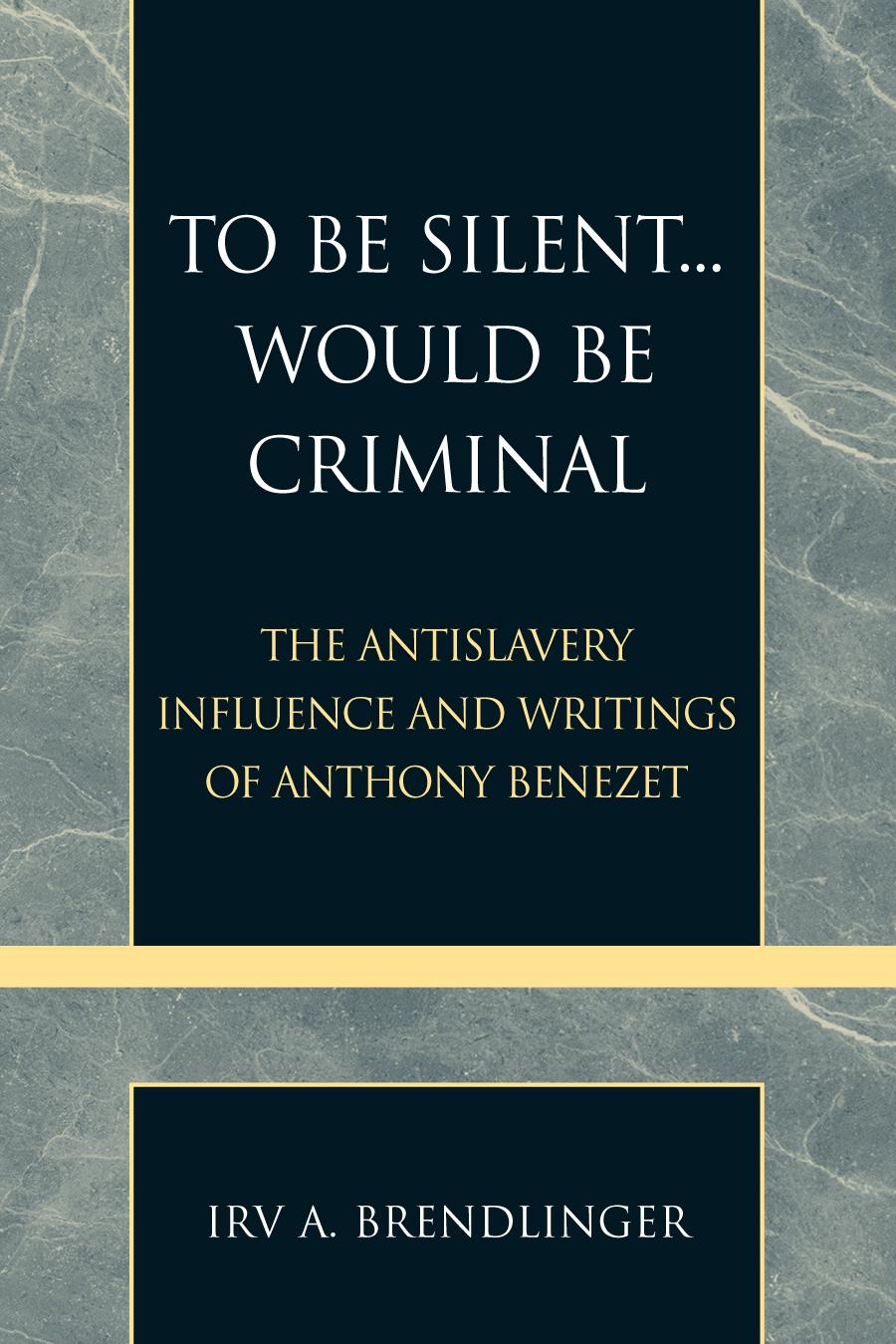
Born in 1713 of French Huguenot stock, Philadelphia Quaker Anthony Benezet was probably the most significant force in advancing the cause against slavery and the African slave trade in the eighteenth century. However, while abolitionists like Granville Sharp, William Wilberforce, Thomas Clarkson, and John Wesley are familiar, the name "Benezet" is hardly recognized. And yet, it was his work that reinforced Sharp's legal battles, his tracts that singularly influenced both Wesley and Clarkson to join the cause, and his friendship with Benjamin Franklin that led to Franklin leading the American antislavery society after Benezet's death.
To Be Silent... Would Be Criminal introduces the development of antislavery activity in America and then traces the life of Benezet, examining both his work and influence on individuals, including Wesley, Sharp, Clarkson, and Franklin. Benezet's correspondence with these and other contemporaries is reproduced here, giving insight into his relationships and his desire to build a viable network to oppose slavery. It's from a letter Benezet wrote to Lady Huntingdon, the chief administer behind the Calvinistic wing of Methodism, that the title of this book is derived: "...where the lives & natural as well as religious welfare of so vast a number of our Fellow Creatures is concerned, to be Silent, where we apprehend it a duty to speak our sense of that which causes us to go mourning on our way, would be criminal." With one exception, all of Benezet's antislavery tracts, which are otherwise available only in special archives, are replicated in full within the book, further demonstrating Benezet's uniquely significant role in the eventual victory over slavery.
To Be Silent... Would Be Criminal introduces the development of antislavery activity in America and then traces the life of Benezet, examining both his work and influence on individuals, including Wesley, Sharp, Clarkson, and Franklin. Benezet's correspondence with these and other contemporaries is reproduced here, giving insight into his relationships and his desire to build a viable network to oppose slavery. It's from a letter Benezet wrote to Lady Huntingdon, the chief administer behind the Calvinistic wing of Methodism, that the title of this book is derived: "...where the lives & natural as well as religious welfare of so vast a number of our Fellow Creatures is concerned, to be Silent, where we apprehend it a duty to speak our sense of that which causes us to go mourning on our way, would be criminal." With one exception, all of Benezet's antislavery tracts, which are otherwise available only in special archives, are replicated in full within the book, further demonstrating Benezet's uniquely significant role in the eventual victory over slavery.
Paga fácilmente con tarjeta, Klarna, Apple Pay o Google Pay. ¿No estás contento? Siempre tienes 14 días de garantía de devolución. Lee más en nuestros términos. Si tienes preguntas, escríbenos a hello@memmo.org.
Memmo hace que estudiar sea más fácil, estés donde estés. Aquí tienes tus libros de texto y herramientas de estudio inteligentes en un solo lugar: resúmenes, quizzes, podcasts y flashcards. Y también a Ted, tu compañero de estudio que responde a todo lo que te preguntes. Más de 50 000 estudiantes ya estudian aquí. Está hecho para que aprendas más rápido y te estreses menos.