
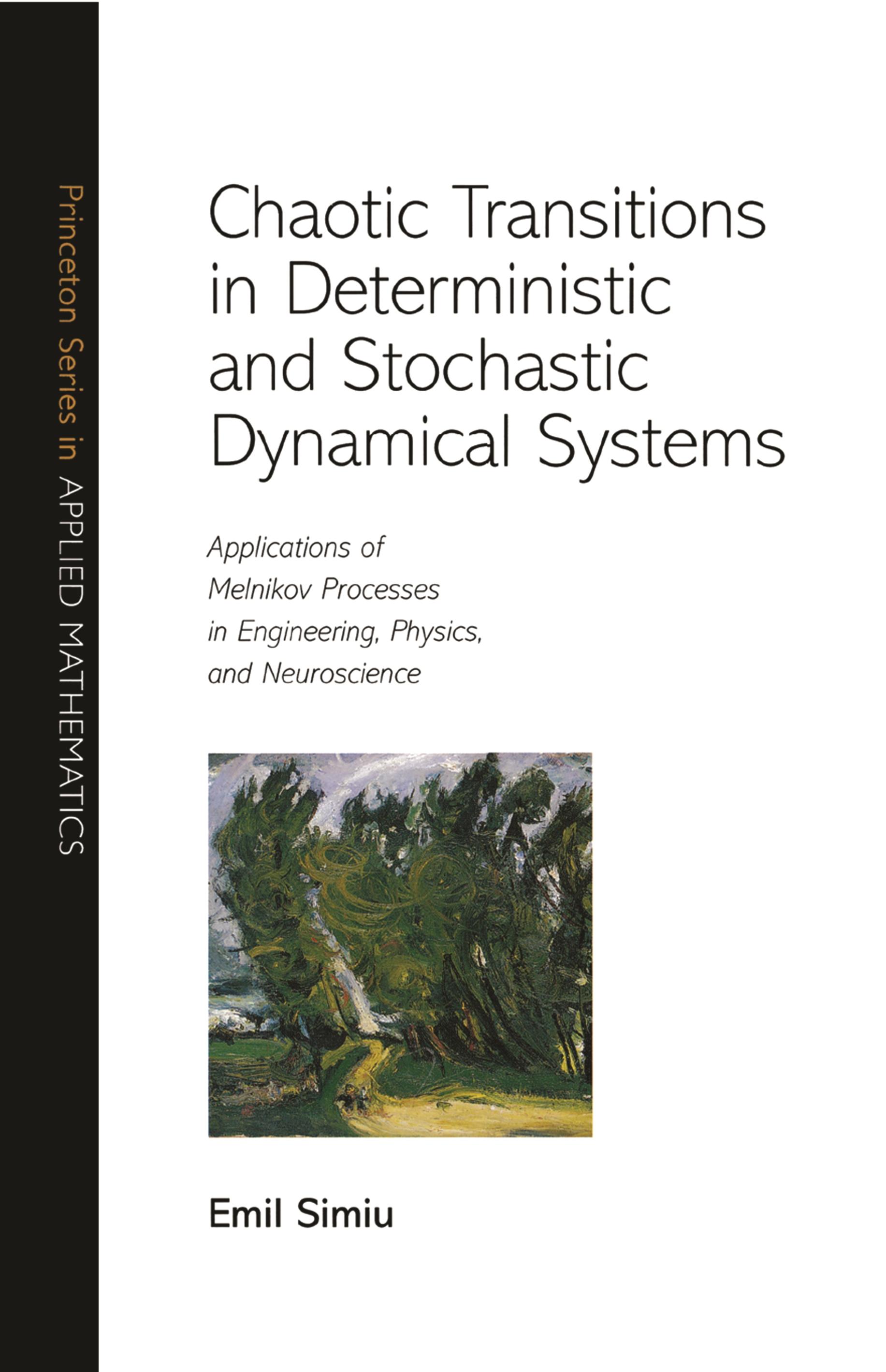
The classical Melnikov method provides information on the behavior of deterministic planar systems that may exhibit transitions, i.e. escapes from and captures into preferred regions of phase space. This book develops a unified treatment of deterministic and stochastic systems that extends the applicability of the Melnikov method to physically realizable stochastic planar systems with additive, state-dependent, white, colored, or dichotomous noise. The extended Melnikov method yields the novel result that motions with transitions are chaotic regardless of whether the excitation is deterministic or stochastic. It explains the role in the occurrence of transitions of the characteristics of the system and its deterministic or stochastic excitation, and is a powerful modeling and identification tool.
The book is designed primarily for readers interested in applications. The level of preparation required corresponds to the equivalent of a first-year graduate course in applied mathematics. No previous exposure to dynamical systems theory or the theory of stochastic processes is required. The theoretical prerequisites and developments are presented in the first part of the book. The second part of the book is devoted to applications, ranging from physics to mechanical engineering, naval architecture, oceanography, nonlinear control, stochastic resonance, and neurophysiology.
Paga fácilmente con tarjeta, Klarna, Apple Pay o Google Pay. ¿No estás contento? Siempre tienes 14 días de garantía de devolución. Lee más en nuestros términos. Si tienes preguntas, escríbenos a hello@memmo.org.
Memmo hace que estudiar sea más fácil, estés donde estés. Aquí tienes tus libros de texto y herramientas de estudio inteligentes en un solo lugar: resúmenes, quizzes, podcasts y flashcards. Y también a Ted, tu compañero de estudio que responde a todo lo que te preguntes. Más de 50 000 estudiantes ya estudian aquí. Está hecho para que aprendas más rápido y te estreses menos.