
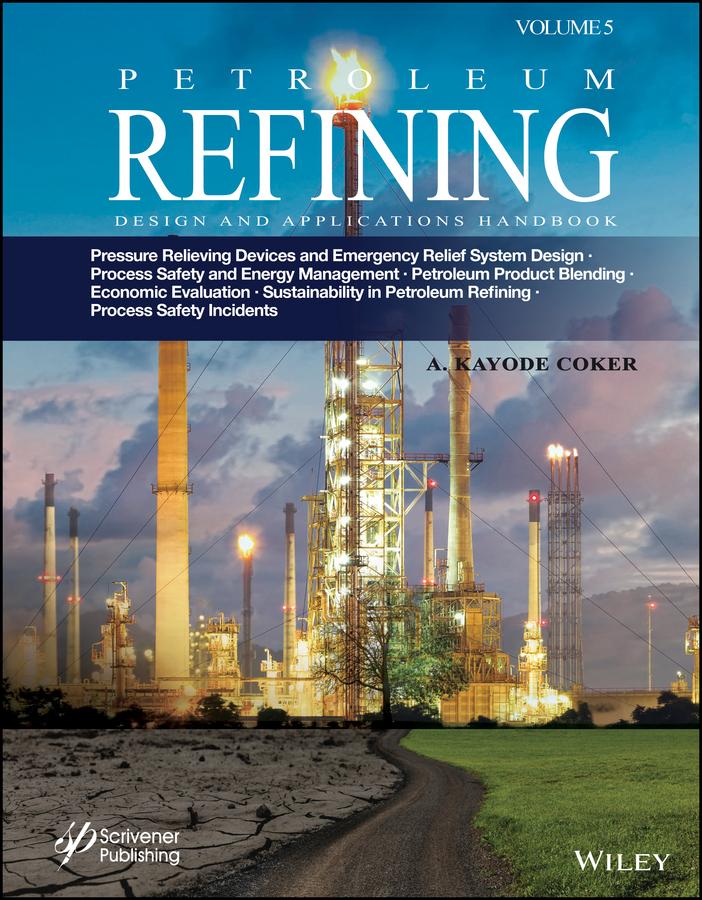
With no new refineries having been built in decades, companies continue to build onto or reverse engineer and re-tool existing refineries. With so many changes in the last few years alone, books like this are very much in need. There is truly a renaissance for chemical and process engineering going on right now across multiple industries.
This fifth and final volume in the “Petroleum Refining Design and Applications Handbook” set, this book continues the most up-to-date and comprehensive coverage of the most significant and recent changes to petroleum refining, presenting the state-of-the-art to the engineer, scientist, or student.
Besides the list below, this groundbreaking new volume describes blending of products from the refinery, applying the ternary diagrams and classifications of crude oils, flash point blending, pour point blending, aniline point blending, smoke point and viscosity blending, cetane and diesel indices. The volume further reviews refinery operational cost, cost allocation of actual usage, project and economic evaluation involving cost estimation, cash flow involving return on investment, net present values, discounted cash flow rate of return, net present values, payback period, inflation and sensitivity analysis, and so on. It reviews global effects on the refining economy, carbon tax, carbon foot print, global warming potential, carbon dioxide equivalent, carbon credit, carbon offset, carbon price, and so on. It reviews sustainability in petroleum refining and alternative fuels (biofuels and so on), impact of the overall greenhouse effects, carbon capture and storage in refineries, process intensification in biodiesel, biofuel from green diesel, acid-gas removal and emerging technologies, carbon capture and storage, gas heated reformer unit, pressure swing adsorption process, steam methane reforming for fuel cells, grey, blue and green hydrogen production, new technologies for carbon capture and storage, carbon clean process design, refinery of the future, refining and petrochemical industry characteristics. The text is packed with Excel spreadsheet calculations and Honeywell UniSim Design software in some examples, and it includes an invaluable glossary of petroleum and petrochemical technical terminologies.
Useful as a textbook, this is also an excellent, handy go-to reference for the veteran engineer, a volume no chemical or process engineering library should be without. Written by one of the world’s foremost authorities, this book sets the standard for the industry and is an integral part of the petroleum refining renaissance. It is truly a must-have for any practicing engineer or student in this area.
Paga fácilmente con tarjeta, Klarna, Apple Pay o Google Pay. ¿No estás contento? Siempre tienes 14 días de garantía de devolución. Lee más en nuestros términos. Si tienes preguntas, escríbenos a hello@memmo.org.
Memmo hace que estudiar sea más fácil, estés donde estés. Aquí tienes tus libros de texto y herramientas de estudio inteligentes en un solo lugar: resúmenes, quizzes, podcasts y flashcards. Y también a Ted, tu compañero de estudio que responde a todo lo que te preguntes. Más de 50 000 estudiantes ya estudian aquí. Está hecho para que aprendas más rápido y te estreses menos.