
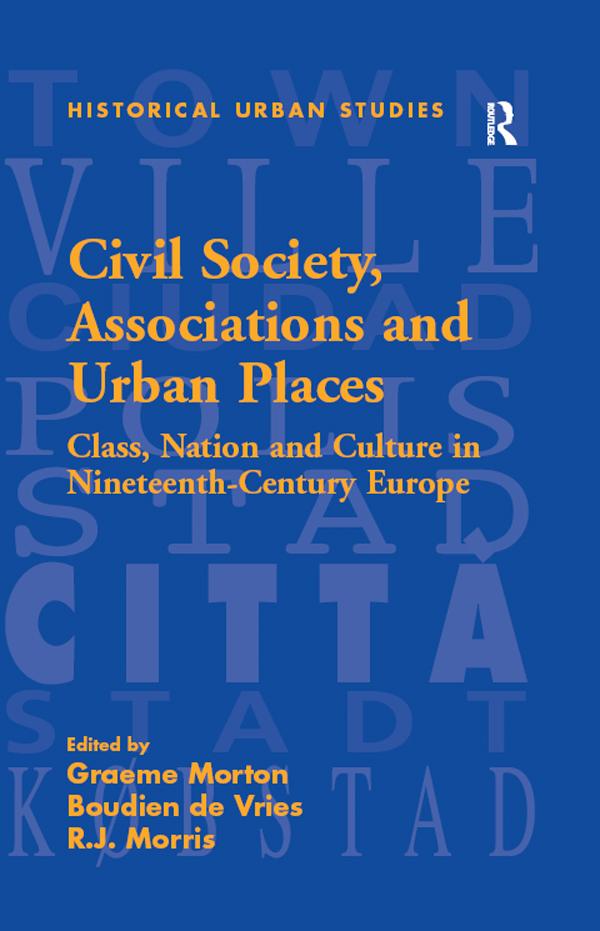
In recent years the concept of 'civil society' has become central to the historian's understanding of class, cultural and political power in the nineteenth-century town and city. Increasingly clubs and voluntary societies have been regarded as an important step in the formation of formal political parties, particularly for the working and middle classes. The result of this is the assertion that the more associations existing in a particular society, the deeper democracy becomes entrenched. In order to test this hypothesis, this volume brings together essays by an international group of urban historians who examine the construction of civil society from associational activity in the urban place. From their studies, it soon becomes clear that such simple propositions do not adequately reflect the dynamics of nineteenth-century urban society and politics. Urban associations were ideological in purpose and deliberately discriminatory and as such set the boundaries of civil society. Thus competing and segmented associations were not only an indication of pluralism and strength, but also highlighted a fundamental weakness when faced down by the interests of the state. Through a wide array of urban associations in a broad range of settings, comprising Austria and Bratislava, France and Italy, the Netherlands, Austro-Hungary, England, Scotland and the US, this volume reflects on the construction of class, nation and culture in the associations of the nineteenth-century urban place. In so doing it shows that a deep and interlocking civil society does not automatically lead to a rise in democratic activity. Expansion of the networks of urban association could equally result in greater subdivision and to the fragmentation and isolation of certain groups. Partition as much as coherence is our understanding of civil society and associations in the nineteenth-century urban place.
Paga fácilmente con tarjeta, Klarna, Apple Pay o Google Pay. ¿No estás contento? Siempre tienes 14 días de garantía de devolución. Lee más en nuestros términos. Si tienes preguntas, escríbenos a hello@memmo.org.
Memmo hace que estudiar sea más fácil, estés donde estés. Aquí tienes tus libros de texto y herramientas de estudio inteligentes en un solo lugar: resúmenes, quizzes, podcasts y flashcards. Y también a Ted, tu compañero de estudio que responde a todo lo que te preguntes. Más de 50 000 estudiantes ya estudian aquí. Está hecho para que aprendas más rápido y te estreses menos.
También te podría gustar
Comprar el libro0