
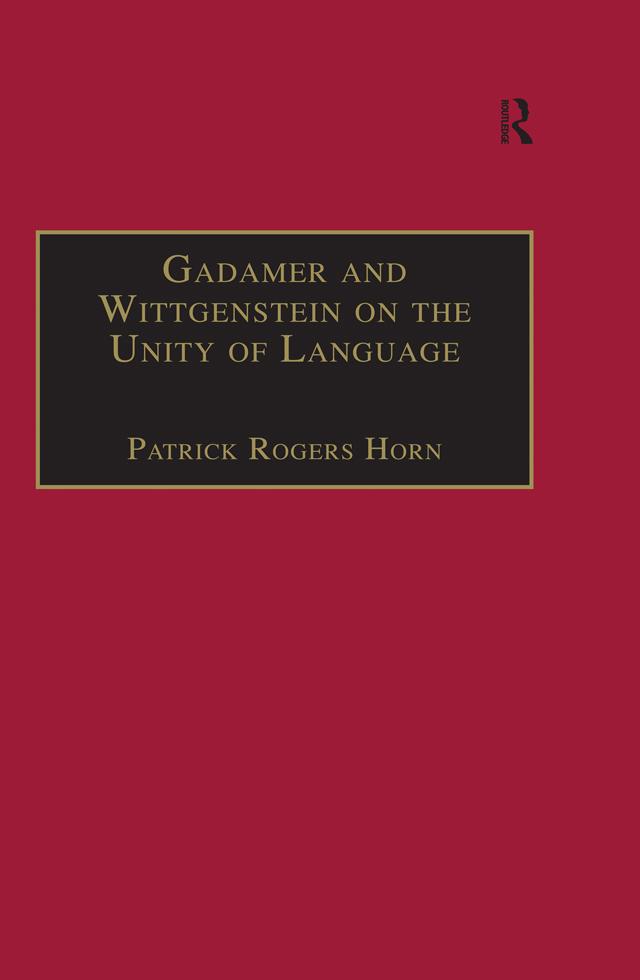
In this innovative comparison of Gadamer and Wittgenstein, the author explores their common concern with the relation of language to reality. Patrick Horn's starting point is the widely accepted view that both philosophers rejected a certain metaphysical account of that relation in which reality determines the nature of language. Horn proceeds to argue that Gadamer never completely escaped metaphysical assumptions in his search for the unity of language. In this respect, argues Horn, Gadamer's work is nearer to the earlier rather than to the later Wittgenstein. The final chapter of the book highlights the work of Wittgenstein’s pupil Rush Rhees, who shows that Wittgenstein's own later emphasis on language games, while doing justice to the variety of language, does less than justice to the dialogical relation between speakers of a language, wherein the unity of language resides. Contrasting Rhees's account of the unity of language with those given by Gadamer and the early Wittgenstein brings out the importance of understanding reality in terms of the life that people share rather than in terms of what philosophers say about reality.
Paga fácilmente con tarjeta, Klarna, Apple Pay o Google Pay. ¿No estás contento? Siempre tienes 14 días de garantía de devolución. Lee más en nuestros términos. Si tienes preguntas, escríbenos a hello@memmo.org.
Memmo hace que estudiar sea más fácil, estés donde estés. Aquí tienes tus libros de texto y herramientas de estudio inteligentes en un solo lugar: resúmenes, quizzes, podcasts y flashcards. Y también a Ted, tu compañero de estudio que responde a todo lo que te preguntes. Más de 50 000 estudiantes ya estudian aquí. Está hecho para que aprendas más rápido y te estreses menos.
También te podría gustar
Comprar el libro0