
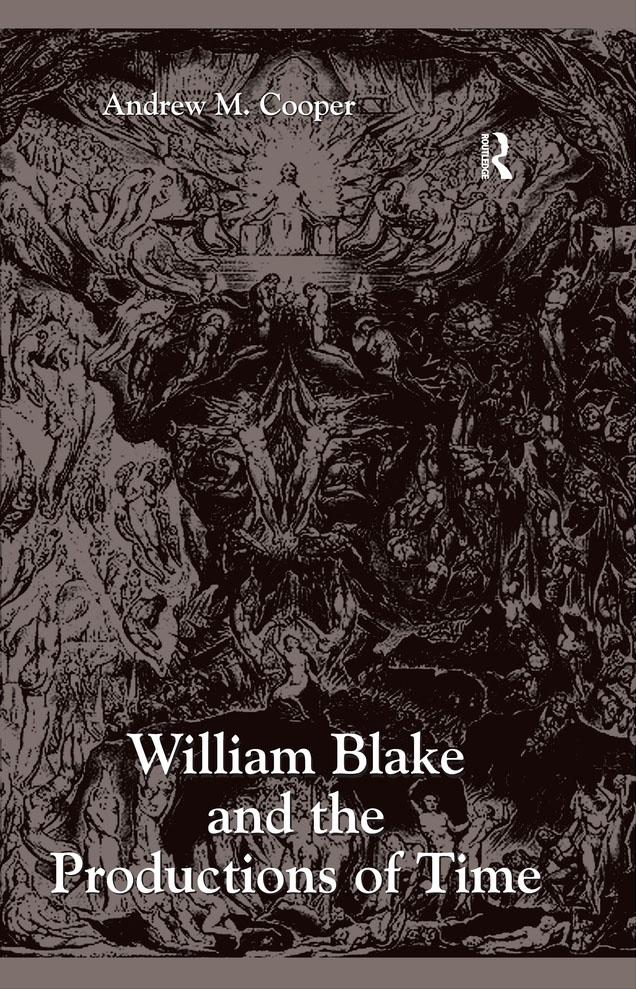
Challenging the idea that a writer’s work reflects his experiences in time and place, Andrew M. Cooper locates the action of William Blake’s major illuminated books in the ahistorical present, an impersonal spirit realm beyond the three-dimensional self. Blake, Cooper shows, was a formalist who exploited eighteenth-century scientific and philosophical research on vision, sense, and mind for spiritual purposes. Through irony, dialogism, two-way syntax, and synesthesia, Blake extended and refined the prophetic method Milton forged in Paradise Lost to bring the performativity of traditional oral song and storytelling into print. Cooper argues that historicist attempts to place Blake’s vision in perspective, as opposed to seeing it for oneself, involve a deeply self-contradictory denial of his performativity as a poet-artist. Rather, Blake’s expansion of linear reading into a space of creative, self-conscious collaboration laid the basis for his lifelong critique of dualism in religion and science, and anticipated the non-Euclidean geometrics of twentieth-century Modernism.
Páginas: 362
Categoría: Litteraturvetenskap & Teori
e-ISBN: 9781351872928
Peso de envío: 1.2 kg
Envío en: 1-2 días
Paga fácilmente con tarjeta, Klarna, Apple Pay o Google Pay. ¿No estás contento? Siempre tienes 14 días de garantía de devolución. Lee más en nuestros términos. Si tienes preguntas, escríbenos a hello@memmo.org.
Memmo hace que estudiar sea más fácil, estés donde estés. Aquí tienes tus libros de texto y herramientas de estudio inteligentes en un solo lugar: resúmenes, quizzes, podcasts y flashcards. Y también a Ted, tu compañero de estudio que responde a todo lo que te preguntes. Más de 50 000 estudiantes ya estudian aquí. Está hecho para que aprendas más rápido y te estreses menos.
También te podría gustar
Comprar el libro0