
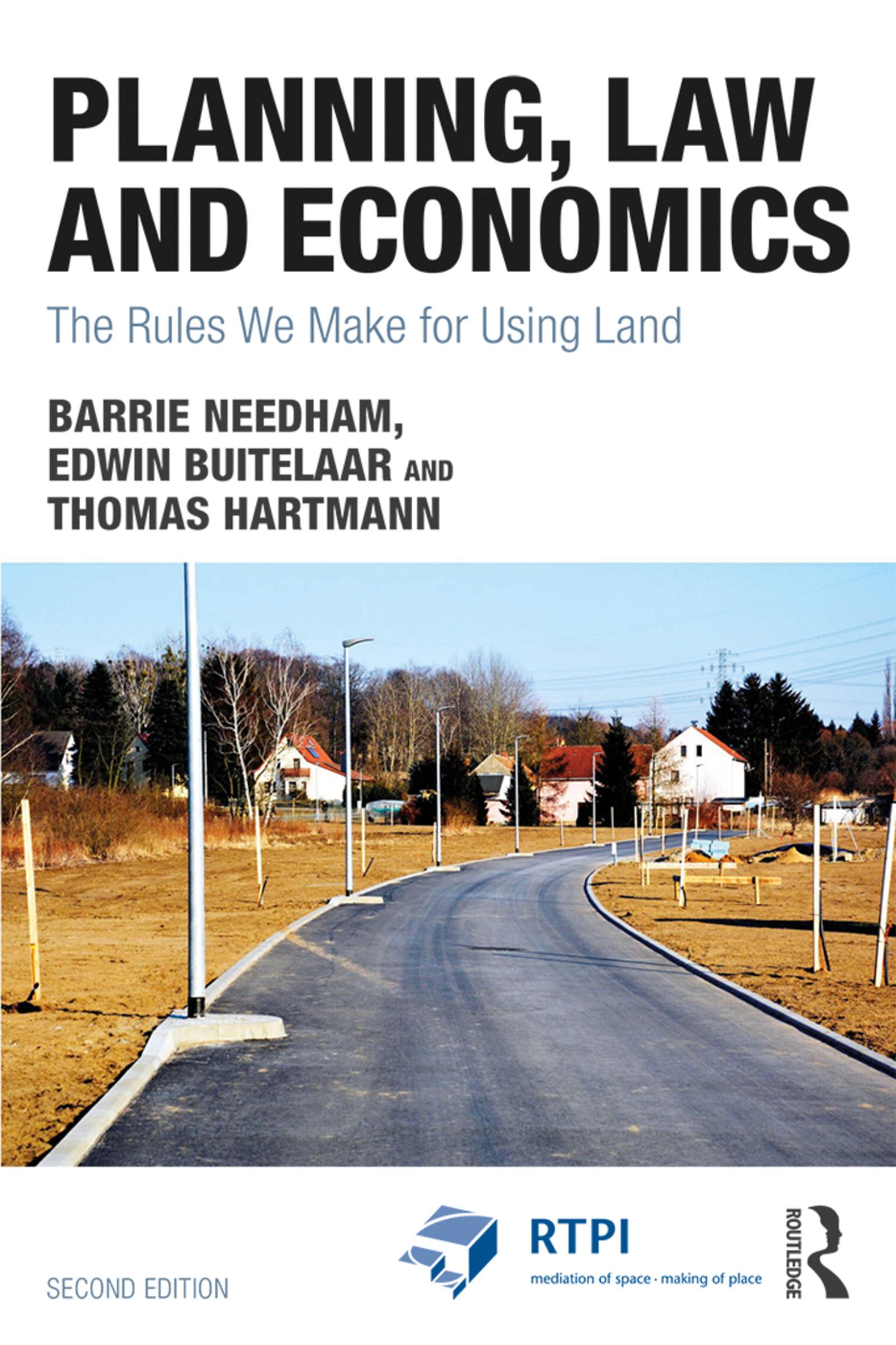
Planning, Law and Economics sets out a new framework for applying a legal approach to spatial planning, showing how to improve the practice and help achieve its aims. The book covers planning laws, citizens' rights and property rights, asking ‘What rules do we want to make and, where necessary, enforce? And how do we want to apply them in planning practice?’ This book sets out, in general and illustrated with concrete examples, how the three types of law mentioned above are unavoidably involved in all types of spatial planning. The book also makes clear that these laws can be combined in different ways, each way a particular approach to the practice of spatial planning (regulative planning, structuring markets, pro-active planning, collaborative planning, etc.).
Throughout, the book shows what legal approaches can be taken to spatial planning, and uses a four-part framework to evaluate the effects of choosing such an approach. The spatial planning should be effective, legitimate, morally just and economically sound. In particular the book details why the economic effects for society are important and how spatial planning affects how the economic resources of land and buildings are used. The book will be invaluable to students and planners to understand the relationship between their actions and the basic principles of the rule of law in a democratic, liberal society.
Paga fácilmente con tarjeta, Klarna, Apple Pay o Google Pay. ¿No estás contento? Siempre tienes 14 días de garantía de devolución. Lee más en nuestros términos. Si tienes preguntas, escríbenos a hello@memmo.org.
Memmo hace que estudiar sea más fácil, estés donde estés. Aquí tienes tus libros de texto y herramientas de estudio inteligentes en un solo lugar: resúmenes, quizzes, podcasts y flashcards. Y también a Ted, tu compañero de estudio que responde a todo lo que te preguntes. Más de 50 000 estudiantes ya estudian aquí. Está hecho para que aprendas más rápido y te estreses menos.