
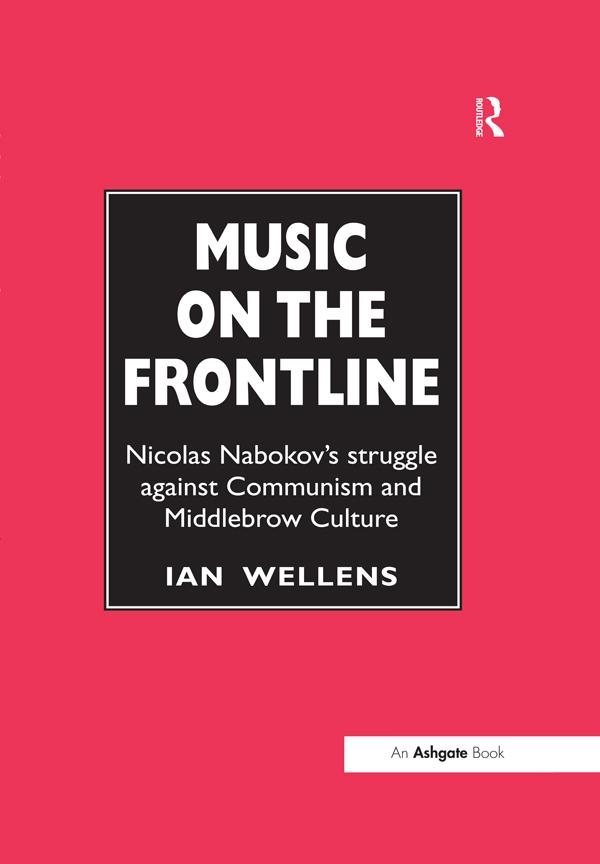
The story of Nicolas Nabokov's involvement with the CIA-funded Congress for Cultural Freedom (CCF) is a story of the politics and sociology of culture; how music was used for political ends and how intellectual groups formed and functioned during the Cold War. The seemingly independent CCF, established to counteract apparent Soviet successes in the fields of the arts and intellectual life, appointed Nabokov (a Russian emigre and minor composer) as its Secretary General in 1951.Over the next ten years he gave music a high profile in the work of the organisation, producing four international musical festivals, the first and most ambitious of which was 1952's L'Oeuvre du XXe siècle in Paris, an event which showcased the work of no less than 62 composers. As Ian Wellens reveals, Nabokov's musical involvement with the CCF was in fact a struggle on two fronts.Apparently a defence of Western modernism against 'backward', 'provincial' Soviet music, Nabokov's writings show this to have meshed closely with the domestic concern- shared by many intellectuals -that high culture was being undermined by an increasingly culturally aware middle class. His attacks on Soviet cultural policy, and his unflattering assessments of Shostakovich, are seen to be not merely salvos in the cold war but part of a broader campaign aimed at securing the authority and prestige of intellectuals.
Paga fácilmente con tarjeta, Klarna, Apple Pay o Google Pay. ¿No estás contento? Siempre tienes 14 días de garantía de devolución. Lee más en nuestros términos. Si tienes preguntas, escríbenos a hello@memmo.org.
Memmo hace que estudiar sea más fácil, estés donde estés. Aquí tienes tus libros de texto y herramientas de estudio inteligentes en un solo lugar: resúmenes, quizzes, podcasts y flashcards. Y también a Ted, tu compañero de estudio que responde a todo lo que te preguntes. Más de 50 000 estudiantes ya estudian aquí. Está hecho para que aprendas más rápido y te estreses menos.
También te podría gustar
Comprar el libro0