
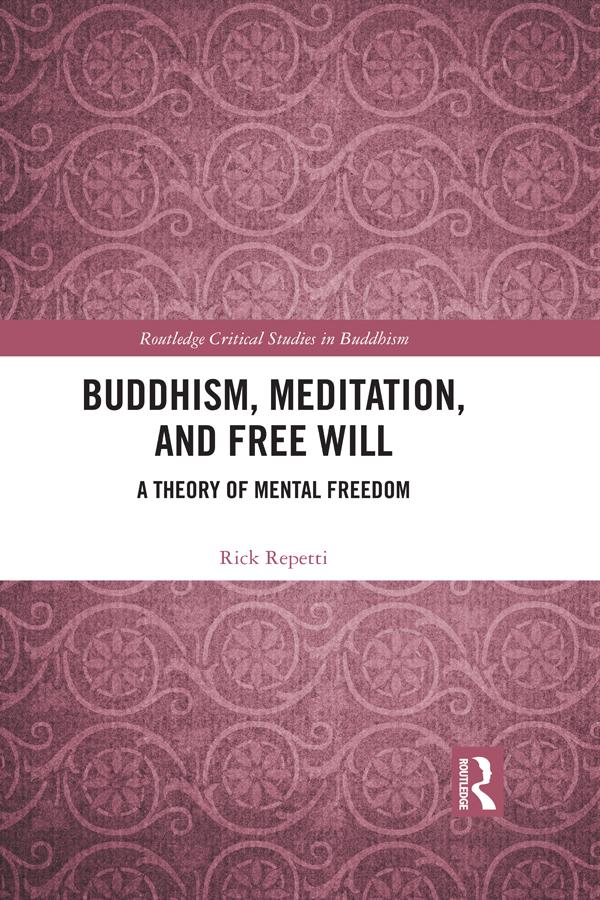
Traditionally, Buddhist philosophy has seemingly rejected the autonomous self. In Western philosophy, free will and the philosophy of action are established areas of research.
This book presents a comprehensive analytical review of extant scholarship on perspectives on free will. It studies and refutes the most powerful Western and Buddhist philosophical objections to free will and explores the possibility that a form of agency may in fact exist within Buddhism. Providing a detailed explanation of how Buddhist meditation increases self-regulative mind-control abilities, the author argues that the Buddhist path is designed to produce meditation virtuosos exhibiting mind-control abilities far exceeding the free-will advocate’s ability to ‘do otherwise’ or have their choices be ‘up to’ them. Based on the empirically-supported mind-control cultivated by these meditation virtuosos, the book proposes the principle of, ‘Buddhist Soft Compatibilism’, a theory of ‘freedom of the mind’ that entails freedoms of the will, attention, emotion and action, compatible with both determinism and indeterminism.
Buddhism, Meditation and Free Will will be of interest to Buddhist and Western philosophers and academics interested in comparative philosophy, free will, philosophy of action, metaphysics, ethics and Religious Studies.
Paga fácilmente con tarjeta, Klarna, Apple Pay o Google Pay. ¿No estás contento? Siempre tienes 14 días de garantía de devolución. Lee más en nuestros términos. Si tienes preguntas, escríbenos a hello@memmo.org.
Memmo hace que estudiar sea más fácil, estés donde estés. Aquí tienes tus libros de texto y herramientas de estudio inteligentes en un solo lugar: resúmenes, quizzes, podcasts y flashcards. Y también a Ted, tu compañero de estudio que responde a todo lo que te preguntes. Más de 50 000 estudiantes ya estudian aquí. Está hecho para que aprendas más rápido y te estreses menos.