
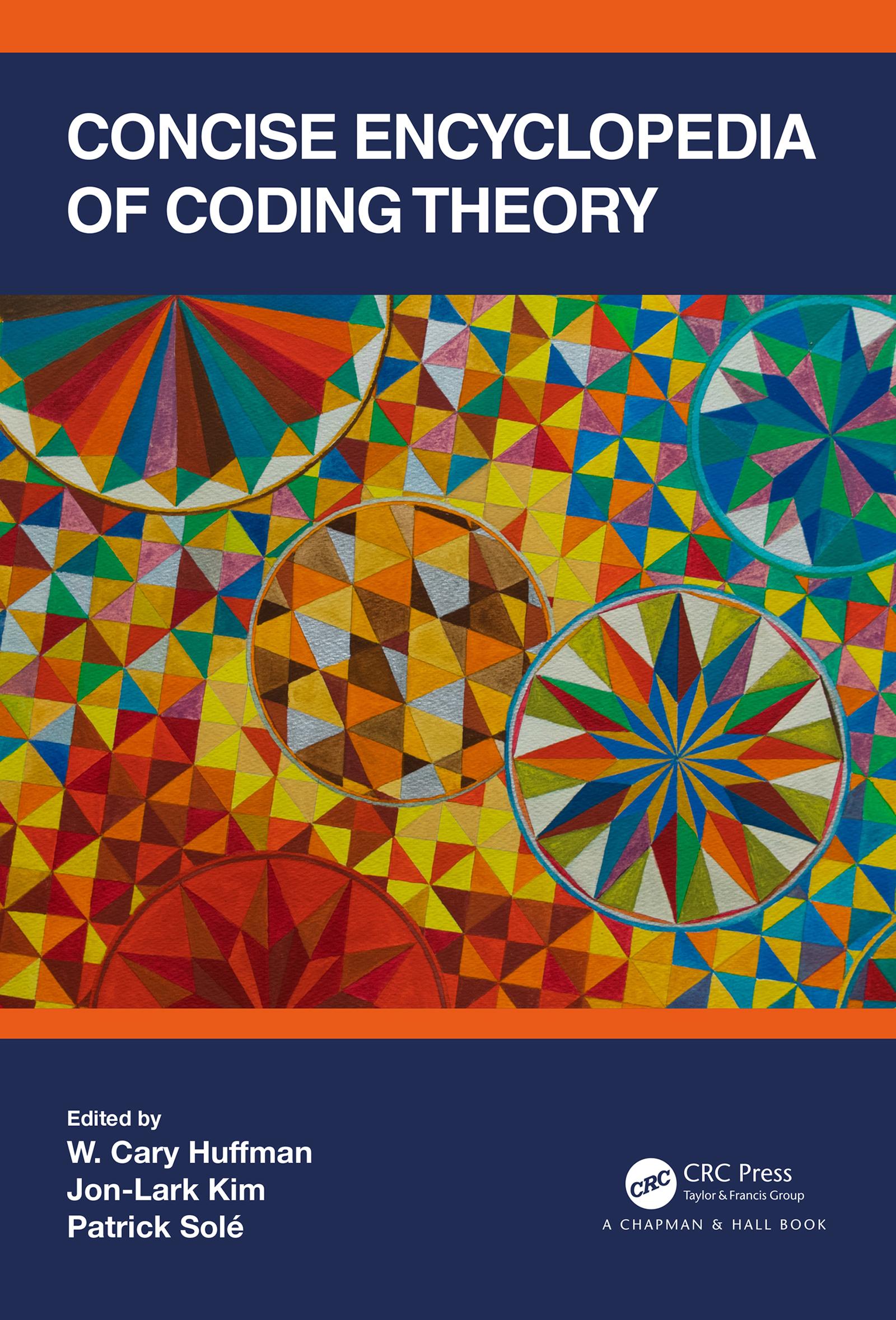
Most coding theory experts date the origin of the subject with the 1948 publication of A Mathematical Theory of Communication by Claude Shannon. Since then, coding theory has grown into a discipline with many practical applications (antennas, networks, memories), requiring various mathematical techniques, from commutative algebra, to semi-definite programming, to algebraic geometry.
Most topics covered in the Concise Encyclopedia of Coding Theory are presented in short sections at an introductory level and progress from basic to advanced level, with definitions, examples, and many references.
The book is divided into three parts:
Part I fundamentals: cyclic codes, skew cyclic codes, quasi-cyclic codes, self-dual codes, codes and designs, codes over rings, convolutional codes, performance bounds
Part II families: AG codes, group algebra codes, few-weight codes, Boolean function codes, codes over graphs
Part III applications: alternative metrics, algorithmic techniques, interpolation decoding, pseudo-random sequences, lattices, quantum coding, space-time codes, network coding, distributed storage, secret-sharing, and code-based-cryptography.
Features
- Suitable for students and researchers in a wide range of mathematical disciplines
- Contains many examples and references
- Most topics take the reader to the frontiers of research
Paga fácilmente con tarjeta, Klarna, Apple Pay o Google Pay. ¿No estás contento? Siempre tienes 14 días de garantía de devolución. Lee más en nuestros términos. Si tienes preguntas, escríbenos a hello@memmo.org.
Memmo hace que estudiar sea más fácil, estés donde estés. Aquí tienes tus libros de texto y herramientas de estudio inteligentes en un solo lugar: resúmenes, quizzes, podcasts y flashcards. Y también a Ted, tu compañero de estudio que responde a todo lo que te preguntes. Más de 50 000 estudiantes ya estudian aquí. Está hecho para que aprendas más rápido y te estreses menos.