
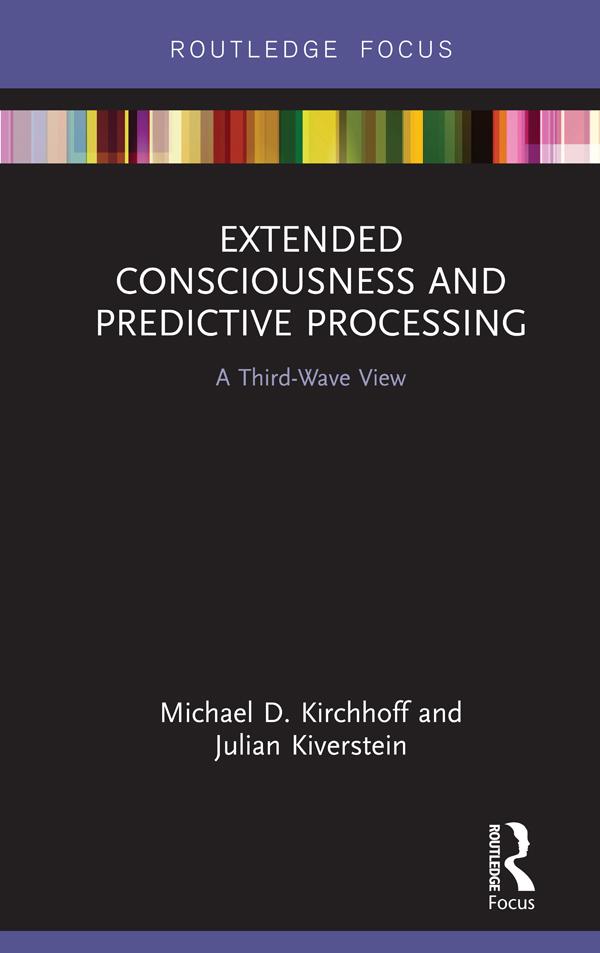
In this jointly authored book, Kirchhoff and Kiverstein defend the controversial thesis that phenomenal consciousness is realised by more than just the brain. They argue that the mechanisms and processes that realise phenomenal consciousness can at times extend across brain, body, and the social, material, and cultural world. Kirchhoff and Kiverstein offer a state-of-the-art tour of current arguments for and against extended consciousness. They aim to persuade you that it is possible to develop and defend the thesis of extended consciousness through the increasingly influential predictive processing theory developed in cognitive neuroscience. They show how predictive processing can be given a new reading as part of a third-wave account of the extended mind.
The third-wave claims that the boundaries of mind are not fixed and stable but fragile and hard-won, and always open to negotiation. It calls into question any separation of the biological from the social and cultural when thinking about the boundaries of the mind. Kirchhoff and Kiverstein show how this account of the mind finds support in predictive processing, leading them to a view of phenomenal consciousness as partially realised by patterns of cultural practice.
Paga fácilmente con tarjeta, Klarna, Apple Pay o Google Pay. ¿No estás contento? Siempre tienes 14 días de garantía de devolución. Lee más en nuestros términos. Si tienes preguntas, escríbenos a hello@memmo.org.
Memmo hace que estudiar sea más fácil, estés donde estés. Aquí tienes tus libros de texto y herramientas de estudio inteligentes en un solo lugar: resúmenes, quizzes, podcasts y flashcards. Y también a Ted, tu compañero de estudio que responde a todo lo que te preguntes. Más de 50 000 estudiantes ya estudian aquí. Está hecho para que aprendas más rápido y te estreses menos.