
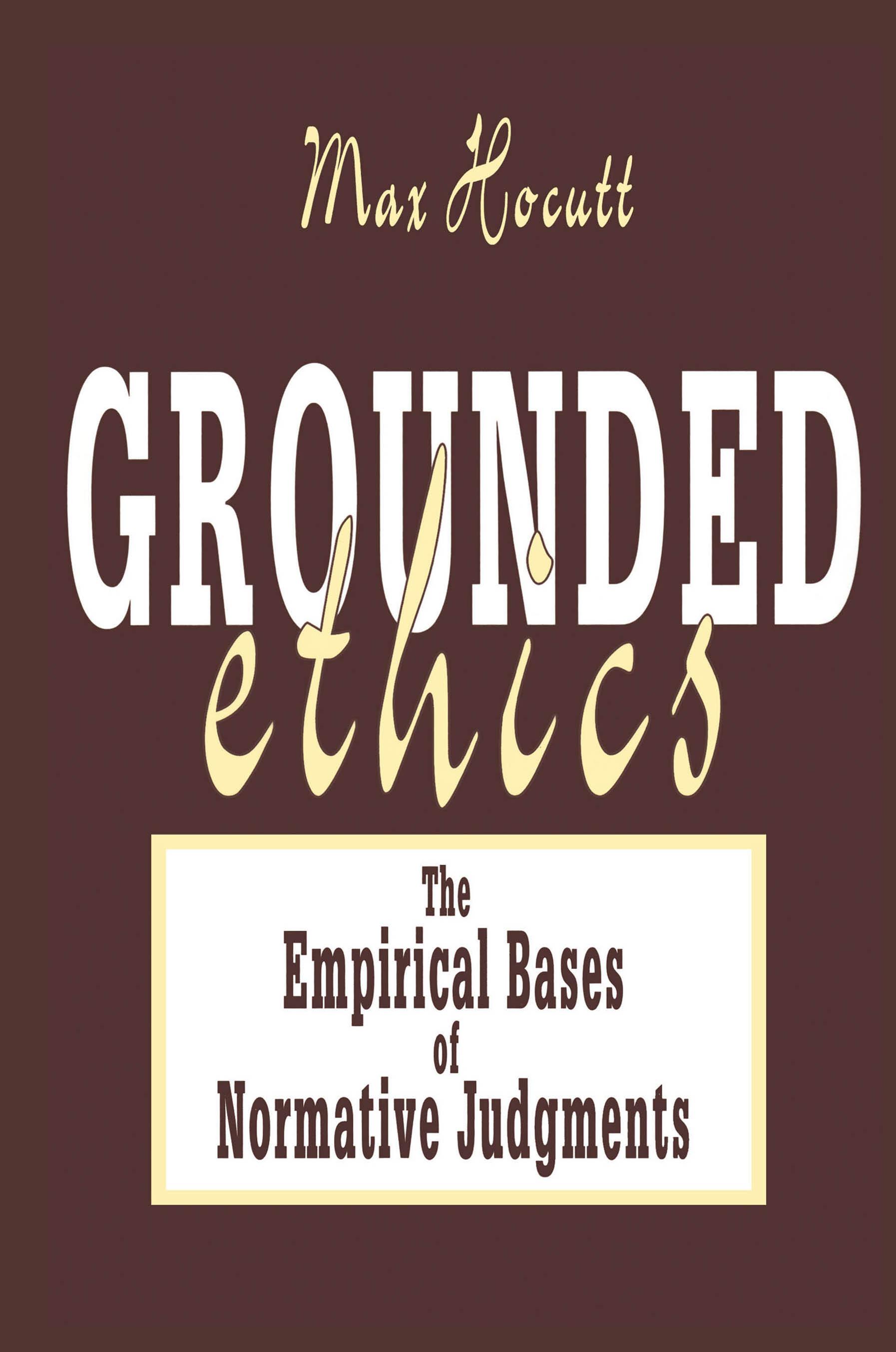
Scientific naturalism--basing beliefs on empirical evidence--has now triumphed in every field of inquiry except moral philosophy. There it is still thought appropriate to cite otherworldly standards known by divine revelation or moral intuition. In Grounded Ethics Max Hocutt argues that, since there is no transcendent reality on which to base the claims of ethics, normative truth must be sought in the desires of individuals and the conventions of societies.
Hocutt begins with an empiricist analysis of normative judgments. Following B.F. Skinner, he asserts that we call good what reinforces our desires, and that we call right or just what we desire to reinforce. Consequently, desire is the immediate measure of both goodness and justice. Acknowledging that goodness is relative to individual preferences, and justice is relative to social norms, Hocutt denies that goodness is a matter of personal opinion and that every society's institutions are as good as every other's. Instead, he says, the conduct of individuals and the customs of societies must ultimately be evaluated by how well they serve biologically based needs. These must be discovered empirically, because they cannot be known a priori.
In support of this analysis, Hocutt challenges rationalist belief, that normative concepts cannot be defined in empirical terms because they are rooted in divine law or ideals of pure reason. Against this view, Hocutt argues that if the moral law exists only as an ideal, it is not binding in the same sense as the empirically known laws and moralities of actual societies. He also points out that rationalist intuitions are best understood as expressions of animal instinct, socially conditioned prejudice, and personal preference. In addition, he offers extensive critiques of major philosophers, both ancient and modern, who hold contrary views.
All of this is meant to show that there is no escaping the empirical: A sensible ethics must be built on observable facts; it cannot be pulled from a vague but pious rationalist sky. Hocutt's demonstration of this thesis will interest philosophers, behavioral biologists, sociologists and ethicists.
Paga fácilmente con tarjeta, Klarna, Apple Pay o Google Pay. ¿No estás contento? Siempre tienes 14 días de garantía de devolución. Lee más en nuestros términos. Si tienes preguntas, escríbenos a hello@memmo.org.
Memmo hace que estudiar sea más fácil, estés donde estés. Aquí tienes tus libros de texto y herramientas de estudio inteligentes en un solo lugar: resúmenes, quizzes, podcasts y flashcards. Y también a Ted, tu compañero de estudio que responde a todo lo que te preguntes. Más de 50 000 estudiantes ya estudian aquí. Está hecho para que aprendas más rápido y te estreses menos.