
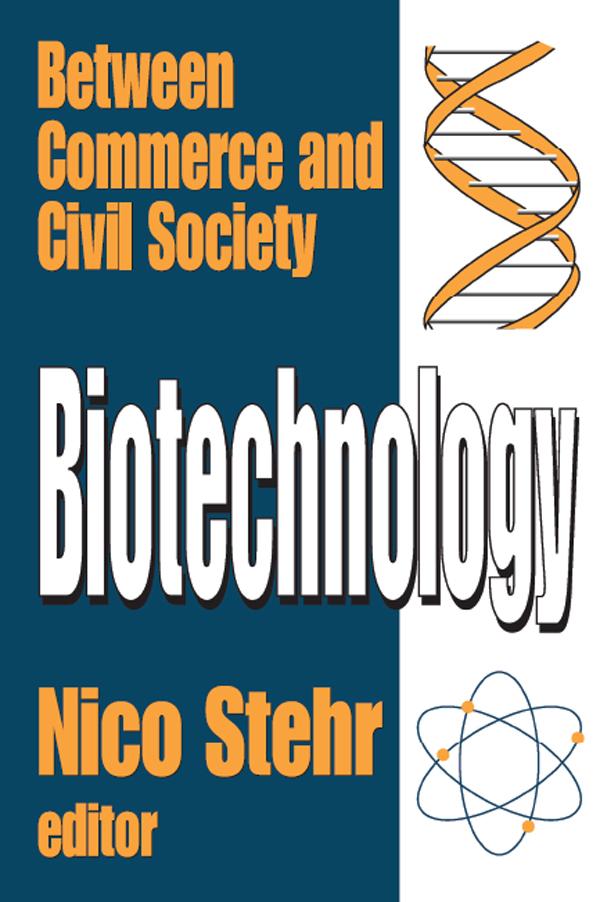
"While other books have addressed isolated aspects of recent developments in the biomedical sciences, Biotechnology: Between Commerce and Civil Society is the first book tgo engage with the full range of biotechnology's implications for social science and for society at large." -Professor Volker Meja
New scientific knowledge is no longer merely the key to unlocking the secrets of nature and society. It now represents the "becoming" of a new world. Scientific developments affect the ways in which we conduct our affairs, as well as how we comprehend the changes underway as the result of novel technical artefacts and scientific knowledge. The practical fruits of biotechnology are a case in point; they have grasped our imaginations, and generated worldwide debate and concern. Debates on biotechnology shift between images of utopia and dystopia. The social sciences deserve a voice in the debate, and can do so through sober examination of the economic, social, and cultural implications of biotechnology. Some economists even predict that the importance of biotechnology as the technology of the future will far exceed that of the information technologies, in particular the Internet. The contributors to this volume are drawn from a broad spectrum of the social sciences, and include Nico Stehr, Gene Rosa, Steve Fuller, Steve Best and Douglas Kellner, Nikolas Rose, Fred Buttel, Javier Lezaun, Anne Kerr, Susanna Hornig Priest and Toby Ten Eyck, Martin Schulte, Alexander Somek, Steven P. Vallas, Daniel Lee Kleinman, Abby Kinchy and Raul Necochea, Herbert Gottweis, J. Rogers Hollingsworth, Gysli Pblsson, Elizabeth Ettore, Richard Hindmarch and Reiner Grundmann. The impact of science on society is destined to be a fundamental concern in the new century. This volume illustrates the contributions anthropology, law, political science, and sociology can make to the ongoing discussions about the role of biotechnology in modern societies. Nico Stehr is senior research associate, Institut for Technikfolgenabschotzung, Forschungszentrum Karlsruhe and Institut for Kostenforschung, GKSS, Germany. He also is a fellow in the Center for Advanced Cultural Studies in Essen, Germany, editor of the Canadian Journal of Sociology, and a fellow of the Royal Society of Canada. Among his recent books are Werner Sombart: Economic Life in the Modern Age (with Reiner Grundmann, published by Transaction); The Fragility of Modern Societies: Knowledge and Risk in the Information Age; Knowledge and Economic Conduct: The Social Foundations of the Modern Economy; and Wissenspolitik: Die ?berwachung des Wissens.
Paga fácilmente con tarjeta, Klarna, Apple Pay o Google Pay. ¿No estás contento? Siempre tienes 14 días de garantía de devolución. Lee más en nuestros términos. Si tienes preguntas, escríbenos a hello@memmo.org.
Memmo hace que estudiar sea más fácil, estés donde estés. Aquí tienes tus libros de texto y herramientas de estudio inteligentes en un solo lugar: resúmenes, quizzes, podcasts y flashcards. Y también a Ted, tu compañero de estudio que responde a todo lo que te preguntes. Más de 50 000 estudiantes ya estudian aquí. Está hecho para que aprendas más rápido y te estreses menos.