
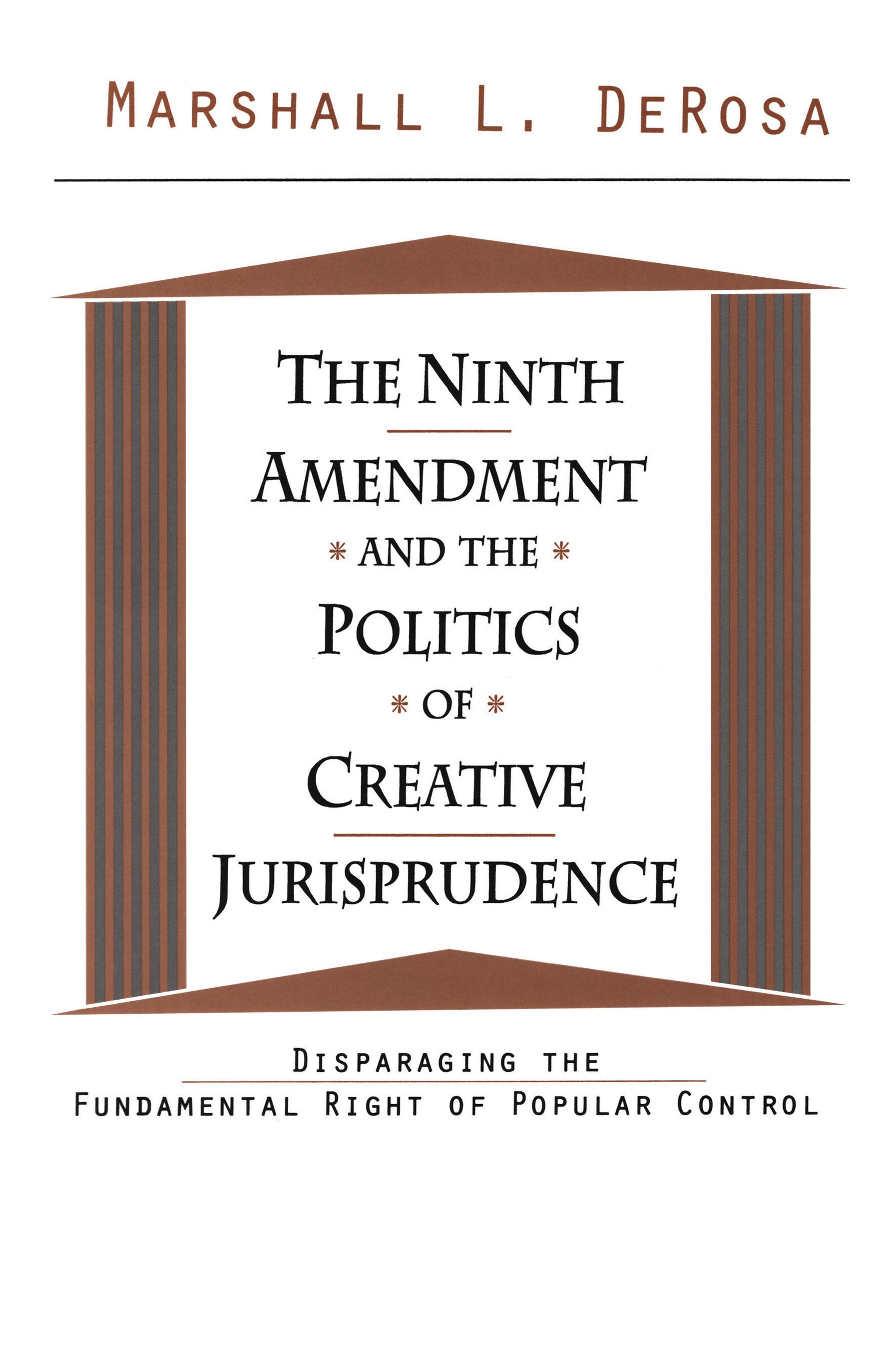
The Ninth Amendment holds that every right not explicitly granted to the federal government by the Constitution belongs to the states or to the individual. Further, those rights held by the government should not be construed to deny or disparage other rights held by the people. As in other areas of contention between federal power and states' rights, the Ninth Amendment has become subject to activist Supreme Court interpretation whereby the traditional model of federalism, in which states had meaningful public policy prerogatives, has given way to a model in which states become mere extensions of the U. S. government.
In this volume, Marshall DeRosa provides a thorough analysis of Supreme Court unenumerated rights policy and offers suggestions toward reestablishing American federalism as envisioned by the framers of the Constitution. The book opens with a review and analysis of current debates over Ninth Amendment rights and then utilizes the privileges and immunities clauses as demonstrative of the traditional relationship between the states' police powers and unenumerated fundamental rights. DeRosa then considers the critical role of academia in shifting public policy away from popular control and toward the judiciary. Later chapters include national and state case studies as instances of judicial creativity, an examination of the effects of Ninth Amendment jurisprudence on the Second Amendment as it bears on the gun control debate, and a comparative analysis of contrasting theories on the status of unenumerated rights. In his conclusion DeRosa offers some prescriptive thoughts on how to restore the original constitutional concept of popular consent as a remedy to an increasingly unaccountable federal judiciary.
By restoring the Ninth Amendment to the context of American federalism, this volume constitutes a major contribution to contemporary scholarship, challenging a corpus of commentary that either ignores, misunderstands, or misrepresents the relevance of popular control in the articulation of unenumerated rights. The Ninth Amendment and the Politics of Creative Jurisprudence will be of interest to political scientists, historians, legal theorists, and political practitioners.
Paga fácilmente con tarjeta, Klarna, Apple Pay o Google Pay. ¿No estás contento? Siempre tienes 14 días de garantía de devolución. Lee más en nuestros términos. Si tienes preguntas, escríbenos a hello@memmo.org.
Memmo hace que estudiar sea más fácil, estés donde estés. Aquí tienes tus libros de texto y herramientas de estudio inteligentes en un solo lugar: resúmenes, quizzes, podcasts y flashcards. Y también a Ted, tu compañero de estudio que responde a todo lo que te preguntes. Más de 50 000 estudiantes ya estudian aquí. Está hecho para que aprendas más rápido y te estreses menos.