
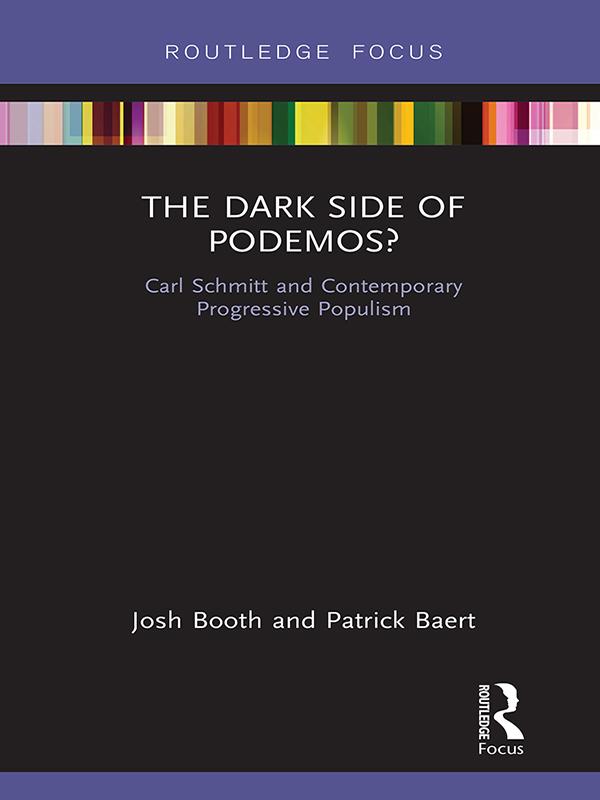
In 2014 a new progressive party, Podemos, emerged on the Spanish political scene. Within just over two years it had become the country’s third-biggest party, winning a slew of seats in parliament and regularly making headline news. While some see Podemos as the saviour of Spanish democracy, others have accused it of corrosive populism. But what few have noticed is that behind its distinctive rhetoric lies a thinker closely associated with Germany’s Third Reich: Carl Schmitt.
Why has an ostensibly progressive and avowedly anti-fascist political party taken up Schmitt’s ideas? The puzzle only deepens when we learn of Schmitt’s links with Francisco Franco’s dictatorship. In The Dark Side of Podemos?, Booth and Baert explain why Schmittian theory resonated with Podemos’ founders. In doing so, the authors position Podemos and the ideas that guide it within the context of recent Spanish history and ongoing politics of memory, revealing a story about how personal and political narratives have combined to produce a formidable political force.
This enlightening monograph will appeal to undergraduates and postgraduates, as well as postdoctoral researchers, interested in fields such as Politics, Political Theory and Sociology. It will also be relevant to those curious about contemporary Spanish politics, the nature of populism, the future of the European left, or Carl Schmitt and his links with Spain.
Paga fácilmente con tarjeta, Klarna, Apple Pay o Google Pay. ¿No estás contento? Siempre tienes 14 días de garantía de devolución. Lee más en nuestros términos. Si tienes preguntas, escríbenos a hello@memmo.org.
Memmo hace que estudiar sea más fácil, estés donde estés. Aquí tienes tus libros de texto y herramientas de estudio inteligentes en un solo lugar: resúmenes, quizzes, podcasts y flashcards. Y también a Ted, tu compañero de estudio que responde a todo lo que te preguntes. Más de 50 000 estudiantes ya estudian aquí. Está hecho para que aprendas más rápido y te estreses menos.