
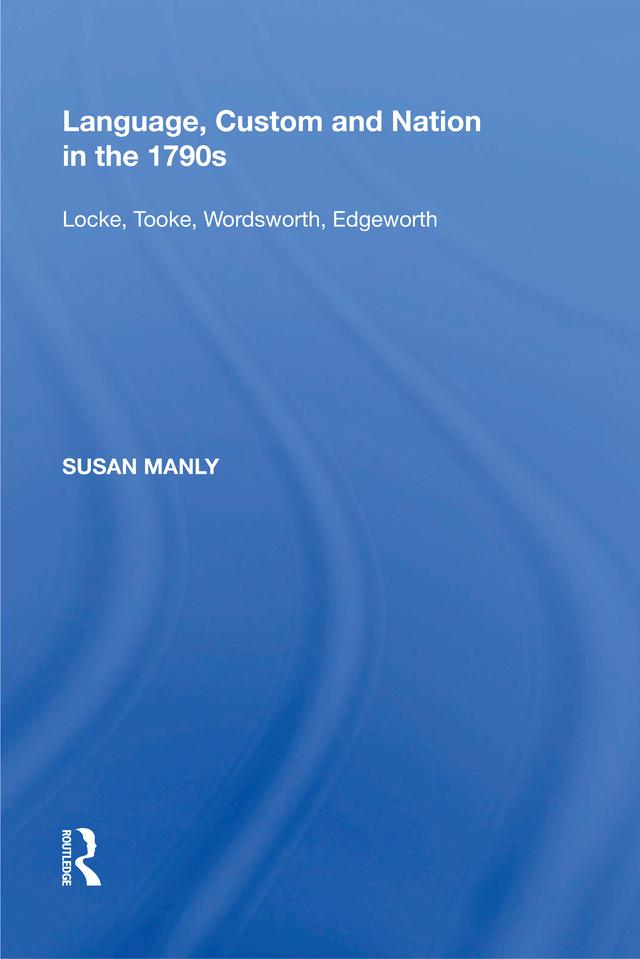
Language, Custom and Nation in the 1790s shows for the first time how the radical 'Jacobin' poets, and their ideas of a 'revolutionary' poetry, were impelled - even 'invented' - by the seventeenth-century English philosopher John Locke. For too long the revolutionary Romanticism and poetic experiments of the 1790s have been understood as responses to the American and French revolutions or attributed to the intellectual influence of Rousseau. The author counters these assumptions, by tracing threads of influence from Locke's ideas of 'arbitrary' language and tyranny, through Tooke's attacks on terms such as 'majesty' and 'law', to the supposedly 'real language' of Wordsworthian Romanticism. She breaks new ground in establishing Maria Edgeworth's place in Locke's anti-authoritarian tradition, contending that Edgeworth's work, produced in the shadow of the United Irishmen uprising, revives the politicisation of the idea of common language displaced in Wordsworth's neutralizing of Locke's radical impulse in the preface to Lyrical Ballads. The author's original and engaging book will appeal to scholars of 1790s radicalism, eighteenth-century linguistic theory, women's writing, and the relations between Britain and Ireland.
Paga fácilmente con tarjeta, Klarna, Apple Pay o Google Pay. ¿No estás contento? Siempre tienes 14 días de garantía de devolución. Lee más en nuestros términos. Si tienes preguntas, escríbenos a hello@memmo.org.
Memmo hace que estudiar sea más fácil, estés donde estés. Aquí tienes tus libros de texto y herramientas de estudio inteligentes en un solo lugar: resúmenes, quizzes, podcasts y flashcards. Y también a Ted, tu compañero de estudio que responde a todo lo que te preguntes. Más de 50 000 estudiantes ya estudian aquí. Está hecho para que aprendas más rápido y te estreses menos.