
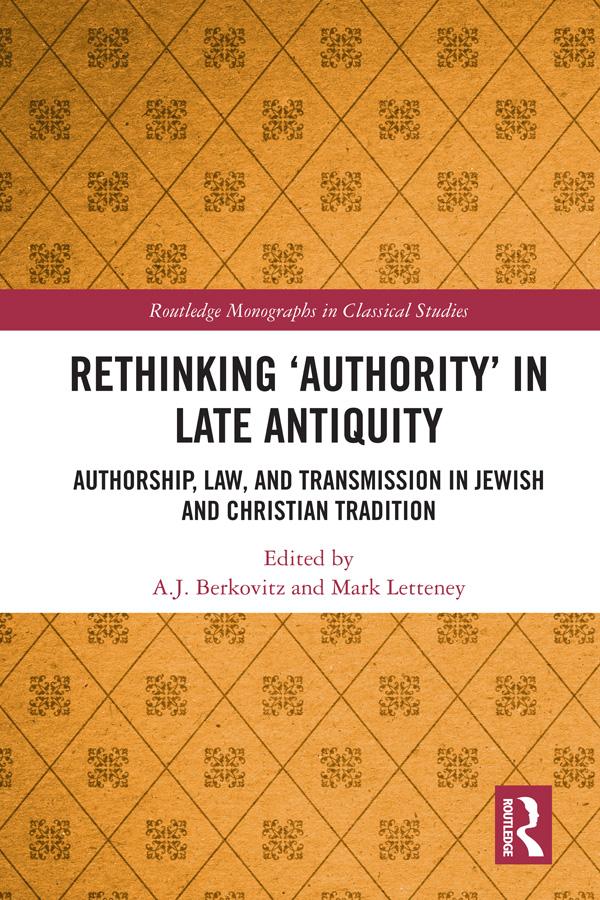
The historian’s task involves unmasking the systems of power that underlie our sources. A historian must not only analyze the content and context of ancient sources, but also the structures of power, authority, and political contingency that account for their transmission, preservation, and survival. But as a tool for interpreting antiquity, "authority" has a history of its own. As authority gained pride of place in the historiographical order of knowledge, other types of contingency have faded into the background. This book’s introduction traces the genesis and growth of the category, describing the lacuna that scholars seek to fill by framing texts through its lens. The subsequent chapters comprise case studies from late ancient Christian and Jewish sources, asking what lies "beyond authority" as a primary tool of analysis. Each uncovers facets of textual and social history that have been obscured by overreliance on authority as historical explanation. While chapters focus on late ancient topics, the methodological intervention speaks to the discipline of history as a whole. Scholars of classical antiquity and the early medieval world will find immediately analogous cases and applications. Furthermore, the critique of the place of authority as used by historians will find wider resonance across the academic study of history.
Paga fácilmente con tarjeta, Klarna, Apple Pay o Google Pay. ¿No estás contento? Siempre tienes 14 días de garantía de devolución. Lee más en nuestros términos. Si tienes preguntas, escríbenos a hello@memmo.org.
Memmo hace que estudiar sea más fácil, estés donde estés. Aquí tienes tus libros de texto y herramientas de estudio inteligentes en un solo lugar: resúmenes, quizzes, podcasts y flashcards. Y también a Ted, tu compañero de estudio que responde a todo lo que te preguntes. Más de 50 000 estudiantes ya estudian aquí. Está hecho para que aprendas más rápido y te estreses menos.