
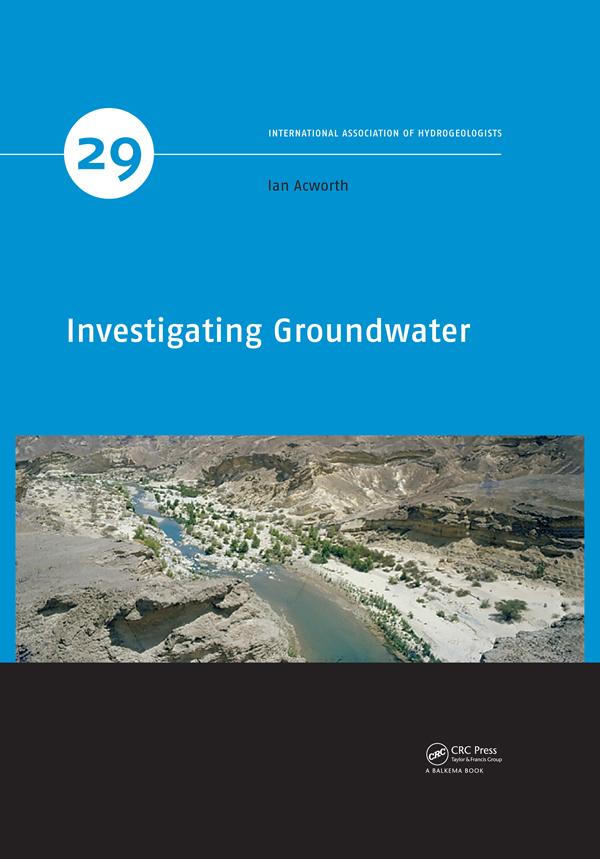
Investigating Groundwater provides an integrated approach to the challenges associated with locating groundwater. Uniquely, the book provides a review of the wide range of techniques that can be deployed to investigate this important resource. Many of the practical examples given are based upon Australian experience but the methods have worldwide applicability. The book is published in colour and includes many original diagrams and photographs. Particular effort has been made to provide consistent terminology and SI units are used throughout the text
Investigating Groundwater starts with an introduction to the historical significance of groundwater and gives an account of climate change. A description of the occurrence of groundwater in different rock types is then provided. A detailed account of surface water techniques is then followed by an account of the interconnections between surface water and groundwater. Four chapters describing groundwater hydraulics are then followed by four chapters describing the latest geophysical techniques. Once the best location of a borehole is determined using these techniques; chapters then describe appropriate drilling methods to use; provide a wide ranging review of geophysical logging, hydrochemical and isotopic techniques, before concluding with a detailed description of groundwater flow to a well.
Written for a worldwide audience of degree level geology/engineering practitioners, academics and students involved in groundwater resource investigation methods; Investigating Groundwater is essential reading for those involved in groundwater research.
Key Features:
- Presents the theoretical background and a detailed description of the techniques used in the investigation of groundwater.
- Describes the general occurrence of groundwater in different rock types; surface water hydrology and interconnected surface and groundwater systems.
- Provides detailed descriptions of geophysical techniques (seismic, electrical, gravity and heat) and an account of available geophysical logging methods.
- Reviews hydrochemical and isotope methods, followed by an account of drilling techniques.
- Gives a detailed account of radial flow to a well, including appropriate modelling and pump-testing techniques and a consideration of non-linear flow.
- Of interest to anyone involved in the development of groundwater resources, either for domestic supply, for agriculture or for mining.
Paga fácilmente con tarjeta, Klarna, Apple Pay o Google Pay. ¿No estás contento? Siempre tienes 14 días de garantía de devolución. Lee más en nuestros términos. Si tienes preguntas, escríbenos a hello@memmo.org.
Memmo hace que estudiar sea más fácil, estés donde estés. Aquí tienes tus libros de texto y herramientas de estudio inteligentes en un solo lugar: resúmenes, quizzes, podcasts y flashcards. Y también a Ted, tu compañero de estudio que responde a todo lo que te preguntes. Más de 50 000 estudiantes ya estudian aquí. Está hecho para que aprendas más rápido y te estreses menos.