
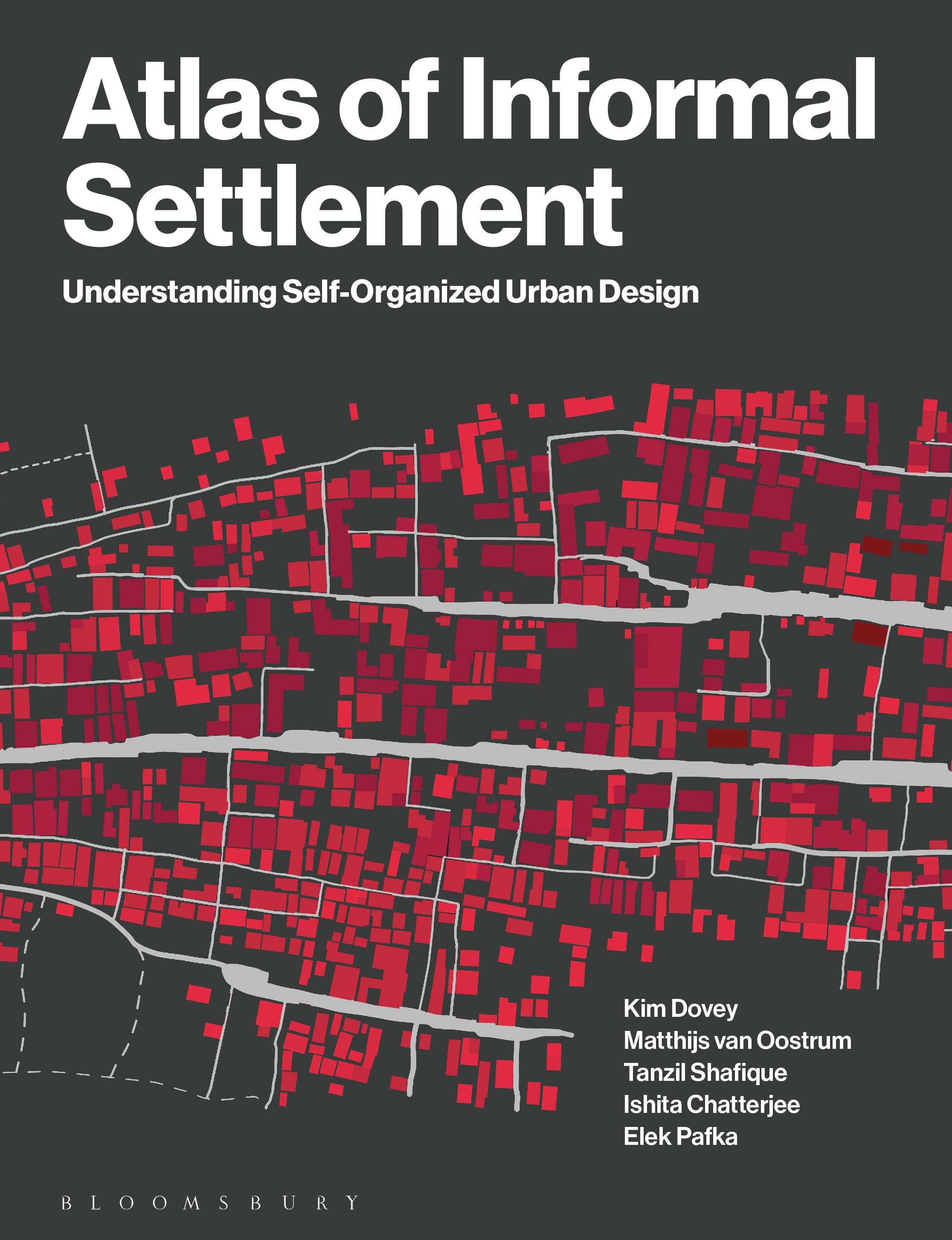
While often seen as unplanned or spontaneous, informal settlement is better understood as a mode of production: a co-evolution of architecture, urban design and planning that embodies informal rules and shapes urban development.
The Atlas of Informal Settlement is a comparative study of the spatial logic of informal settlement based on mapping and analysing the evolution of urban form (morphogenesis) in 51 contemporary settlements across the planet – the first of its kind and a fundamental change in thinking for urban studies and built environment professionals.
Each of the 51 case studies uses maps and aerial photographs to examine key stages of development, showing how informal settlement adapts to different contexts of political economy, topography, culture, climate and land tenure; revealing a complex range of actors from settlers and states to land mafias and pirate developers. It demonstrates the range of design processes and formal outcomes; how the informal becomes formalized and vice versa. Interspersed with short chapters introducing key theoretical concepts, the Atlas shows how such practices may or may not produce 'slums', and how settlement is already a form of 'upgrading'.
Informal settlement is the primary mode of production of affordable housing and neighbourhood infrastructure within cities of the Global South; with detailed mapping and profiling of 51 settlements this book shows how such urban morphologies emerge in terms of architecture, urban design and planning.
The Atlas of Informal Settlement is a comparative study of the spatial logic of informal settlement based on mapping and analysing the evolution of urban form (morphogenesis) in 51 contemporary settlements across the planet – the first of its kind and a fundamental change in thinking for urban studies and built environment professionals.
Each of the 51 case studies uses maps and aerial photographs to examine key stages of development, showing how informal settlement adapts to different contexts of political economy, topography, culture, climate and land tenure; revealing a complex range of actors from settlers and states to land mafias and pirate developers. It demonstrates the range of design processes and formal outcomes; how the informal becomes formalized and vice versa. Interspersed with short chapters introducing key theoretical concepts, the Atlas shows how such practices may or may not produce 'slums', and how settlement is already a form of 'upgrading'.
Informal settlement is the primary mode of production of affordable housing and neighbourhood infrastructure within cities of the Global South; with detailed mapping and profiling of 51 settlements this book shows how such urban morphologies emerge in terms of architecture, urban design and planning.
Páginas: 304
Categoría: Arkitektur & Stadsplanering
e-ISBN: 9781350295063
Peso de envío: 1.2 kg
Envío en: 1-2 días
Paga fácilmente con tarjeta, Klarna, Apple Pay o Google Pay. ¿No estás contento? Siempre tienes 14 días de garantía de devolución. Lee más en nuestros términos. Si tienes preguntas, escríbenos a hello@memmo.org.
Memmo hace que estudiar sea más fácil, estés donde estés. Aquí tienes tus libros de texto y herramientas de estudio inteligentes en un solo lugar: resúmenes, quizzes, podcasts y flashcards. Y también a Ted, tu compañero de estudio que responde a todo lo que te preguntes. Más de 50 000 estudiantes ya estudian aquí. Está hecho para que aprendas más rápido y te estreses menos.