
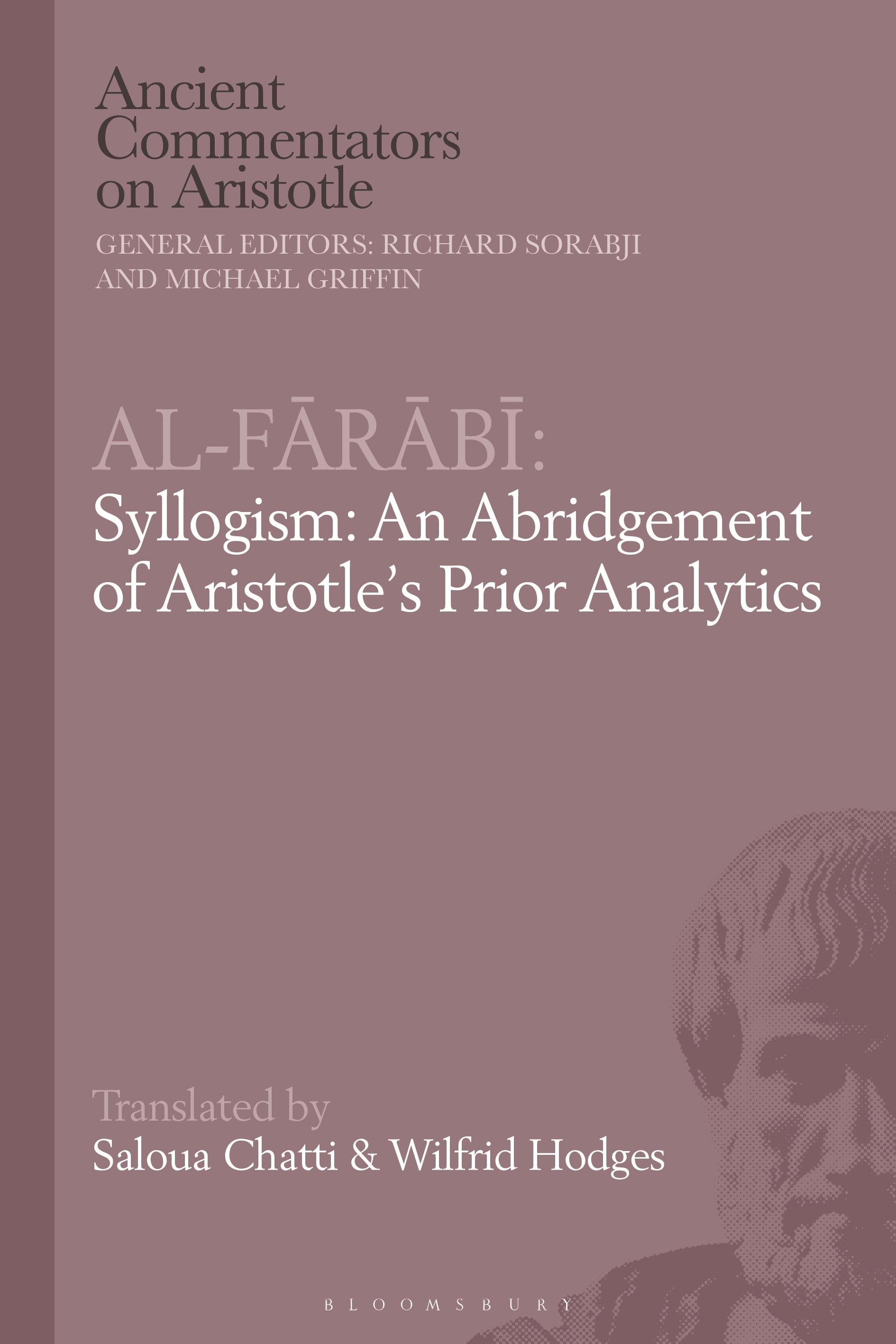
The philosopher Abu Nasr al-Farabi (c. 870-c. 950 CE) is a key Arabic intermediary figure. He knew Aristotle, and in particular Aristotle's logic, through Greek Neoplatonist interpretations translated into Arabic via Syriac and possibly Persian. For example, he revised a general description of Aristotle's logic by the 6th century Paul the Persian, and further influenced famous later philosophers and theologians writing in Arabic in the 11th to 12th centuries: Avicenna, Al-Ghazali, Avempace and Averroes. Averroes' reports on Farabi were subsequently transmitted to the West in Latin translation. This book is an abridgement of Aristotle's Prior Analytics, rather than a commentary on successive passages. In it Farabi discusses Aristotle's invention, the syllogism, and aims to codify the deductively valid arguments in all disciplines.
He describes Aristotle's categorical syllogisms in detail; these are syllogisms with premises such as 'Every A is a B' and 'No A is a B'. He adds a discussion of how categorical syllogisms can codify arguments by induction from known examples or by analogy, and also some kinds of theological argument from perceived facts to conclusions lying beyond perception. He also describes post-Aristotelian hypothetical syllogisms, which draw conclusions from premises such as 'If P then Q' and 'Either P or Q'. His treatment of categorical syllogisms is one of the first to recognise logically productive pairs of premises by using 'conditions of productivity', a device that had appeared in the Greek Philoponus in 6th century Alexandria.
He describes Aristotle's categorical syllogisms in detail; these are syllogisms with premises such as 'Every A is a B' and 'No A is a B'. He adds a discussion of how categorical syllogisms can codify arguments by induction from known examples or by analogy, and also some kinds of theological argument from perceived facts to conclusions lying beyond perception. He also describes post-Aristotelian hypothetical syllogisms, which draw conclusions from premises such as 'If P then Q' and 'Either P or Q'. His treatment of categorical syllogisms is one of the first to recognise logically productive pairs of premises by using 'conditions of productivity', a device that had appeared in the Greek Philoponus in 6th century Alexandria.
Paga fácilmente con tarjeta, Klarna, Apple Pay o Google Pay. ¿No estás contento? Siempre tienes 14 días de garantía de devolución. Lee más en nuestros términos. Si tienes preguntas, escríbenos a hello@memmo.org.
Memmo hace que estudiar sea más fácil, estés donde estés. Aquí tienes tus libros de texto y herramientas de estudio inteligentes en un solo lugar: resúmenes, quizzes, podcasts y flashcards. Y también a Ted, tu compañero de estudio que responde a todo lo que te preguntes. Más de 50 000 estudiantes ya estudian aquí. Está hecho para que aprendas más rápido y te estreses menos.