
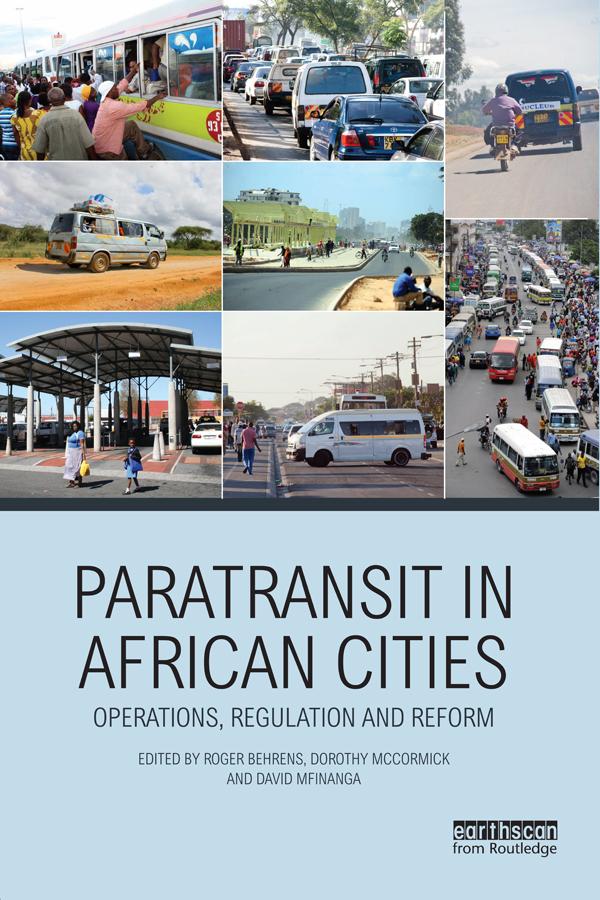
Public transport systems in contemporary Sub-Saharan African cities are heavily reliant upon paratransit services. These services are defined as informal transportation which operates between the public and individual private spheres. In Africa paratransit is characterized by low quality of vehicles and chaotic management but it also provides cheap, accessible and flexible transport solutions for the urban poor. It is typically poorly regulated and operates as a set of informal businesses. A common result of weak public sector regulation and a fare strategy in which owners claim a fixed daily revenue target and drivers who keep the variable balance as income, is destructive competition and poor quality of service. There is an incontrovertible case for improving the quality, reliability and coverage of public transport systems, and some city governments have attempted to do so by initiating reform projects that envisage the phased replacement of paratransit operations with formalised bus rapid transit systems.
In this book the authors argue that there are, however, path dependencies and constraints that limit the possible extent of public transport system reform. Paratransit operations also have some inherent advantages with respect to demand responsiveness and service innovation. Attempts to eradicate paratransit may be neither pragmatic nor strategic. Two future scenarios are likely: hybrid systems comprised of both paratransit and formally planned modes; and systems improved by upgrades and strengthened regulation of existing paratransit services. The business strategies and aspirations of incumbent paratransit operators in three case cities – Cape Town, Dar es Salaam and Nairobi – are discussed, as well as their attitudes towards emerging public transport reform projects. International experiences of hybrid system regulation and paratransit business development are reviewed in order to explore policy options. The authors contend that policies recognising paratransit operators, and seeking contextually appropriate complementarity with formalised planned services, will produce greater benefits than policies ignoring their continued existence.
Paga fácilmente con tarjeta, Klarna, Apple Pay o Google Pay. ¿No estás contento? Siempre tienes 14 días de garantía de devolución. Lee más en nuestros términos. Si tienes preguntas, escríbenos a hello@memmo.org.
Memmo hace que estudiar sea más fácil, estés donde estés. Aquí tienes tus libros de texto y herramientas de estudio inteligentes en un solo lugar: resúmenes, quizzes, podcasts y flashcards. Y también a Ted, tu compañero de estudio que responde a todo lo que te preguntes. Más de 50 000 estudiantes ya estudian aquí. Está hecho para que aprendas más rápido y te estreses menos.