
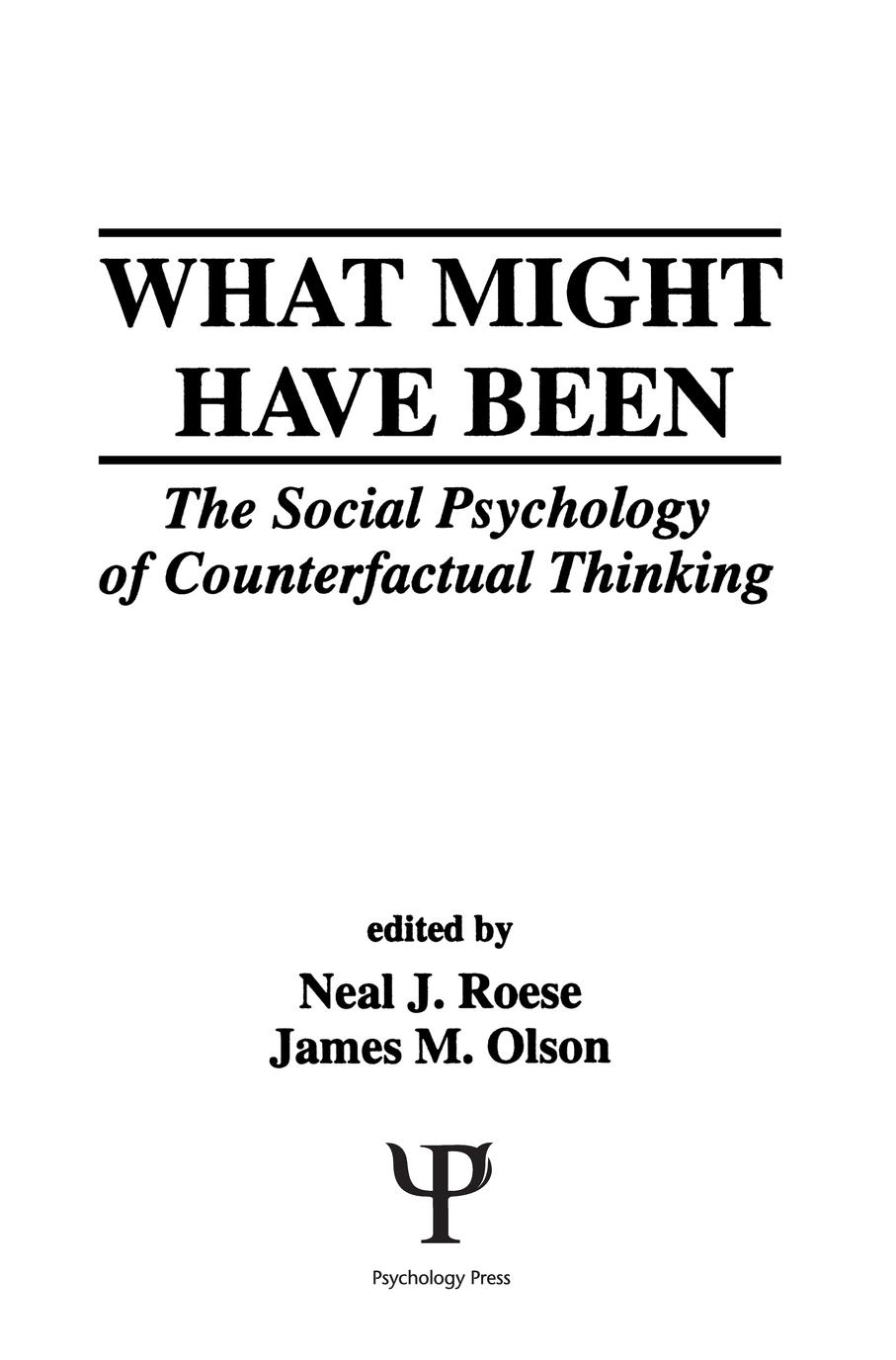
Within a few short years, research on counterfactual thinking has mushroomed, establishing itself as one of the signature domains within social psychology. Counterfactuals are thoughts of what might have been, of possible past outcomes that could have taken place. Counterfactuals and their implications for perceptions of time and causality have long fascinated philosophers, but only recently have social psychologists made them the focus of empirical inquiry.
Following the publication of Kahneman and Tversky's seminal 1982 paper, a burgeoning literature has implicated counterfactual thinking in such diverse judgments as causation, blame, prediction, and suspicion; in such emotional experiences as regret, elation, disappointment and sympathy; and also in achievement, coping, and intergroup bias. But how do such thoughts come about? What are the mechanisms underlying their operation? How do their consequences benefit, or harm, the individual? When is their generation spontaneous and when is it strategic? This volume explores these and other numerous issues by assembling contributions from the most active researchers in this rapidly expanding subfield of social psychology. Each chapter provides an in-depth exploration of a particular conceptual facet of counterfactual thinking, reviewing previous work, describing ongoing, cutting-edge research, and offering novel theoretical analysis and synthesis. As the first edited volume to bring together the many threads of research and theory on counterfactual thinking, this book promises to be a source of insight and inspiration for years to come.
Paga fácilmente con tarjeta, Klarna, Apple Pay o Google Pay. ¿No estás contento? Siempre tienes 14 días de garantía de devolución. Lee más en nuestros términos. Si tienes preguntas, escríbenos a hello@memmo.org.
Memmo hace que estudiar sea más fácil, estés donde estés. Aquí tienes tus libros de texto y herramientas de estudio inteligentes en un solo lugar: resúmenes, quizzes, podcasts y flashcards. Y también a Ted, tu compañero de estudio que responde a todo lo que te preguntes. Más de 50 000 estudiantes ya estudian aquí. Está hecho para que aprendas más rápido y te estreses menos.