
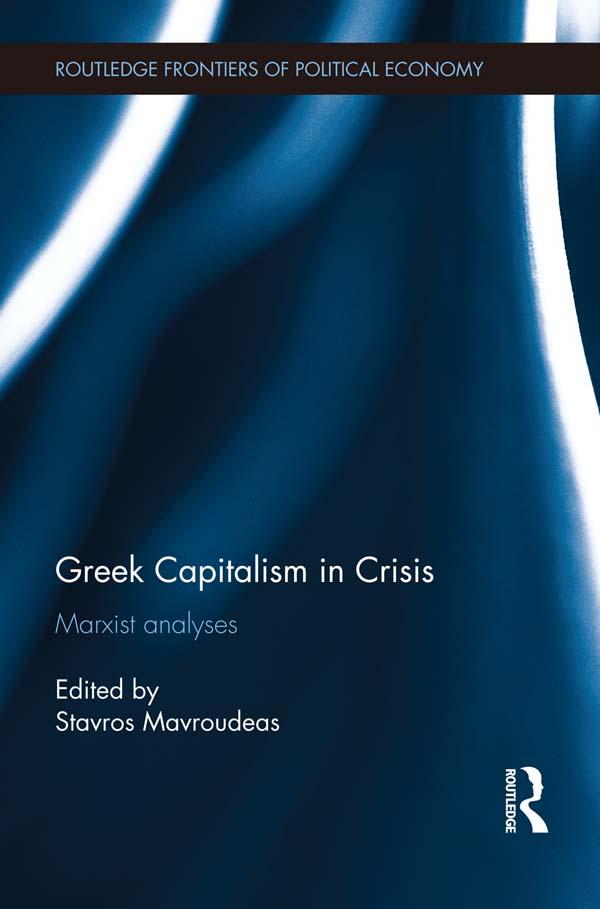
Despite the depth of the Greek crisis, the exorbitant burdens placed upon the working people and the massive popular resistance movement to capitalist policies, there is a definite lack of consistently Marxist analyses of the Greek problem. International debates regarding the Greek crisis have been dominated by orthodox (Neoclassical and neo-Keynesian) approaches.
The heterodox side of these debates has been occupied by Radical Political Economy approaches (usually radical post-Keynesian or Marxo-Keynesian perspectives). Moreover, they are dominated by the ‘financialisation’ thesis which is quite alien to Marxism, neglects the sphere of production and professes that the global crisis is simply a financial crisis that has nothing to do with ‘real’ accumulation and the profit rate.
This book argues that by emphasising the sphere of production and profitability, classical Marxist analysis better explains the Greek crisis than its orthodox and heterodox competitors. The contributors present critiques of the prevalent approaches and offer studies of the Greek crisis that use the methodology and the analytical and empirical tools of classical Marxist Political Economy. In particular, it is shown that the Greek crisis was caused by falling profitability and the ensuing overaccumulation crisis. The ‘broad unequal exchange’ existing between the euro-center and the euro-periphery contributed to Greek capital’s falling profitability. This book enriches the debate about the Greek economic crisis by demonstrating the insights that can be drawn by considering the Marxist alternative to the dominant mainstream and heterodox approaches.
Paga fácilmente con tarjeta, Klarna, Apple Pay o Google Pay. ¿No estás contento? Siempre tienes 14 días de garantía de devolución. Lee más en nuestros términos. Si tienes preguntas, escríbenos a hello@memmo.org.
Memmo hace que estudiar sea más fácil, estés donde estés. Aquí tienes tus libros de texto y herramientas de estudio inteligentes en un solo lugar: resúmenes, quizzes, podcasts y flashcards. Y también a Ted, tu compañero de estudio que responde a todo lo que te preguntes. Más de 50 000 estudiantes ya estudian aquí. Está hecho para que aprendas más rápido y te estreses menos.