
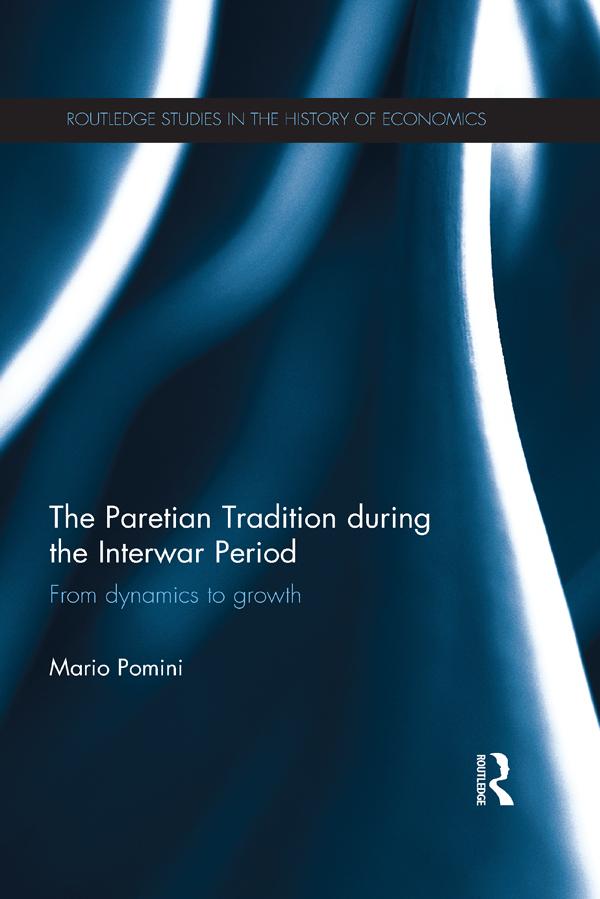
The years in-between the two World Wars were a crucial period for the building of economic dynamics as an autonomous field. Different competing research programs arose at international level. Great progress was achieved by studies on the business cycle, with the first statistical applications. Outside the theory of the business cycle, a significant line of inquiry was that pursued at the end of the 1930s by Hicks and Samuelson. This period also saw the formulation of another approach to formal economic dynamics which in the 1930s represented the frontier of research from the analytical point of view. It was an approach which set the notion of equilibrium at the basis of dynamics, exactly as in the case of statics, thus leading to the definition of a dynamic equilibrium approach. The aim of this volume is to take into consideration this original research field sparked from Pareto’s works and initially developed during the 1920s in the United States by two American mathematicians, G. Evans and C. Ross.
In the 1930s, the concept of dynamic equilibrium became the main research field of the Pareto school which gave its most important contributions in this field. The Paretian economists as Amoroso, de Pietri Tonelli, Sensini, and the younger, such as Bordin, Palomba, La Volpe, Fossati and Zaccagnini, for the most part students of the former, developed this approach in many directions. The theory of dynamic equilibrium reached remarkable results from an analytical viewpoint through the wide application of the functional calculus, thus anticipating a perspective which was taken into consideration in the 1960s with the theory of optimal growth. Despite the Pareto school’s relevance, it remained widely unknown, not only at international level, but also in Italy. Recently, it has been object of renewed interest. This present work aims at reconstructing the fundamental contributions offered by the Pareto school in forming the economic dynamics theory.
Paga fácilmente con tarjeta, Klarna, Apple Pay o Google Pay. ¿No estás contento? Siempre tienes 14 días de garantía de devolución. Lee más en nuestros términos. Si tienes preguntas, escríbenos a hello@memmo.org.
Memmo hace que estudiar sea más fácil, estés donde estés. Aquí tienes tus libros de texto y herramientas de estudio inteligentes en un solo lugar: resúmenes, quizzes, podcasts y flashcards. Y también a Ted, tu compañero de estudio que responde a todo lo que te preguntes. Más de 50 000 estudiantes ya estudian aquí. Está hecho para que aprendas más rápido y te estreses menos.